

← All articles
Neuroathletic training & performance
Neuroathletic training for children and adolescents: Developing coordination through play
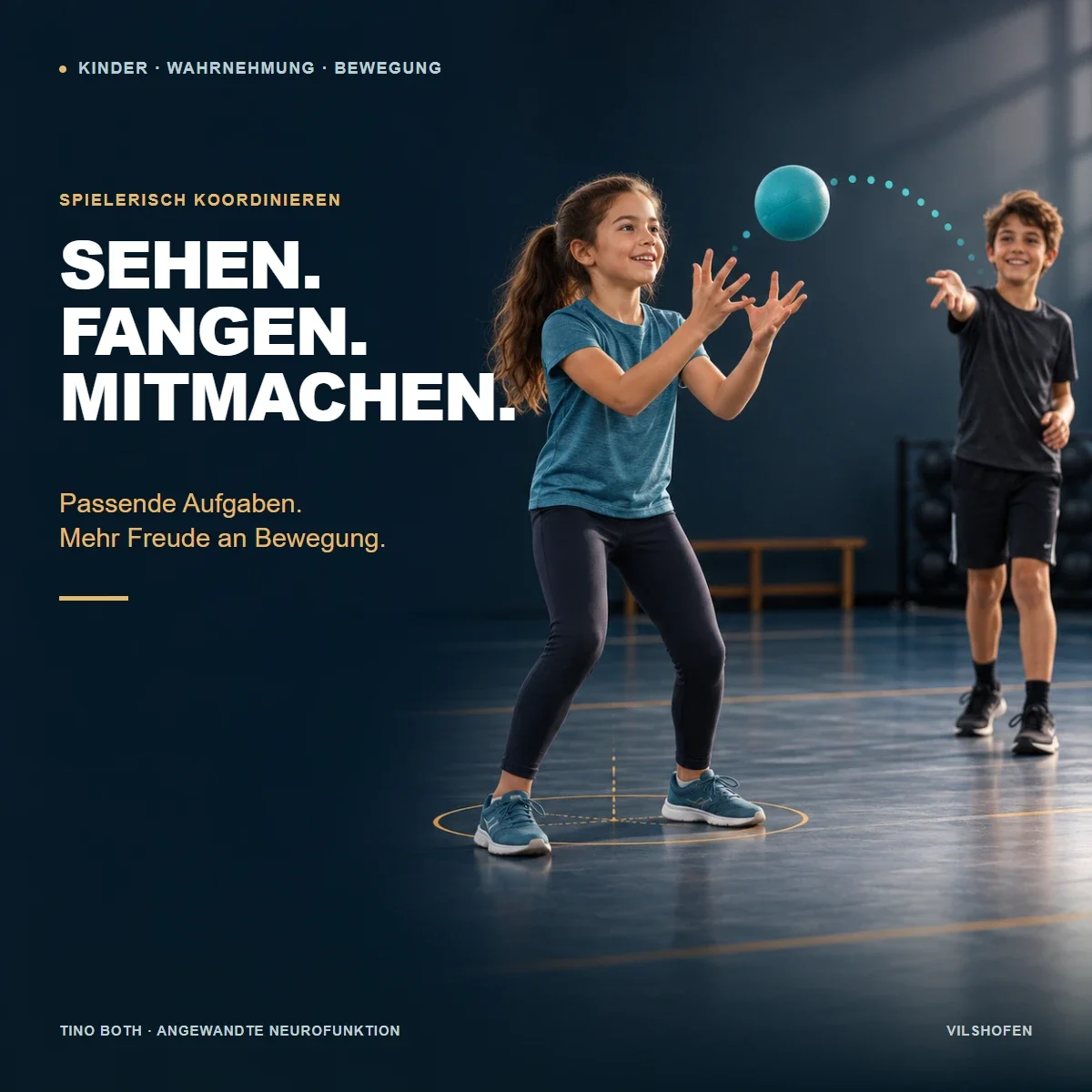
Briefly explained: Neuroathletic training for children and adolescents considers how perception, balance and movement control work together in a specific task. The aim is not to test children constantly or keep them quiet. It concerns suitable movement experiences, understandable small steps and greater enjoyment of participation.
Does your child want to join in, but catching, balancing or coordination are difficult?During the free initial telephone consultation, tell me which situation causes your child difficulty and what has already helped. We discuss whether a playful functional perspective fits your family.
Discuss your child's situation →
Discuss your child's situation →
'Do not make such a fuss' will not help with the next ball either
Your child is ready, the ball flies — and just before it reaches their hands, things become hectic. Other children seem to catch effortlessly. After several unsuccessful attempts, they may say, 'I cannot do it anyway'. From outside, the missed ball is visible. Which part of the task was difficult is not yet visible.
Was the ball noticed late? Did it come too fast? Was distance difficult to judge? Were the hands not ready yet? Or did the task suddenly become uncomfortable under other children's gaze? Such questions turn a judgement into an opportunity to adapt the game better.
Motor skills are more than strength and mobility
When catching, jumping or balancing, a child uses information from the eyes, balance organs, skin, muscles and joints. Attention, understanding of the task and movement experience add to this. Practice can become easier when the challenge fits these prerequisites.
Children develop differently. One difficult task therefore does not yet show a disorder. Fatigue, interest, unfamiliar materials or a new environment can also change a great deal. I first want to know what already goes well. A new experience can build on that without explaining a supposed defect to the child.
What varied movement offersClimbing and balancing: Judging positions and trying suitable movements.
Throwing and catching: Bringing vision, timing and hand movement together.
Hopping and rhythm games: Organising and adapting the timing of movements.
Running, stopping and changing direction: Coordinating space, speed and body position.
These experiences do not all need to happen simultaneously in one complicated exercise.
Throwing and catching: Bringing vision, timing and hand movement together.
Hopping and rhythm games: Organising and adapting the timing of movements.
Running, stopping and changing direction: Coordinating space, speed and body position.
These experiences do not all need to happen simultaneously in one complicated exercise.
A possible example: Why a larger ball alone is not always enough
Suppose a child frequently misses a gently thrown ball. As a starting point, we choose a short, comfortable catching task with a constant distance and clearly visible ball. A few attempts initially suffice to see how the child approaches it. The aim is not public scoring.
Break the task down step by step1. Understand and prepare: Can the child show where the ball should arrive and get their hands ready in time? A brief cue before the throw can make the task more manageable.
2. Track without catching: Initially, a slowly moving ball is only watched. The hands do not need to do anything yet. This shows us whether the added catching movement substantially changes the demand.
3. Simplify body position: Sitting safely or standing comfortably on both feet, we compare whether the child is less occupied with balance while catching.
4. Bring it together again: After a suitable brief exercise variation, we repeat the original catching task. Ball, distance and throw remain comparable.
2. Track without catching: Initially, a slowly moving ball is only watched. The hands do not need to do anything yet. This shows us whether the added catching movement substantially changes the demand.
3. Simplify body position: Sitting safely or standing comfortably on both feet, we compare whether the child is less occupied with balance while catching.
4. Bring it together again: After a suitable brief exercise variation, we repeat the original catching task. Ball, distance and throw remain comparable.
Perhaps recognition goes well but the transition to hand movement remains difficult. Perhaps the same task immediately becomes more manageable sitting down. Perhaps a clear start announcement already helps. These differences lead to different next steps. They explain more than the label 'poor coordination'.
How small perceptual stimuli fit into assessment
Within my method, a short hand-awareness task, a simple rhythm or a well-tolerated gaze task can be added separately, for example. The child might feel light contact on the palm and then deliberately open their hands. Catching follows again. If nothing changes, the stimulus does not become a compulsory daily programme.
It matters that we do not pile up an arbitrary number of aids. Otherwise, neither child nor parents know what made the task easier. A good result should also work beyond my setting: Can the agreed, comfortable variation be used again later in play? Does the child want to participate? How do they seem afterwards? This feedback belongs in the process.
Balance: More than standing on a wobble board for as long as possible
Balance is needed when walking, climbing stairs, cycling, landing and in many games. The demands differ, however. A child may stand quietly and feel unsteady during a turn. Another manages movement well but finds still single-leg standing boring or unfamiliar.
I therefore compare suitable tasks on a safe surface. Stance width, visual target, direction of movement or an additional hand task can be changed individually. Unstable surfaces and closed eyes are not a necessary starting stage. The goal is a manageable challenge, rather than as much wobbling as possible.
The eyes and hand–eye coordination
Gaze shifts, tracking a target and cooperation between both eyes can matter for movement. But a child missing a ball does not automatically have a visual disorder. Only precise comparison helps narrow the question. Unusual vision, recurring headaches during close work or double vision should be assessed by an ophthalmologist or orthoptist.
Large, high-contrast targets, slow speed and short tasks can provide a good training foundation. A further demand is added later. A ball game does not need to be overloaded with arithmetic, calling colours and balancing if catching itself already requires full attention.
What movement has to do with concentration
Attention depends on sleep, motivation, emotions, surroundings and the particular task, among other things. Movement is a useful part of children's daily life. The WHO also identifies benefits of physical activity for cognitive development and wellbeing. This does not mean a particular eye or balance exercise automatically solves school difficulties.
I observe specifically: Can the child follow the game's rule? Take in an instruction and act on it? Rejoin after a mistake? Perhaps this becomes easier with fewer simultaneous stimuli. Or a short movement break makes the next task more accessible. Such changes are useful without deriving a training diagnosis from every restless behaviour.
Children need play opportunities — rather than an adult programme
How to keep the demands appropriateAn understandable task: Explain briefly and demonstrate if needed.
An achievable difficulty: The child can make an effort but should not fail constantly.
Short sections: A good round with a break is preferable to a long compulsory series.
A say in decisions: Let the child choose the ball colour, target or sequence.
A clear limit: Stop with pain, dizziness, nausea or marked discomfort and assess the situation.
An achievable difficulty: The child can make an effort but should not fail constantly.
Short sections: A good round with a break is preferable to a long compulsory series.
A say in decisions: Let the child choose the ball colour, target or sequence.
A clear limit: Stop with pain, dizziness, nausea or marked discomfort and assess the situation.
For younger children, free movement, discovery and fun are particularly central. Adolescents can increasingly formulate their own sporting goals and provide feedback. The key is whether task, understanding and current tolerance fit together, rather than date of birth alone.
Youth sport: Build foundations instead of specialising everything too early
Football, gymnastics, tennis and handball each demand particular abilities. Varied experiences remain valuable alongside these: Throwing, climbing, turning, jumping, moving rhythmically and discovering different games. The American Academy of Pediatrics emphasises suitable demands and enjoyment in sport and warns about the strain of intensive specialisation too early.
A neuroathletic perspective complements this principle. It can help distinguish whether a technical task should be simplified, a perceptual aspect examined more closely or simply more playful experience enabled. A child does not need constant optimisation for movement to be valuable.
What parents and youth coaches can contribute
A specific observation is more useful than a judgement: 'With throws from the side, he turns towards the ball late' rather than 'He never pays attention'. Or 'After two added rules, she disengages' rather than 'She cannot cope'. Tasks can then be changed without devaluing the child.
At home, a soft ball, floor markers or a simple clapping rhythm can be entirely sufficient. Choose safe surroundings and a game the child likes. Change only one thing first, such as distance or speed. You do not need to perform muscle tests, classify reflexes yourselves or record errors daily.
When other specialist services matter
If movement problems clearly restrict daily life, skills are lost, frequent falls are new or pain and unusual visual symptoms occur, paediatric assessment matters. Depending on the concern, occupational therapy, physiotherapy, ophthalmology or school support may be useful. Persistent concentration and learning problems require consideration of the overall picture, rather than one movement task alone.
Frequently asked questions
For which age is neuroathletic training suitable?There is no uniform age limit for every task. For young children, simple games and varied movement are central. Specific sporting goals can be included more with adolescents.
Can neuroathletic training resolve ADHD or a reading and spelling disorder?No such promise can be made. Appropriate assessment and support matter for these difficulties. In my work, we consider specifically agreed perception and movement tasks as an addition.
Does my child need to be athletic?No. The concern can equally be joining games more easily or feeling safer with a particular movement. No performance goal is needed.
How much do we need to practise at home?This is agreed individually. Short, enjoyable game variations often fit daily life better than an extensive plan. The child's response and usefulness for the target task determine further duration.
Can this take place in a club too?Practical ideas may interest youth coaches and clubs. During the initial consultation, we clarify the target group, setting and whether a group offering or individual appointment makes more sense.
One specific concern is enough to beginIf you want to understand your child's movement difficulty more precisely, we first discuss it by telephone. In Vilshofen, I work with Applied Neurofunction — in a child-appropriate way and focused on what might really help in daily life.
Arrange a free initial consultation for parents →
Arrange a free initial consultation for parents →
All children's topics at a glance
Perception, concentration, learning and movementRestlessness in children: What may be behind fidgeting
Reading is demanding: What parents can observe in their child
Neurofunctional assessment in children: What parents can expect
Concentration difficulties in children: Why motivation does not explain everything
Writing, reading and sitting: Why some children find them so demanding
Balance and concentration in children: Assessing connections thoughtfully
Podcast recommendation: Why learning involves more than the head
Reading is demanding: What parents can observe in their child
Neurofunctional assessment in children: What parents can expect
Concentration difficulties in children: Why motivation does not explain everything
Writing, reading and sitting: Why some children find them so demanding
Balance and concentration in children: Assessing connections thoughtfully
Podcast recommendation: Why learning involves more than the head
Related pages and articles
Relevant areas of focus and supportNeuroathletic training & performance optimisation
Concentration and learning in children
Neuroathletic exercises: Why general exercises are often insufficient
Neuroathletic training for sports clubs — modern performance assessment in team training
A functional view of visual disturbances and visual processing
A functional view of dizziness & balance
How I work: Angewandte Neurofunktion
Concentration and learning in children
Neuroathletic exercises: Why general exercises are often insufficient
Neuroathletic training for sports clubs — modern performance assessment in team training
A functional view of visual disturbances and visual processing
A functional view of dizziness & balance
How I work: Angewandte Neurofunktion
Sources and further reading
WHO: Physical activity — the importance of movement for health and development.
American Academy of Pediatrics: Is Your Child Ready for Sports?
American Academy of Pediatrics: Is Your Child Ready for Sports?