Sometimes school difficulties involve more than a lack of practice or motivation.
With Applied Neurofunction, we explore whether eye movements, balance, body awareness, coordination or stress regulation are making learning more difficult.
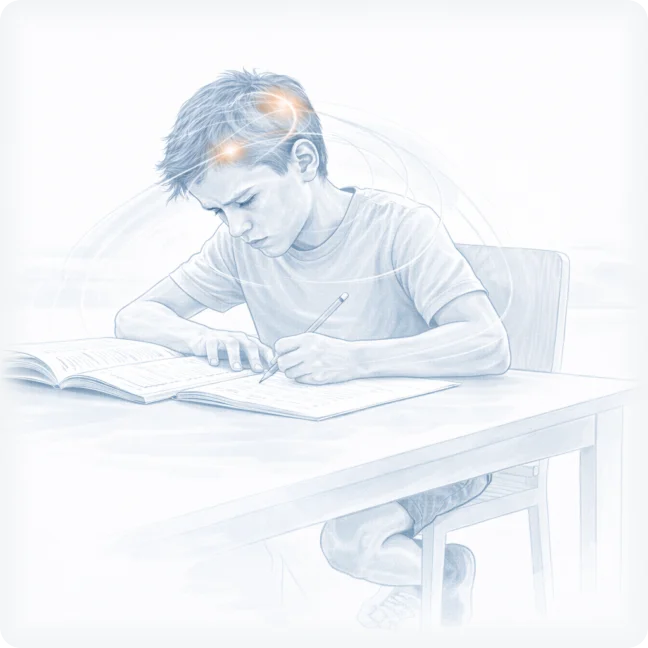
When learning takes more effort than it should
Some children try very hard — yet school remains exhausting. Perhaps you recognise some of these situations from your everyday life.
Concentration only lasts a short time
Your child starts with enthusiasm but is soon distracted, tired or needs considerable pressure from others.
Reading is slow or tiring
Understanding a text takes effort, reading uses a lot of energy or your child increasingly avoids it.
Losing their place
Words are skipped, lines are confused or the eyes struggle to find their place again while reading.
Writing takes a lot of energy
Handwriting looks tense or unsettled, or writing takes noticeably long.
Homework becomes stressful
Small tasks quickly lead to frustration, arguments, tears or exhaustion.
Restlessness or quickly slumping
Your child fidgets, shifts around or soon slumps while learning.
Little progress despite practice
You practise regularly, but progress is smaller than you would expect for the effort involved.
Everything feels more demanding
School, reading, writing or concentration do not just feel difficult — they feel draining.
Your child starts doubting themselves
Eventually it is no longer only about school, but also about confidence and motivation.
This does not mean your child is lazy, unmotivated or lacks ability.
Sometimes the nervous system simply does not work efficiently enough in everyday school life for the daily demands of concentration, reading, writing and sitting. A neurofunctional perspective may offer useful clues here.
Reading, writing and concentration are not purely mental tasks
For learning to work well, your child does not simply need to practise more. The nervous system needs to receive and organise many kinds of information at once and translate them into appropriate action.
Eye movements, balance, body awareness, coordination and regulation are constantly involved. If one of these systems uses a lot of energy, school can become tiring more quickly.
It may then look as though motivation or practice is lacking. From a functional perspective, another question is possible: is learning currently taking too much of your child's basic energy?
Instead, it asks: which functions does your child need to make learning easier and more consistent?
From perception to learning
Receive information
Vision · Hearing · Balance · Body awareness
Process and filter
Organise input, sustain attention and maintain orientation
Everyday learning
Reading · Writing · Sitting · Concentration · Endurance
What does a neurofunctional assessment consider?
Depending on the situation, I look at different functions that may play a part in concentration, reading, writing, posture, coordination and resilience in everyday school life.
Eye movements & visual processing
Can your child take in a text steadily, control shifts of gaze and follow lines accurately?
Balance & posture
Are sitting, standing and orientation sufficiently stable, or do they take noticeably more effort?
Body awareness & coordination
How well does your child perceive individual parts of the body, and how precisely do they control movement?
Writing & movement patterns
Do writing, pencil grip or stability of the shoulders, hands or trunk become unnecessarily tiring?
Filtering input & attention
Can your child stay with relevant information, or are they quickly distracted by sounds, movement or their surroundings?
Signs of stress & regulation
Do inner restlessness, rapid fatigue, overwhelm or sensitivity to input play a part?
The aim is not to label your child. It is to assess functionally which systems work well, which take noticeably more effort and which inputs allow a change.
What happens at the first appointment?
The first appointment should give you a sense of direction. Together we explore what stands out in everyday life, which functions might be involved and which inputs your child processes well.
Initial conversation
We calmly discuss what your child finds difficult, what you notice in everyday life and what you have already tried.
Neuro-Check
I use simple, age-appropriate functional tests of posture, eye movements, balance, coordination, processing sensory input and resilience.
Targeted inputs
Based on the assessment, we introduce initial targeted inputs and check straight away whether attention, stability, movement or perception changes.
Next steps
At the end, you receive a clear explanation and we discuss whether further appointments, exercises or additional assessments would be useful.
The assessment is calm, practical and appropriate for children.
It is not about judging your child or putting them under pressure. The aim is to better understand which functions may make learning, concentration, reading, writing or coordination easier or harder.
What you can expect — and what you cannot
I want parents to know from the outset what my work involves: a functional assessment, without premature diagnoses or simple promises.
Making functional relationships visible
I look at which physical and neurofunctional factors may make learning, reading, writing, concentrating or sitting more difficult in everyday school life.
No labels, diagnoses or promises
My work does not replace educational, medical, psychological, occupational therapy, speech and language therapy or specialist learning assessments.
It can help identify functional influences that are not always the main focus of conventional assessments. This is a privately paid service and is generally not covered by statutory or private health insurance.
When children finally feel better understood
Many children repeatedly hear that they simply need to concentrate more, write more neatly or practise harder. A child can quickly begin to feel: “Something is wrong with me.”
A neurofunctional perspective may help reduce this pressure. Sometimes the difficulty is not willingness, but the way perception, movement, attention and regulation work together in everyday life.
This does not replace diagnostic assessment or offer simple promises. It may, however, provide new clues about where your child needs support and which functions deserve a closer look.
When we better understand what uses a child's energy at school, we can take a more focused and fair approach.
More understanding, less pressure
Difficulties are not immediately labelled as laziness, defiance or a lack of ability.
More specific starting points
Parents gain a clearer idea of which everyday functions may take particularly large amounts of energy.
A calm view of the whole picture
Learning is considered alongside vision, movement, body awareness, attention and regulation.
Relief for the child and family
When relationships become easier to understand, conversations, decisions and next steps may become easier too.
Would you like to better understand what makes learning difficult for your child?
A free first conversation is a good starting point. We briefly discuss what you have noticed, whether a neurofunctional assessment might be useful and which next step could fit.
No pressure. No rushed labels. First, a calm conversation about whether I can offer useful support.
More information on this topic
If you would like to read more, you can find relevant information about concentration, learning, the nervous system and related neurofunctional areas of focus here.
Blog: children, learning & the nervous system
Relevant articles about concentration, learning, school and neurofunctional relationships.
View articles →How I work
More about Applied Neurofunction, a neurocentric approach and the way I work.
Explore the method →Dizziness & balance
More about balance, orientation, stability and neurofunctional relationships in dizziness.
Explore this area of focus →Visual difficulties & visual processing
More about eye movements, visual strain, gaze stability and processing visual information in everyday life.
Explore this area of focus →