

← All articles
Children, concentration & learning
Restlessness in children: What may be behind the fidgeting
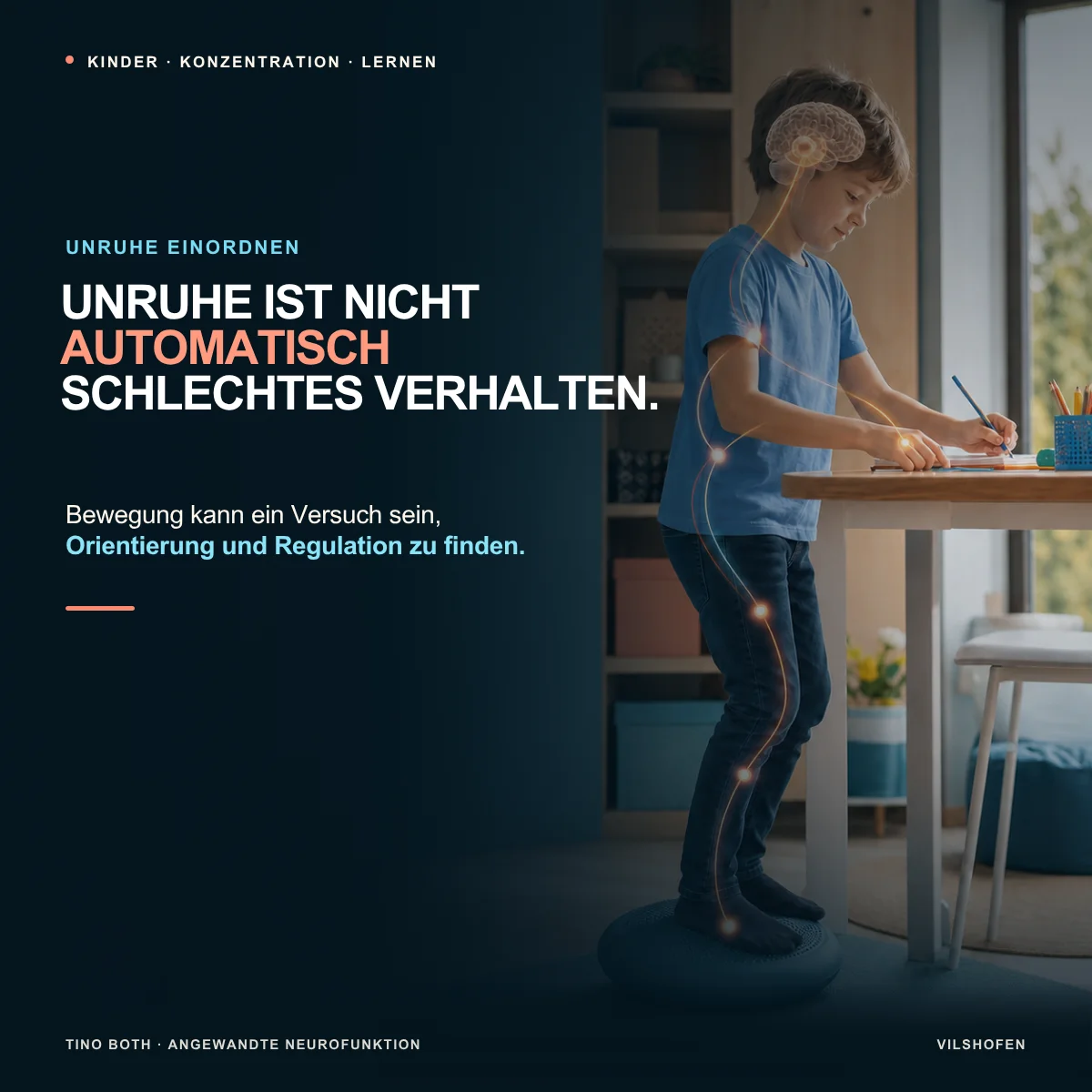
Briefly explained: Restlessness in children can relate to fatigue, demands, emotions and the processing of sensory impressions. Fidgeting alone does not reveal which factor matters. A more useful question is: When does your child particularly need movement — and under which conditions does a task become easier?
Do homework and transitions take a lot of energy every day?During the free initial telephone consultation, you describe the situations in which your child becomes restless. Together, we explore whether a functional view of perception, movement and regulation in Vilshofen suits your concerns.
Arrange an initial consultation about your child's restlessness →
You need neither a ready-made explanation nor a list of supposed deficits.
Arrange an initial consultation about your child's restlessness →
You need neither a ready-made explanation nor a list of supposed deficits.
Does your child want to participate — yet still find it impossible to stay still?
The pencil falls down. The feet search for support on the chair. After two tasks, your child gets up even though you have only just begun. You remind them to stay seated, they try — and a few minutes later it all starts again. Such situations can cause frustration on both sides.
The visible behaviour is initially an observation, rather than an explanation. A child may move because they are tired, because the task is too difficult or monotonous, because something feels uncomfortable or because many impressions demand their attention simultaneously. Sometimes several factors coincide. Useful support therefore begins with what makes the situation difficult for this child at this moment, rather than how to stop the fidgeting.
The goal is not a child who is as still as possibleWhat matters is whether your child can follow a task, participate and recover afterwards. Movement is allowed to help. Sitting quietly and concentrating successfully are different things.
Why restlessness after school can look different from the weekend
At school, your child has to understand language, switch between the exercise book and board, tune out other children and follow rules. At home, the next demand may follow immediately. The difference between a relaxed Saturday morning and homework after a long school day is therefore valuable information.
Transitions also deserve attention: From playing to eating, from outdoors to the desk or from a lively evening to bed. Does your child need advance preparation? Does a clear announcement help? Is it easier with fewer simultaneous instructions? Such observations are often more useful than a broad description of 'always wound up'.
Three situations, three different questionsRestlessness mainly while reading: Is the text appropriate? How demanding is near vision? Are there symptoms such as blurred print?
Restlessness in noisy surroundings: What changes at a quieter workspace with the same task?
Restlessness in the late afternoon: What part do sleep, hunger, breaks and the day's demands so far play?
Restlessness in noisy surroundings: What changes at a quieter workspace with the same task?
Restlessness in the late afternoon: What part do sleep, hunger, breaks and the day's demands so far play?
Does marked restlessness automatically mean ADHD?
No. An ADHD assessment considers much more than movement on a chair: Including the development, duration, extent and effects of difficulties across different areas of life. If your child is substantially affected over a longer period, a paediatric practice and, where appropriate, specialist services are suitable points of contact. An existing diagnosis and consideration of specific everyday conditions can coexist.
The NICE NG87 ADHD guideline considers adjustments to noise, light, workspace and working periods, for example. This does not create a uniform programme for every restless child. Rather, it underlines that the environment can be part of support.
What the neurocentred perspective adds
For your child to manage a task, their nervous system continually processes information: Where is the body? What can be seen? Which sounds matter? What movement is required now? The model Input → processing → output helps us consider these demands clearly. Visible output might be a movement, completion of a task or reported effort.
In my work with Applied Neurofunction, we therefore look at a specific situation and select suitable functional assessments. Different questions may be useful for reading than for balancing or switching between two activities. The aim is not to test every sense in every child.
When fidgeting begins only when shifting gaze
A possible example: Your child tells you something attentively, but quickly becomes restless when copying. The words are not too difficult. Yet they keep searching for the right place, move their head along with their eyes and shift around on the chair. 'Practise concentration more' would now be a very broad answer. My first question is: What changes between telling a story and copying?
The same words — different demands on the eyesHolding gaze: Can your child look comfortably at a single word or small picture without anything blurring or becoming unpleasant?
Switching between two targets: Next, we consider brief gaze shifts between targets at the same distance. This avoids immediately adding the demand of refocusing between near and far.
Switching between the original and the exercise book: Only then do we compare the actual copying situation. Suppose the first two tasks go well, but searching starts when distance changes. This does not simply mean 'poor attention'. The additional demand deserves a closer look.
Switching between two targets: Next, we consider brief gaze shifts between targets at the same distance. This avoids immediately adding the demand of refocusing between near and far.
Switching between the original and the exercise book: Only then do we compare the actual copying situation. Suppose the first two tasks go well, but searching starts when distance changes. This does not simply mean 'poor attention'. The additional demand deserves a closer look.
This distinction changes my approach: A clearly visible original placed closer to the exercise book is a different approach from training rapid gaze shifts. Looking steadily at one target and making many rapid gaze shifts are also different stimuli. I check which starting point makes the task easier for your child and pay attention to their feedback. Visual discomfort is assessed by an ophthalmologist or orthoptist.
When we pursue the noticeable function more closelyI can supplement the comparison with an indicator muscle that can be tested reliably and without pain. The selected gaze task becomes the specific test stimulus: If the muscle response remains stable during quiet viewing but changes after switching between near and far, I pursue precisely this combination within my method.
One possible addition is an extra, well-tolerated cue from body awareness, such as clear foot contact. I compare the same gaze task with and without this addition. If the response repeatedly fits, integration follows; afterwards, I check the gaze task again without the additional cue.
Finally, we return to a copying task of equal difficulty: Does your child find the place more easily? Is accuracy maintained? Does it feel less demanding? We also consider breaks and familiarisation in the comparison.
One possible addition is an extra, well-tolerated cue from body awareness, such as clear foot contact. I compare the same gaze task with and without this addition. If the response repeatedly fits, integration follows; afterwards, I check the gaze task again without the additional cue.
Finally, we return to a copying task of equal difficulty: Does your child find the place more easily? Is accuracy maintained? Does it feel less demanding? We also consider breaks and familiarisation in the comparison.
The interesting differenceWe have not made fidgeting the enemy. We have broken down a task behind the visible behaviour. Whether helpful support results becomes apparent from how your child manages this task — during the appointment and later in everyday life.
Do you recognise your child more in copying, reading or transitions? Just such an example is enough to begin. During the free initial telephone consultation, we discuss what has already been assessed and whether personal functional assessment in Vilshofen suits your family.
Your child can say at any time that something is uncomfortable, boring or too much. This feedback is particularly helpful in adjusting the approach appropriately. They do not have to keep still for an especially long time or push through demanding exercises.
What you can observe at home
First, choose one recurring situation. Briefly note for a few days: Time, preceding demands, task and what visibly helps. Ask your child specific questions where possible: 'Are the words difficult, or does looking feel demanding?' is often easier to answer than 'Why aren't you concentrating?'
One small change is enough to start: A clear workspace, an announced break or an appropriately short task. Consider conflict, effort and recovery as well as the number of completed tasks. Persistent sleep problems, visual discomfort, marked distress or difficulties across several areas of life should also be assessed professionally.
Frequently asked questions about restlessness in children
Does a restless child simply need more sport?Movement can be valuable support. Whether your child currently needs activity, quiet, a smaller task or a change in the environment depends on the situation. More exertion is not automatically better.
Can tiredness look like being wound up?Parents also see restlessness during tired periods. Behaviour alone, however, does not reliably show whether sleep deprivation contributes. Sleep times, the course of the day and your child's view help with interpretation; persistent sleep difficulties belong in the paediatric practice.
Does my child need a diagnosis before an appointment?Not for an initial conversation about your situation. We also clarify which examinations have already taken place and whether another specialist service is useful first.
How do I recognise whether a change really helps?Through an agreed everyday goal: For example, less effort during a short task or an easier transition. It is helpful if the improvement repeats, rather than happening just once during an appointment.
Ease the task rather than fighting the behaviour
A good approach does not need to change every movement your child makes. It should make the situation clearer and give you a specific next step. This is where the functional perspective begins: With a task, a checkable change and the question of whether your child manages better with it in everyday life.
Related pages and articles
All children's topics at a glanceConcentration difficulties in children
Restlessness in children · Current article
When reading is demanding
Balance and concentration while learning
Dreamy or quickly overwhelmed
School difficulties despite intelligence
When writing, reading and sitting are demanding
Neurofunctional assessment: What parents can expect
Podcast: Learning involves more than the head
Restlessness in children · Current article
When reading is demanding
Balance and concentration while learning
Dreamy or quickly overwhelmed
School difficulties despite intelligence
When writing, reading and sitting are demanding
Neurofunctional assessment: What parents can expect
Podcast: Learning involves more than the head
Understanding vision and control of gaze betterVOR: Gaze stability during head movement
Relevant areas of focus in VilshofenConcentration and learning in children
Visual disturbances and visual processing
How I work with Applied Neurofunction
Visual disturbances and visual processing
How I work with Applied Neurofunction
Let us look more closely at your most difficult everyday situationIn Vilshofen, I support families from the region with questions about perception, concentration and movement. During the first conversation, we establish whether my approach suits your concerns and what support already exists.
Arrange a free initial telephone consultation →
Arrange a free initial telephone consultation →
Sources and further reading
NICE: Attention deficit hyperactivity disorder — recommendations for assessment and support, including environmental adjustments.
Federal Institute of Public Health: Common sleep problems in children.
Federal Institute of Public Health: Common sleep problems in children.