

← All articles
Children, concentration & learning
Neurofunctional assessment in children: what parents can expect
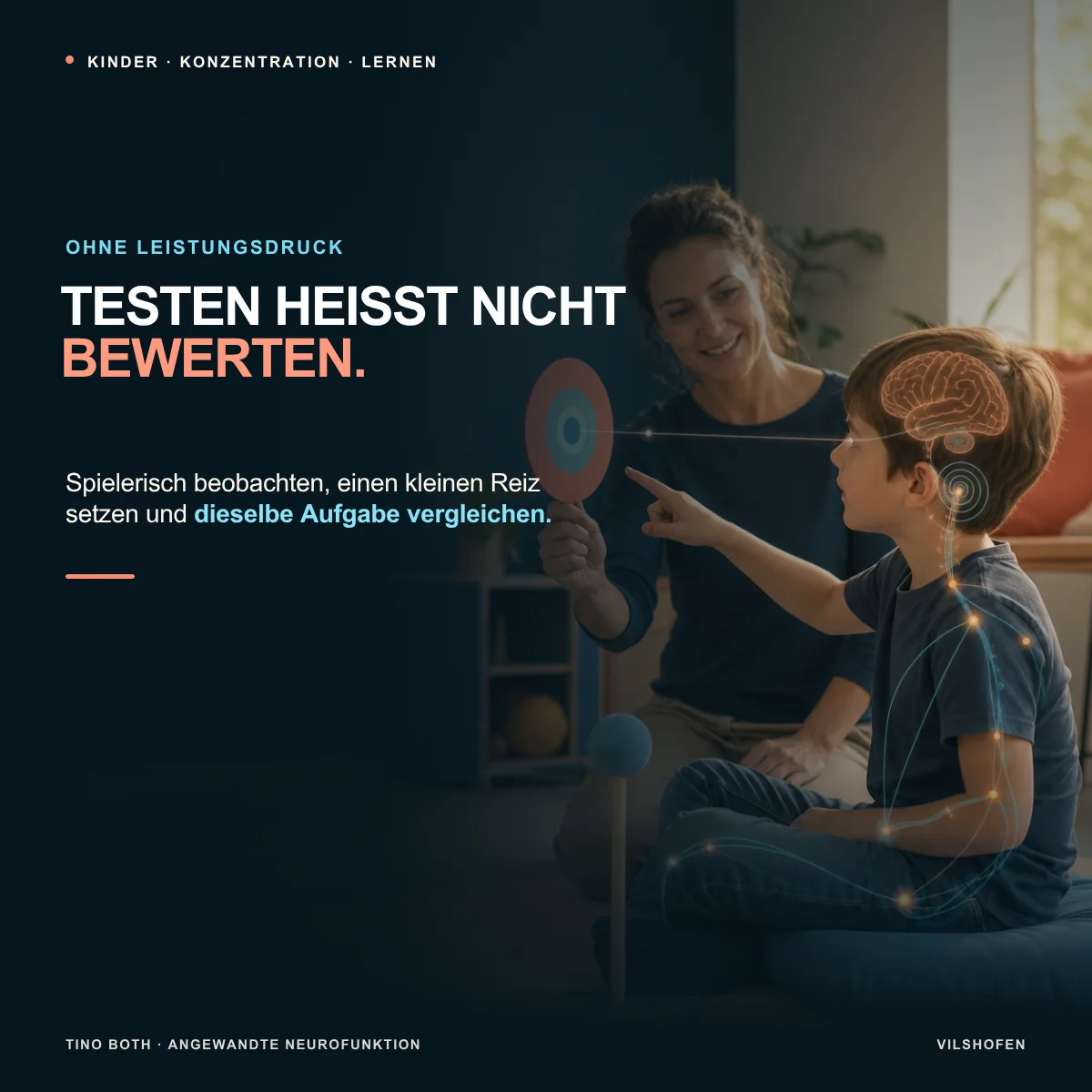
Briefly explained: In neurofunctional assessment of children, I consider how perception and movement interact in a specific everyday task. We choose an understandable starting point, assess suitable functions and compare the response to targeted stimuli. Your child does not have to prove anything.
Would you first like to know whether this fits your child?Describe a situation that concerns you: effortful homework, unsteady movement or rapid fatigue while reading, for example. In the initial telephone consultation, we clarify whether a functional perspective in Vilshofen can sensibly follow.
Discuss questions about your child’s assessment →
The initial telephone consultation is free.
Discuss questions about your child’s assessment →
The initial telephone consultation is free.
An appointment where your child should not just ‘function’
Perhaps your child has often heard what does not work. They should read more accurately, sit more quietly or concentrate harder. It is understandable to worry that another appointment will mainly reveal difficulties again. I am interested in a different question: under which conditions does a task work, and what makes it unnecessarily demanding?
This also includes what your child enjoys and does well. A child who perseveres at building but quickly gives up when copying already provides important information. We do not need to question their entire attention. We can look more closely at the demands of copying.
We begin with a situation, rather than a long test list
‘School is difficult’ describes your burden, but remains very broad for a targeted comparison. More helpful examples are ‘the hand hurts after a few lines’ or ‘they lose their place when switching between reference and exercise book’. Together, we turn this into a small task suited to age and current capacity.
What you can contribute to the first appointmentA typical situation: When do you notice the difficulty?
A difference: When does something similar work better?
Your child’s experience: What feels demanding, unpleasant or confusing in it?
An existing work sample can make description easier. Relevant findings or support already underway help place the approach appropriately. You do not need to create a new observation diary for this.
A difference: When does something similar work better?
Your child’s experience: What feels demanding, unpleasant or confusing in it?
An existing work sample can make description easier. Relevant findings or support already underway help place the approach appropriately. You do not need to create a new observation diary for this.
What is considered functionally in children?
This follows your concern. For a writing task, hand control, a comfortable sitting position or the gaze switch to a reference may be interesting, for example. With unsteadiness in movement, it may be orientation, simple step sequences or interaction of gaze and head movement. Not every child needs every topic.
The tasks may look playful: looking at a target, copying a movement, deliberately touching something or performing a short sequence. What matters is that the task has been understood. An unfamiliar instruction, fatigue or excitement should not be confused with a functional difficulty.
Comparison needs reliable conditionsBefore evaluating a stimulus, the starting task needs to be sufficiently understandable. I therefore attend to the same instruction, suitable duration and comparable conditions. If a task is only understood on the second attempt, that is initially learning progress.
How I assess a selected connection more closely
In my work, Angewandte Neurofunktion connects observation of specific tasks with targeted functional assessments. If an additional stimulus assessment makes sense, I can use an indicator muscle. Your child holds against a measured resistance. This concerns a reliable response under defined conditions, rather than a contest about who is stronger. The muscle is chosen so testing is possible without pain.
From indicator muscle back to the everyday task1. Find a suitable muscle. I first assess whether the starting response can be tested reliably.
2. Assess a specific connection. A defined stimulus or suitable contacts direct testing towards the selected question, such as a particular visual or body-related functional relationship.
3. Compare the response. Within this assessment system, an unusual inhibition is distinguished from an expected physiological response.
4. Seek a suitable solution input. The original stimulus alone and the stimulus together with additional input are repeatedly compared. We seek an understandable change in the unusual response.
5. Integrate and assess again. After the method’s integration step, the same original stimulus is assessed again without the additional solution input.
6. Repeat the starting task. We then consider whether targeted grasping, movement or the short writing task becomes easier, for example.
2. Assess a specific connection. A defined stimulus or suitable contacts direct testing towards the selected question, such as a particular visual or body-related functional relationship.
3. Compare the response. Within this assessment system, an unusual inhibition is distinguished from an expected physiological response.
4. Seek a suitable solution input. The original stimulus alone and the stimulus together with additional input are repeatedly compared. We seek an understandable change in the unusual response.
5. Integrate and assess again. After the method’s integration step, the same original stimulus is assessed again without the additional solution input.
6. Repeat the starting task. We then consider whether targeted grasping, movement or the short writing task becomes easier, for example.
For me, these two levels belong together: the method’s test response and your child’s experience of the actual task. A stable indicator muscle is not the everyday goal. What matters more is whether your child can use something better and whether this holds up outside the appointment too.
One possible example: shift gaze without losing your place
A child struggles to find their place in the exercise book after looking at the reference. We choose a brief, well-understood task with a few symbols. The reference first stays directly beside the book. We then deliberately change its position and observe when finding the place again becomes demanding.
If this produces a suitable gaze control question, I can assess it more closely and select a small, tolerable visual input. The original task then follows again. We compare more than speed: does the child find their place more easily? Do they remain accurate? How demanding does it feel?
A more favourable response can provide a starting point for further work. If it does not occur, we do not simply change more and more things together. We review the starting question and choose another starting point where appropriate.
What happens if my child does not want to participate?
The appointment does not become an endurance test. A task can be explained, simplified, made more playful or paused. If reliable participation is not possible at the moment, no reliable comparison can be drawn from the attempt either. The pace needs to fit the child.
Beforehand, you can simply tell your child: ‘We will look together at what might help you with a difficult task.’ They need neither practised answers nor a promise that everything will be easy afterwards. Your child’s own feedback explicitly matters.
What do parents take away from assessment?
The goal is an understandable next decision: which observation mattered? Which change was tolerable? What is worth pursuing? This may lead to a selected training idea, an adjustment to the task or a recommendation to clarify an open question elsewhere first.
If you try something in everyday life, how you recognise benefit should be clear. ‘Train the nervous system’ is too vague for this. ‘Find the place more easily during the short copying task’ is more tangible. The child’s effort and willingness also belong in this assessment.
When other professionals belong in the picture
Persistent learning difficulties, marked developmental concerns, recurrent pain or visual and hearing symptoms should be assessed by a paediatrician or relevant professionals. Depending on the topic, school, occupational therapy, ophthalmology or school psychology are important partners. The IQWiG: ADHD – symptoms, assessment and support explains, for example, why marked inattention requires consideration of different areas of life and other possible triggers.
Frequently asked questions about neurofunctional assessment in children
Does my child need a diagnosis beforehand?You do not need a ready-made explanation for a first conversation. Existing findings and open medical questions belong in it, however, so the next step can be chosen sensibly.
Is the muscle test strenuous or painful?It should be carefully dosed and pain-free. If discomfort, exhaustion or an ununderstood task influences the response, conditions need adapting.
Will we notice a change immediately?A task may feel different during the appointment already. This cannot be predicted. Repeated observations and implementation in everyday life matter for further benefit.
Will we need to do many exercises afterwards?An extensive exercise catalogue is not the goal. A manageable approach whose performance and purpose you understand and which fits everyday life is more sensible.
An understandable first step instead of more pressure
Before contacting me, you do not need to decide whether vision, movement or attention is the main focus. Sorting this out can be the starting point. In my work with Angewandte Neurofunktion in Vilshofen, the aim is to turn a burdensome everyday situation into a specific, assessable question.
Which task should become easier for your child?We can begin with this question. In the initial consultation, tell me what concerns you and which support already exists. Together, we clarify whether and how I can support you sensibly.
Free initial consultation about children’s assessment →
The initial telephone consultation is free.
Free initial consultation about children’s assessment →
The initial telephone consultation is free.
Related pages and articles
All children’s topics at a glanceConcentration problems: starting, staying with it and returning
Restlessness in children: considering behaviour functionally
Daydreaming or quickly overwhelmed: sensory processing at school
When reading is demanding: eyes and gaze control
Writing, reading and sitting: understanding effort more closely
School problems despite intelligence: ability and implementation
Balance and concentration: movement and learning
Neurofunctional assessment: what parents can expect – this article
Neuroathletic training for children and adolescents
Podcast recommendation: learning does not happen only in the head
Restlessness in children: considering behaviour functionally
Daydreaming or quickly overwhelmed: sensory processing at school
When reading is demanding: eyes and gaze control
Writing, reading and sitting: understanding effort more closely
School problems despite intelligence: ability and implementation
Balance and concentration: movement and learning
Neurofunctional assessment: what parents can expect – this article
Neuroathletic training for children and adolescents
Podcast recommendation: learning does not happen only in the head
Relevant areas of focus and my approachWhen school is difficult: concentration and learning in Vilshofen
Vision and visual processing
Angewandte Neurofunktion: my approach
Vision and visual processing
Angewandte Neurofunktion: my approach
Sources and further reading