

← All articles
Pain & functional symptoms
Hand tingling in certain arm positions: nerve, blood vessel or tissue?
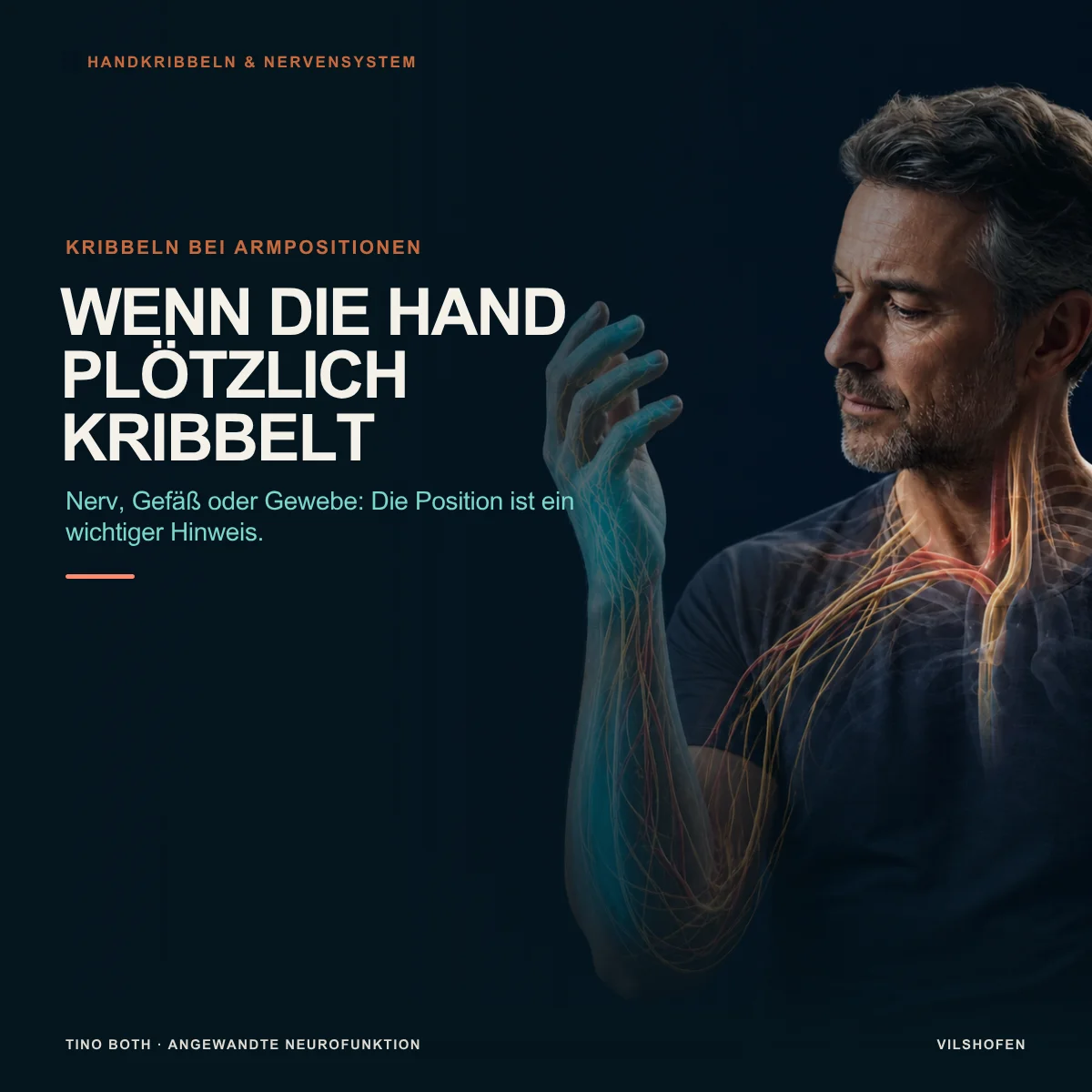
You hold a smartphone to your ear, rest your arm above your head at night or reach upwards for a while, and suddenly your hand tingles. Changing position improves it. This sounds like a trapped nerve. Yet the same arm position also changes tension, pressure and mobility in nerves, vessels, muscles, fascia and joints. Position is therefore a valuable clue, but not a definite answer.
The most important answer firstHand tingling in certain arm positions may arise from mechanical irritation of a nerve pathway. Vascular mechanics, surrounding tissue or joint position may also matter. Describe the reproducible triggering position precisely, consider warning signs and assess possible connections individually.
Why can an arm position make the hand tingle?
Several structures adapt simultaneously to posture from neck to fingers.
Nerves are not rigid cables. They must glide during movements of head, shoulder blade, arm, elbow and wrist and adapt to changes in their pathway's length. Greater load on a nerve pathway in a particular combination may produce tingling, electric sensations, burning or numbness.
The same posture also changes space for blood vessels, muscle and fascia tension and several joint positions. An overhead arm may therefore provoke something different from a deeply bent elbow or sharply bent wrist.
Nerve, vessel or tissue: which indications differ?
The overall pattern, rather than one sign, determines the next assessment route.
Nerve involvementElectric tingling, burning, numbness or a sensation clearly travelling into particular fingers makes a nerve-related assessment plausible. It matters whether head position, shoulder girdle, elbow, forearm rotation or wrist change symptoms. Research nevertheless shows that neurodynamic tests alone have limited ability to distinguish individual entrapment syndromes. Symptom pattern, side comparison, structural differentiation and other diagnostic findings make them more informative.
Vascular involvementVessels partly run alongside nerves through narrow spaces. Coldness, pallor, bluish colour or swelling should be taken seriously. Tingling alone does not prove vascular compression. Visible colour or temperature changes and new weakness warrant medical assessment first.
Muscle, fascia, skin or jointA neurodynamic arm position does not load only a nerve. It also lengthens muscles, tensions fascia, displaces skin and changes several joint positions. If tingling is influenced more by local pressure, shoulder-blade position or a small joint change, this layer becomes more relevant. It may contribute independently or alter mechanical conditions for nerves and vessels.
Why the familiar trigger is so valuableThe exact arm position is an everyday baseline marker. Record onset, affected fingers, intensity, time until tingling and change after releasing the position. After an intervention, reassess exactly the same position under comparable conditions.
How NeuroFI differentiates tingling with arm positions
The symptomatic arm provides the question; a painlessly testable muscle makes responses to precise stimuli comparable.
1. Determine a stable indicator muscleFirst choose and calibrate a muscle that can be tested physiologically, painlessly and reproducibly. The tingling arm is not used as indicator if the test position itself creates symptoms or a non-physiological protective response. A suitable muscle in the other arm or leg may then show the response to the question.
2. Apply the stimulus preciselyThe triggering arm position forms the reference stimulus. Possible connections are then examined individually: the same arm reference with a specific nerve position, vascular-mechanics contact points or clearly defined tissue or joint information. Rather than provoking everything together, ask one question at a time.
3. Test the indicator muscle under the stimulusIf the previously stable muscle stays physiologically strong, this specific connection is initially unremarkable in this version. If it becomes non-physiologically weak under the stimulus, the connection is considered notable within NeuroFI. Repeat the test in control before deriving the next step.
4. Find a suitable solutionPossible solution levels are checked. The solution must reliably remove non-physiological inhibition: the stimulus alone makes the indicator weak; stimulus plus solution makes it test strong again. This clear alternating pattern distinguishes a suitable solution from random change.
5. Integrate the solutionStimulus and solution are connected neurofunctionally. Then comes the crucial check: the original stimulus alone should no longer inhibit the indicator muscle. The new pattern is stimulus → strong.
6. Check transfer to the handOnly now return to the original arm position. Does tingling appear later, more mildly or not at all? Do sensation and grip strength stay more stable? Is posture easier to control? This transfer retest shows whether the integrated connection was relevant to the particular everyday problem.
The repeatable NeuroFI logicBefore integration: stimulus → non-physiologically weak. Stimulus plus solution → strong.
After integration: stimulus alone → strong. The same symptomatic arm-position test then checks transfer.
After integration: stimulus alone → strong. The same symptomatic arm-position test then checks transfer.
A specific example: hand tingling while using the phone
Elbow bending is the trigger, but not automatically the explanation.
A person notices ring- and little-finger tingling after two minutes with a deeply bent elbow. Time to onset, intensity and grip sensation are recorded as baseline markers. Since the arm position already tingles, a painlessly stable leg muscle is chosen as indicator.
The elbow reference is first paired with mechanical information from the relevant nerve pathway. In this example, the connection reproducibly inhibits the indicator muscle. Vascular enquiry and separate muscle, fascia and joint questions remain stable. An identified solution removes inhibition, is integrated and checked against the same nerve stimulus. Then the phone task is repeated: only the identical transfer test shows whether tingling actually changed.
Useful observations you can make yourself
Good observations help more than increasingly intense self-tests.
Note affected fingers, time to tingling and the influence of head, shoulder, elbow and wrist. Weakness, colour or temperature changes and the effect of repositioning also matter. Do not repeatedly provoke the position to strong tingling or numbness.
When hand tingling needs medical assessment
New deficits and signs of impaired circulation change the priority.
Please stop functional provocationSudden one-sided numbness with paralysis, a drooping corner of the mouth or speech, vision or balance disturbance is an emergency. A cold, very pale or blue hand, marked swelling, severe persistent pain or new weakness also needs rapid assessment. Recurring or continuous tingling, increasing numbness, declining fine motor skills and muscle wasting warrant medical examination, even if a particular arm position triggers them.
Functional differentiation in Vilshofen
Once medical safety is established, the individual connection can be assessed specifically.
In my practice in Vilshofen an der Donau, we begin with your particular triggering position. Rather than generally mobilising the whole arm, relevant nerve, vessel, tissue and joint relationships are assessed individually using a stable indicator muscle. An identified solution must reproducibly change the test pattern and, after integration, also hold up in the original everyday test.
Does this assessment route suit your concern?In a free initial telephone consultation, discuss when tingling occurs, what has been examined and whether neurofunctional differentiation is a sensible next step.
Arrange a free initial telephone consultation
Arrange a free initial telephone consultation
Common questions about hand tingling
Is a tingling hand always a trapped nerve?No. A nerve is an obvious assessment route, but the same arm position also changes vessels, muscles, fascia, skin and joints. Associated signs and targeted differentiation determine what should be assessed more closely.
Why does the hand tingle especially at night?Elbow or wrist often remain bent longer during sleep. Night-time hand numbness is a typical early symptom of carpal tunnel syndrome. Other distributions and triggers are possible; recurrent symptoms warrant medical assessment.
Can tingling come from the neck or shoulder?Yes. Nerve pathways to the hand begin around the cervical spine and pass through shoulder girdle and arm. Head and shoulder position may affect symptoms. Tingling location alone does not show where the relevant load lies.
What does an immediately better retest mean?It shows that the tested connection responded acutely to the chosen solution. After NeuroFI integration, the original stimulus should no longer inhibit the indicator muscle; the arm position is also checked. Course and capacity remain important for everyday usefulness.
Conclusion: position shows a route in, not automatically the cause
The more precise the question, the more clearly nerves, vessels and tissue can be distinguished.
Hand tingling in arm positions provides a readily reproducible baseline marker. Posture alone may nevertheless load several structures at once. It is worth combining finger distribution, associated signs and positional details, taking medical warning signs seriously and testing functional connections individually.
NeuroFI uses a stable indicator muscle: stimulus alone inhibits, stimulus plus suitable solution stabilises, and after integration the indicator stays strong under the original stimulus too. The specific arm position as a transfer retest then determines whether the connection was truly relevant to the person.
Related pages
More about functional symptoms, the method and first contact.
Further informationPain & functional symptoms
Method — Neurofunctional Integration
Free initial telephone consultation
Method — Neurofunctional Integration
Free initial telephone consultation
Sources and further reading
Guidelines, consensus and current research on position-dependent hand symptoms.