

Neuroathletic training & performance
Head up during stickhandling: Why does the puck get away?
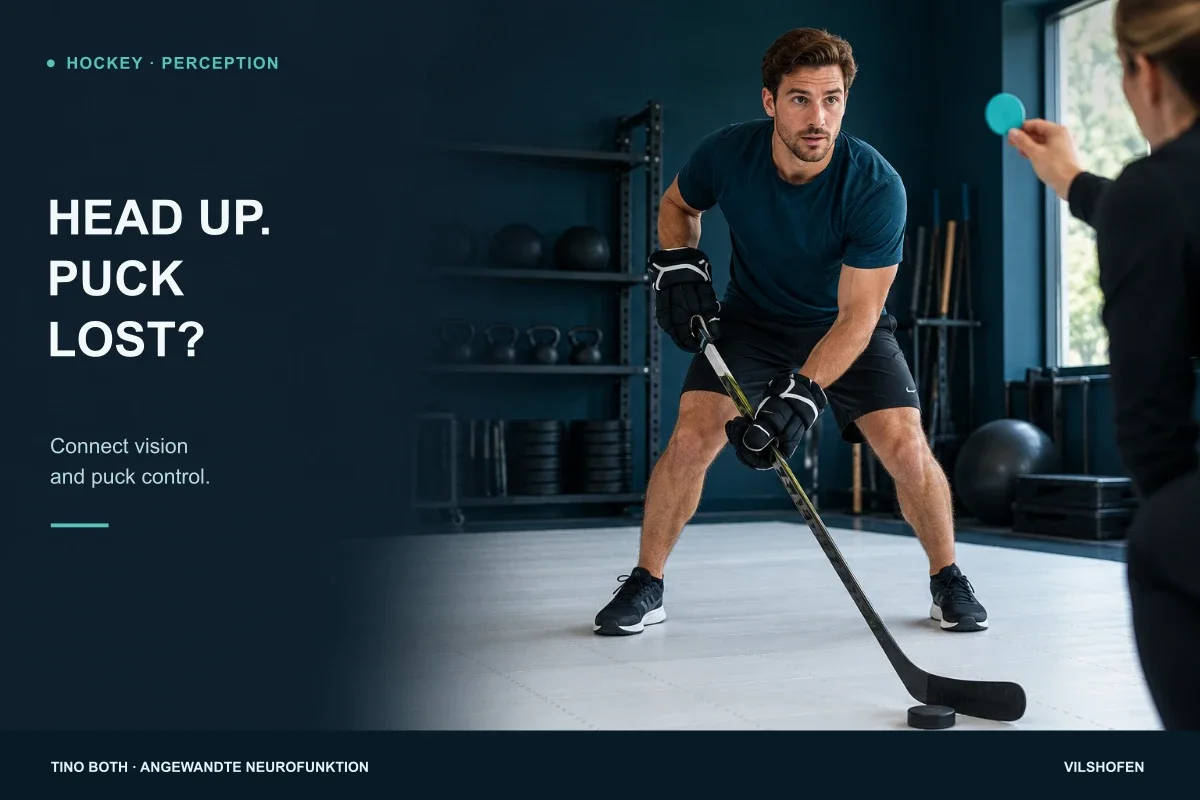
Stickhandling feels smooth while you watch the puck. As soon as you look ahead, the puck gets away or the movement becomes hurried. Meanwhile, information about teammates, opponents and open space is missing.
In Vilshofen, Tino Both uses neuroathletic training and Angewandte Neurofunktion to work on connections between perception and movement. For stickhandling, the specific question is how to take your gaze away from the puck while maintaining control of the stick and puck.
Puck control and awareness of the play require attention together
Looking directly at the puck provides plenty of visual information for stick movement. Looking ahead changes the task. Puck movement is monitored more through peripheral vision and the feel of the hands and stick.
Body position matters too. A player has to organise stance or movement while the hands guide the puck and the eyes take in other information.
The transition can therefore become difficult in several ways. Stick movement may become less fluid under the new gaze condition. Hand tension may increase. Or control may remain good while the signal ahead is barely noticed.
First identify which component becomes difficult
An initial functional comparison can be set up off the ice in a quiet starting position. Tino first observes a simple, familiar stick movement with the puck clearly visible.
A clear visual task is then assessed without stick movement. A target or simple directional cue needs to be recognised. Only afterwards are the two parts combined.
Two outcomes matter: how well puck control is maintained and whether the visual signal is identified correctly. Having the head facing forward alone does not show which information is actually being taken in.
This makes the next training decision more precise. Is the response rule, the visual demand or primarily the combination of tasks becoming difficult?
An example: the hands tighten as soon as gaze moves forward
Suppose a player moves the puck calmly from side to side. With a clear gaze target ahead, hand tension increases and the puck is lost more often.
Tino can first make the stick movement smaller and slower. Brief gaze shifts are then compared with holding a continuous gaze position. Target distance or starting posture can also be changed individually.
The comparison helps identify a variation that allows a controlled basic solution. This is then linked with the same visual information again. It creates an understandable progression between only watching the puck and an overloaded task.
Connecting information from the eyes and hands
Guiding a stick produces sensory feedback: contact with the puck, pressure through the grip and movement of the hands. These signals can be connected deliberately with a clear visual task during practice.
Tino examines which input makes the task easier to perform. A selected hand-awareness input or short gaze task may provide preparation. The agreed combination of puck control and recognition is then repeated.
Conditions stay comparable: the same starting position, similar movement range and the same visual rule. This makes the change in the task clear.
The benchmark remains the combination of both outcomes. Correct signal recognition and controlled puck movement need to work together.
From a basic solution to a sporting task
Simple information presented ahead of the body is enough initially. Its direction, timing or location can then vary. Movement is introduced once the quieter combination is understood and controlled.
Transfer onto the ice remains a distinct step. Gliding, braking, surface conditions, speed and opponents add further demands. An off-ice preparatory task is therefore revisited during normal ice practice and judged against the sporting goal.
This distinction is useful for youth coaches too. It helps clarify whether stick technique needs simplifying, visual information needs presenting more clearly or the combined task needs building more slowly.
Identifying a useful change over time
Useful observations might include fewer puck losses during the same task, calmer stick movement or a more reliable response to the forward signal. The player's experience of the hands and forearms adds context.
Later, the change is examined at greater speed and during movement. Demands are increased so that the player can actively manage the task and give feedback.
Blurred vision, double vision or symptoms after a head impact call for medical assessment before further increases in loading. During ordinary skill development, clear and comfortable comparison conditions provide a useful foundation.
Neuroathletic training for hockey players near Passau and Deggendorf
Tino Both works on sporting perception and movement tasks in Vilshofen. A concern can be examined in an individual appointment or defined for a tailored club session.
A specific description is enough for the introductory call: what works while looking at the puck, what changes when looking up, and under which conditions is control lost?
Would you like to bring your gaze into the game earlier while keeping puck control part of the task? Discuss with Tino which component could provide a starting point for functional work.
Book your free initial conversation
Frequently asked questions
Does the appointment need to take place on the ice?
An initial assessment can begin with a suitable off-ice task. Its application on the ice is then considered under the actual sporting demands.
Is this only about the eyes?
The task involves gaze control, hand sensation, stick movement and body position. The comparison helps identify the relevant connection more precisely.
Can this be adapted for youth players?
The task is matched to age, experience and current capacity. A clear, simple combination can provide an appropriate starting point.