

← All articles
Pain & functional symptoms
Knee pain on stairs: joint, tendon, sensation or movement planning?
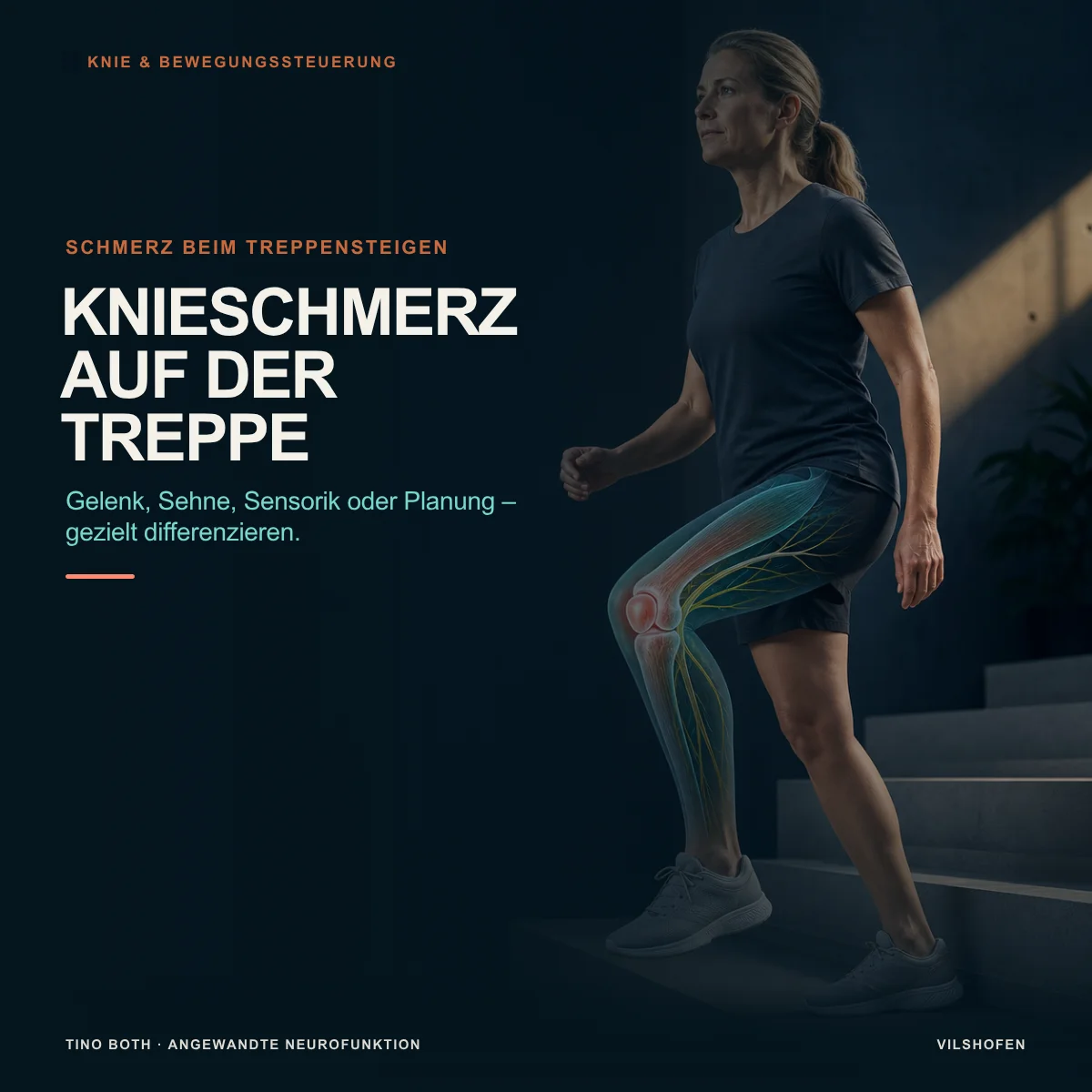
Level ground is still fine, but your knee makes itself felt on the stairs. Perhaps there is a pulling sensation behind the kneecap going up, a stab going down or uncertainty on the first steps. The obvious explanation is often insufficient strength or wear. Both may contribute, but stairs demand more than strength. Joint information, tendon load, body awareness and movement planning must work together at the right moment.
The most important answer firstKnee pain on stairs is a loading pattern, not a definite diagnosis. The area around the kneecap is often involved. Tendons, muscles, joints and movement organisation may also matter. Direction and timing of pain provide important clues.
Why are stairs more demanding for the knee than walking?
On every step, the leg must take body weight, change height and control movement in space.
Going up, the supporting leg generates force to move the body to the next step. Going down, it must brake movement and accept weight in control. In both directions, the knee usually bends more than in ordinary walking. This increases demands on cooperation between kneecap, thigh, hip, foot and trunk.
The nervous system needs information about knee bend, foot position, speed, step edge and tissue tension. Motor output emerges from this. Pain, compensatory movement or a stiff knee may show that the task is not currently well tolerated or organised.
Going up and down are two different testsGoing up emphasises force generation and accepting load. Going down additionally involves braking and spatial estimation of the next step. The difficult direction should later be reassessed identically.
Which layer may be involved in pain on stairs?
Pain location matters, but functional differentiation begins afterwards.
Joint and kneecapFront-of-knee or around-kneecap pain during bending, squatting or stairs often fits a patellofemoral symptom pattern. A single alignment difference is not automatically declared the cause. The particular painful task, capacity, course and response to targeted changes are more informative.
Tendon and muscleQuadriceps and patellar tendons transmit large forces around the knee. Pain below or above the kneecap, a marked difference between slow lowering and forceful pushing up, or a response to repetitions can make this layer more relevant. Muscle strength remains important, but alone does not show how well tendon input and joint control are processed.
Sensation and body mapSkin, fascia, muscles, tendons and joint receptors report position, pressure and movement. After injury, surgery or prolonged protection, the knee may feel unclear or difficult to locate. Touch, joint position and body awareness are then assessed separately.
Movement planning and orientationBefore the first step, the brain estimates height, depth, distance and required force. Eyes, balance and proprioception provide the spatial framework. If descent becomes less steady in darkness or without looking at the step, this planning becomes particularly relevant.
Not every knee needs every assessment routeFor occasional uncomplicated stair pain, a local starting point makes sense: skin and fascia, tendon, muscle, joint and the particular movement pattern. Further nerve, vascular or sensory relationships are added only when history or retest suggests them.
How NeuroFI differentiates knee pain on stairs
The stairs remain the transfer test; functional questions are posed through a physiologically stable indicator muscle.
1. Choose a suitable indicator muscleFirst identify a muscle that can be tested painlessly, physiologically and reproducibly. A painful knee extensor is unsuitable if pressure or test position already causes a protective response. Normal leg movement patterns may also affect a local muscle test. A neutral arm muscle or muscle on the other side is then used as indicator.
2. Introduce the stimulus and examine the connectionThe affected knee or relevant stair position forms the reference area. One precise second piece of information is added: joint position, kneecap movement, tendon contact, muscle information, skin or fascia stimulus, joint position sense or specific movement planning. Each connection is posed individually.
3. Test the indicator muscleIf the calibrated muscle stays physiologically strong under the stimulus, this specific question is initially unremarkable. If it becomes reproducibly non-physiologically weak, the examined connection is considered notable within NeuroFI. An unremarkable individual test does not exclude the entire category of joint, tendon or sensation; position, direction and stimulus quality must fit the original question.
4. Find the appropriate solutionPossible solution levels are checked. A suitable solution removes non-physiological inhibition. The pattern must repeat: stimulus alone → weak; stimulus plus solution → strong. Integration follows only then.
5. Integrate the solutionStimulus and solution are connected neurofunctionally. The original stimulus is then checked again without additional solution contact. The indicator muscle should now stay physiologically strong: stimulus alone → strong.
6. Check transfer on the stairsNow repeat the initial step test: same direction, comparable step height and as similar a speed as possible. Do pain, movement feeling, stability or willingness to take weight through the leg change? This transfer shows whether the integrated connection was relevant to the specific stair difficulty.
The repeatable NeuroFI logicBefore integration: stimulus → non-physiologically weak. Stimulus plus solution → strong.
After integration: stimulus alone → strong. The identical stair or step-down test then checks transfer.
After integration: stimulus alone → strong. The identical stair or step-down test then checks transfer.
A specific assessment example
The same baseline test connects differentiation and transfer.
Pain around the kneecap when going downA low step-down reproduces pain. The knee reference with a particular joint position inhibits the stable arm indicator; tendon and muscle enquiries stay strong. A suitable solution stabilises the indicator, is integrated and checked against the same stimulus. Only then is the step-down repeated.
What you can observe yourself
A precise loading profile makes later examination much more useful.
Note whether going up or down is harder, exactly where pain is felt and whether it begins on the first step or with repetition. Observe swelling, locking, giving way, painful clicking, handrail use and differences with step height, speed, footwear or lighting. Use these observations as a clear baseline marker, rather than for self-diagnosis.
Why strength training may matter, but does not answer every question
Integration and building capacity serve different purposes.
Exercise and load management are important foundations for patellofemoral symptoms. Hip and knee exercises build strength and capacity. NeuroFI does not replace this development; it assesses which connection currently changes movement non-physiologically.
After a positive transfer retest, neurocentric training may consolidate movement: first a tolerable step height, later more repetitions, depth, speed or load. NeuroFI differentiates and integrates; training then develops capacity and everyday usefulness.
When knee pain needs medical assessment
Acute injuries, signs of inflammation and mechanical locking should not undergo further provocation tests.
Please seek prompt or urgent examinationAfter an accident with marked swelling, deformity or inability to bear weight, or with a locked knee, new marked instability, redness, warmth or fever, seek medical assessment. The same applies to rapidly increasing pain, marked calf swelling or breathlessness. Persistent night pain, increasing weakness and symptoms progressing despite adjusted load also warrant medical examination.
Functional assessment of knee pain in Vilshofen
From the particular step problem to the individually relevant connection.
In my practice in Vilshofen, start with your baseline marker: stairs up, stairs down or a standardised step-up or step-down. Local tissues, joint information, sensation and movement planning are then prioritised appropriately.
Would you like to know which assessment route suits your knee?In a free initial telephone consultation, we discuss the course, existing medical findings and whether a neurofunctional assessment is a sensible next step for your concern.
Arrange a free initial telephone consultation
Arrange a free initial telephone consultation
Common questions about knee pain on stairs
Why does the knee hurt more going down than up?Going down, the leg must brake the body in control and accept weight. Greater knee bend, braking and spatial control can intensify the symptom pattern. Which layer actually matters can only be assessed individually.
Is knee pain on stairs always the kneecap?No. Anterior pain often fits a patellofemoral pattern, but tendons, muscles, other joint structures and sensorimotor factors may contribute. Location and task are clues, not a complete diagnosis.
Should I avoid stairs with knee pain?Not as a blanket rule. Warning signs or acute injury make assessment more important than further testing. Without these signs, temporarily adjusted step height, speed or repetition count may be useful. Load progression should fit the individual course.
What does an immediate change after NeuroFI mean?Initially, it shows that the tested connection responded acutely to the solution and the transfer test changed. Repeatability, capacity building and progress matter for stable everyday improvement.
Conclusion: stairs reveal which task the knee finds difficult
The same pain location can arise from different functional connections.
Knee pain on stairs may relate to joint and kneecap, tendon and muscle, local sensation or movement planning. Direction, timing and the exact sensation provide more information than the label “knee pain” alone.
NeuroFI examines these possibilities through a painlessly stable indicator muscle and clearly separated stimuli. A solution must reproducibly remove inhibition; after integration the original stimulus tests strong, and the identical step test then shows transfer. Targeted load and training progression can follow.
Related pages
More about functional symptoms, the method and first contact.
Further informationPain & functional symptoms
Method — Neurofunctional Integration
Free initial telephone consultation
Method — Neurofunctional Integration
Free initial telephone consultation
Sources and further reading
Current recommendations and background on anterior knee pain and patellofemoral symptoms.