← All articles
Professional development and events
Therapy Day 2026 – neurocentric ideas, professional exchange and a look ahead
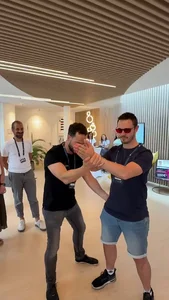
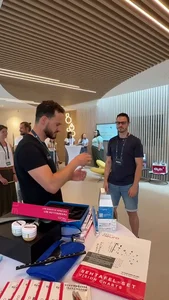
A whole day of practical ideas, professional conversations and new encounters: at Therapy Day 2026 in the Showroom Kanzlsperger, I had the opportunity to answer questions at the ARTZT-Neuro stand about neurocentric tools, their use and the possibilities of an approach guided by the nervous system.
On 18 July 2026, therapists, trainers, speakers, exhibitors and other interested visitors came together in Ortenburg to exchange ideas about current approaches, equipment and applications in therapy and training.
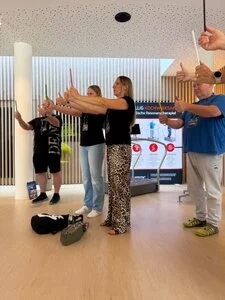
The programme combined specialist presentations with practical workshops, challenges, an exhibition and plenty of time for personal conversations. This meant that it went beyond theoretical information: visitors could try out, question and discuss numerous methods and pieces of equipment together.
For me, the day was also a lovely opportunity to make neurocentric work visible within a wider therapeutic setting and to speak with people who would like to integrate the nervous system more closely into their existing work.
Therapy Day 2026The third Therapy Day took place on 18 July 2026 in the Showroom Kanzlsperger in Ortenburg. Alongside presentations and an exhibition, various practical workshops were offered, including neurocentric training in collaboration with the ARTZT Institut.
Experiencing therapy as well as talking about it
The event brought together specialist knowledge, practical experience and personal exchange.
The combination of short specialist presentations followed by practical experience worked particularly well. In addition to modern equipment-assisted therapy methods, shockwave therapy, taping, Blood Flow Restriction and other training and therapy approaches, visitors could explore various applications directly.
The afternoon also focused on the Olympic Games. Experienced therapists shared their work with competitive athletes and offered insights into the particular demands of professional support in elite sport.
Events like this are valuable because different disciplines can engage with one another. Physiotherapy, training, rehabilitation, sports science and neurocentric approaches can learn from each other without any one method having to claim that it can answer every question on its own.
What made the day special• Practical workshops alongside presentations
• Direct contact with speakers and exhibitors
• Exchange between therapy, training and competitive sport
• Opportunities to try things out and ask questions
• Different professional perspectives in one place
• An open and welcoming atmosphere
• Direct contact with speakers and exhibitors
• Exchange between therapy, training and competitive sport
• Opportunities to try things out and ask questions
• Different professional perspectives in one place
• An open and welcoming atmosphere
At the ARTZT-Neuro stand: questions, tools and practical applications
The focus was on the function that could be addressed through a training tool.
At the ARTZT-Neuro stand, I was able to help visitors with questions about the various neuro tools. Many conversations began with what individual aids could be used for and which nervous system functions they addressed.
It quickly became clear that a tool alone does not make an intervention meaningful. A visual stimulus, a gaze task, a balance challenge or a proprioceptive stimulus may help one person, have no effect on another and even cause deterioration in a third.
The key is therefore to establish which function is to be improved, how the nervous system responds to the chosen stimulus and whether the desired output actually changes in an immediate re-test. Using as many exercises or aids as possible is not the deciding factor.
A tool is only as useful as its applicationPinhole glasses, a Brock string, gaze targets, balance stimuli and other neurocentric aids are not universal solutions. Their effect depends on the starting function, the aim, the dose and the individual's response.
Why neurocentric work raises so many questions
The nervous system is involved in every movement and perception, but is not always assessed specifically in everyday therapeutic practice.
When movement is restricted, balance is uncertain or a training result is difficult to explain, work often starts locally. A joint is mobilised, a muscle is strengthened or a movement is practised repeatedly.
These approaches can be useful. At the same time, every movement arises from the processing of sensory information. The brain needs to know where the body is, where the head is moving, which target the eyes are following and whether the current situation is judged to be safe.
Visual, vestibular and proprioceptive information therefore influences mobility, muscle tone, balance, reactions and coordination. If one of these systems is processed inaccurately, inconsistently or only with considerable effort, this may show in motor output.
The basic working sequenceAssess the starting function → select a targeted stimulus → observe the response → re-test immediately.
Only the comparison shows whether an intervention is useful for that person and the current aim.
Only the comparison shows whether an intervention is useful for that person and the current aim.
You can learn more about my overall approach on the page Method – Applied Neurofunction and Neurofunctional Integration.
Many valuable conversations and different perspectives
The professional exchange was at least as valuable as the programme itself.
Alongside practical questions about individual tools, numerous conversations developed around pain, dizziness, balance, visual processing, rehabilitation and sporting performance.
The variety of previous experience was particularly interesting. Some visitors already worked regularly with neurocentric elements; others had had initial contact with them and wanted to understand how these approaches could be integrated into an existing therapeutic or training process.
For me, this is precisely the value of an event like this: it offers a way to ask additional questions and assess functional relationships more precisely, while continuing to use established therapy and training concepts.
Thank you to the team at the Showroom Kanzlsperger, the ARTZT Institut, the other speakers and exhibitors, and all the visitors whose questions and experiences helped make the day such a success.
Continuing in September: Neurocentric Training and Therapy
The initial insights will be followed by a detailed, practical professional development course.
Anyone whose curiosity was sparked at Therapy Day, or who would like a structured introduction to neurocentric approaches, will have the opportunity to explore them in much greater depth in September.
On 18 and 19 September 2026, I will lead the course ‘Neurocentric Training and Therapy’ at the Showroom Kanzlsperger. The course is aimed at therapists, trainers and other professionals who would like to involve the nervous system more specifically in their existing work.
The event begins on Friday at 14:00 and finishes on Saturday at 17:00. This one-and-a-half-day format allows enough time to build a clear understanding of the foundations, carry out tests together and try practical interventions for yourself.
Dates and venueFriday, 18 September 2026, 14:00 to 19:00
Saturday, 19 September 2026, 09:00 to 17:00
Showroom Kanzlsperger
Kamm 13
94496 Ortenburg
Saturday, 19 September 2026, 09:00 to 17:00
Showroom Kanzlsperger
Kamm 13
94496 Ortenburg
What participants can expect from the course
The content connects neuroanatomical foundations with assessments and interventions that can be applied directly.
The course is deliberately practical. Its aim is to use an understanding of the nervous system to make concrete decisions in therapy and training, rather than to accumulate as many neuroanatomical terms as possible.
Neuroanatomical foundations• How the brain organises movement, pain and balance
• The role of visual, vestibular and proprioceptive information
• How neuroplasticity and adaptation can be understood in practice
• The role of visual, vestibular and proprioceptive information
• How neuroplasticity and adaptation can be understood in practice
Diagnostics and assessment• Simple functional tests for everyday practice
• Screening visual perception
• Assessing balance and gaze stability
• Interpreting proprioceptive and body-related information
• Using re-tests and comparison markers
• Screening visual perception
• Assessing balance and gaze stability
• Interpreting proprioceptive and body-related information
• Using re-tests and comparison markers
Interventions and practical application• Visual tasks for gaze stability and eye control
• Vestibular stimuli for balance and orientation
• Proprioceptive stimuli for body awareness and movement control
• Selecting and dosing suitable interventions
• Checking the individual's response directly
• Vestibular stimuli for balance and orientation
• Proprioceptive stimuli for body awareness and movement control
• Selecting and dosing suitable interventions
• Checking the individual's response directly
Integration into existing approaches• Connecting with therapy, rehabilitation and sports training
• Adapting to different target groups
• Practical exercise sequences and case examples
• Possibilities and limitations of neurocentric methods
• Adapting to different target groups
• Practical exercise sequences and case examples
• Possibilities and limitations of neurocentric methods
Who is the course suitable for?
The course is intended for professionals who would like to connect movement, perception and the nervous system more closely.
It is aimed, among others, at physiotherapists, therapeutic exercise practitioners, occupational therapists, sports therapists, trainers, sports scientists, exercise instructors, osteopaths, Heilpraktiker (German alternative healthcare practitioners) and doctors.
Previous knowledge of neuroathletic training is not required. Practical experience of movement, training or therapy is helpful, along with a willingness to add a functional nervous system perspective to familiar approaches.
The course at a glance• One and a half days of in-person training
• Seven continuing education points
• Detailed course notes as a PDF
• Consumable materials and a certificate
• Drinks and refreshments
• Kanzlsperger special price for customers: 229 euros including tax
• Seven continuing education points
• Detailed course notes as a PDF
• Consumable materials and a certificate
• Drinks and refreshments
• Kanzlsperger special price for customers: 229 euros including tax
Why practical testing is central
Neurocentric work depends on understandable decisions rather than on exercises that are as complicated as possible.
A common mistake is to select exercises based solely on a symptom. A balance exercise is recommended for dizziness, an eye movement is tried for neck pain, or a proprioceptive stimulus is used for restricted mobility.
This may happen to work, but without a baseline test and re-test, the result remains difficult to interpret. The course therefore places great importance on first defining a clear comparison marker.
A targeted stimulus is then used and an immediate check establishes whether the relevant function improves, deteriorates or remains unchanged. This creates a structured process that can usefully connect neurocentric elements with existing methods.
Test rather than guessWhat was noticeable beforehand? Which stimulus is being used? What changes afterwards?
These three questions form the basis of an individual and understandable application.
These three questions form the basis of an individual and understandable application.
Registering for the course
Registration is handled directly by the Showroom Kanzlsperger.
All organisational information and the registration option are available on the Showroom Kanzlsperger event page.
Neurocentric Training and Therapy18 and 19 September 2026 in Ortenburg
View the course details and register with the Showroom Kanzlsperger
View the course details and register with the Showroom Kanzlsperger
Conclusion: a successful event leads to the next step
Therapy Day provided an initial insight – a detailed practical exploration will follow in September.
Therapy Day 2026 showed how much interest there is in new perspectives on movement, pain, balance and training. The conversations at the ARTZT-Neuro stand made it particularly clear that many professionals want to get to know neurocentric approaches and apply them with a sound, practical understanding.
The September course builds on precisely this interest. It provides clear foundations, workable assessments and targeted interventions that can be integrated into existing therapy and training approaches.
I look forward to meeting many interested therapists and trainers again at the Showroom Kanzlsperger and spending one and a half days together discussing the nervous system and testing it in practice.
Further pages
More about my work, professional development courses and neurocentric approaches.