

← All articles
Professional development and events
Z-Health Master Practitioner: what my training means for you
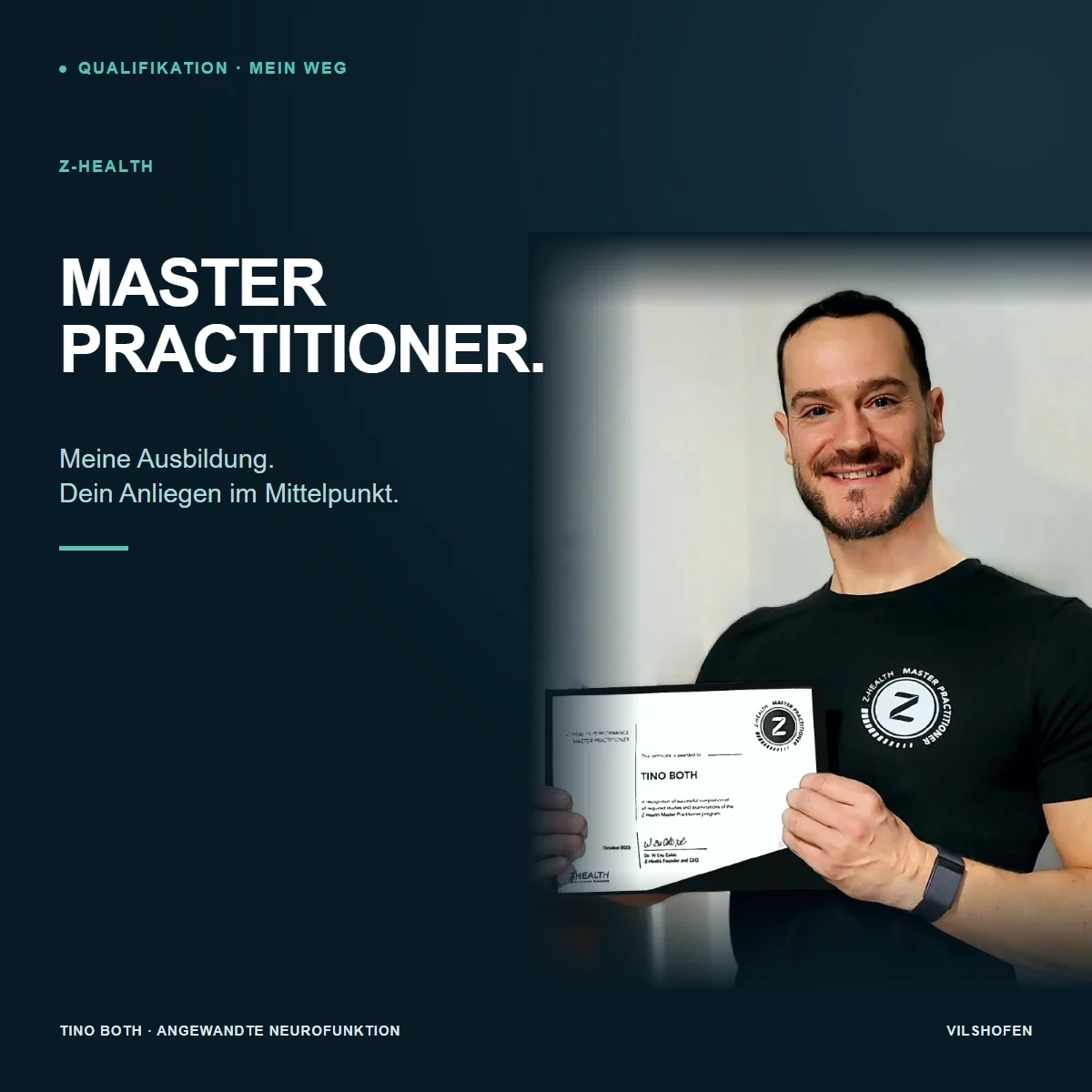
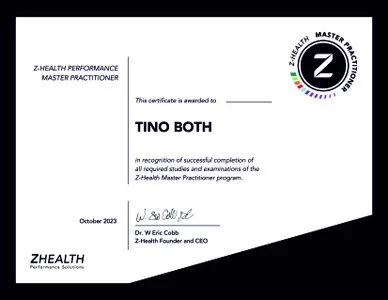
Briefly explained: Z-Health Master Practitioner is an advanced qualification in neurocentric training. I achieved it in 2023. In my work, what matters most is deriving suitable tests, targeted training stimuli and understandable next steps from a specific concern.
Do you train a lot, but a movement remains difficult?In the free initial consultation, describe what does not work as you would like in training or everyday life. We discuss whether a functional assessment in Vilshofen is a sensible next step.
Discuss my concern with Tino →
Discuss my concern with Tino →
What is behind the qualification
With certification as a Z-Health Master Practitioner, I completed an important stage of my training journey. The programme combines regular Z-Health certifications with in-depth practical work and additional examinations. The provider describes a multi-year route with an average total commitment of more than 1,250 hours. You can find the requirements and my entry in the official Z-Health Master Practitioner directory.
Training areas range from movement perception and joint movement through visual and vestibular demands to sporting performance, capacity and understanding pain. These include the R-, I-, S- and T-Phase and advanced 9S modules. What matters to me is not leaving this content as a collection of individual exercises.
Why a larger exercise catalogue alone is not enough
An exercise can make sense yet still not fit the current task. Someone unable to stabilise gaze well while running needs a different question from someone who prepares a change of direction poorly. Even with similar movement, gaze direction, head position or load can make the difference.
The practical question is: what changes for you?I want to know which demand makes a movement difficult and which targeted stimulus it responds to. We define beforehand what to compare: reach, movement flow, effort or stability in a familiar task, for example.
One possible example: turning becomes unsteady with gaze shifts
From a broad observation to a specific training decision1. Starting task: In a safe position, we compare a familiar torso rotation to the right and left. Speed and starting position remain the same.
2. Distinguish the demand: We first consider eye movement and head movement separately. Only then do we assess whether their combination specifically changes the task.
3. Select a suitable stimulus: If gaze control shows a finding, we test a brief, tolerable variation with a clear visual target. Direction, speed and range of movement are deliberately chosen.
4. Repeat the original rotation: If a favourable difference appears, we assess repeatability and transfer. If it does not appear or the variation feels unpleasant, we change the selection.
2. Distinguish the demand: We first consider eye movement and head movement separately. Only then do we assess whether their combination specifically changes the task.
3. Select a suitable stimulus: If gaze control shows a finding, we test a brief, tolerable variation with a clear visual target. Direction, speed and range of movement are deliberately chosen.
4. Repeat the original rotation: If a favourable difference appears, we assess repeatability and transfer. If it does not appear or the variation feels unpleasant, we change the selection.
This is not a random sequence of eye exercises. Your specific movement is the starting point. Assessment helps me decide whether a visual training stimulus is relevant to it at all, and which variation might fit your existing training.
How Z-Health fits into my current work
My overarching approach is called Angewandte Neurofunktion. Z-Health training is an important foundation for the neuroathletic component: observing functions, differentiating demands, trying targeted training stimuli and assessing their effect in comparison. Other neurofunctional procedures supplement this perspective where the specific question fits.
I therefore do not begin with a particular method for its own sake. First, we consider what you want to change, the experiences and findings you bring and what you currently tolerate well. This creates an approach you can understand.
What you should take away from a personal appointment
Ideally, afterwards you understand more precisely under which conditions your task becomes easier or harder. You know which exercise we selected, how to recognise its tolerability and what we will compare next time. For me, the value of training shows itself in these decisions, rather than using as many technical terms as possible.
Related pages and articlesTraining and approachAbout me and my professional journey
Angewandte Neurofunktion: my approach
My Health Coach training at the Medletics Academy
Angewandte Neurofunktion: my approach
My Health Coach training at the Medletics Academy
From knowledge to applicationVOR explained simply – why the vestibulo-ocular reflex keeps gaze stable
Taking a functional look at eye movements
Free initial telephone consultation
Taking a functional look at eye movements
Free initial telephone consultation
Sources and further links
- Z-Health Master Practitioner Program: https://zhealtheducation.com/master-practitioners