

← All articles
Pain & functional symptoms
Jaw clicking with neck pain or headaches: what is connected?
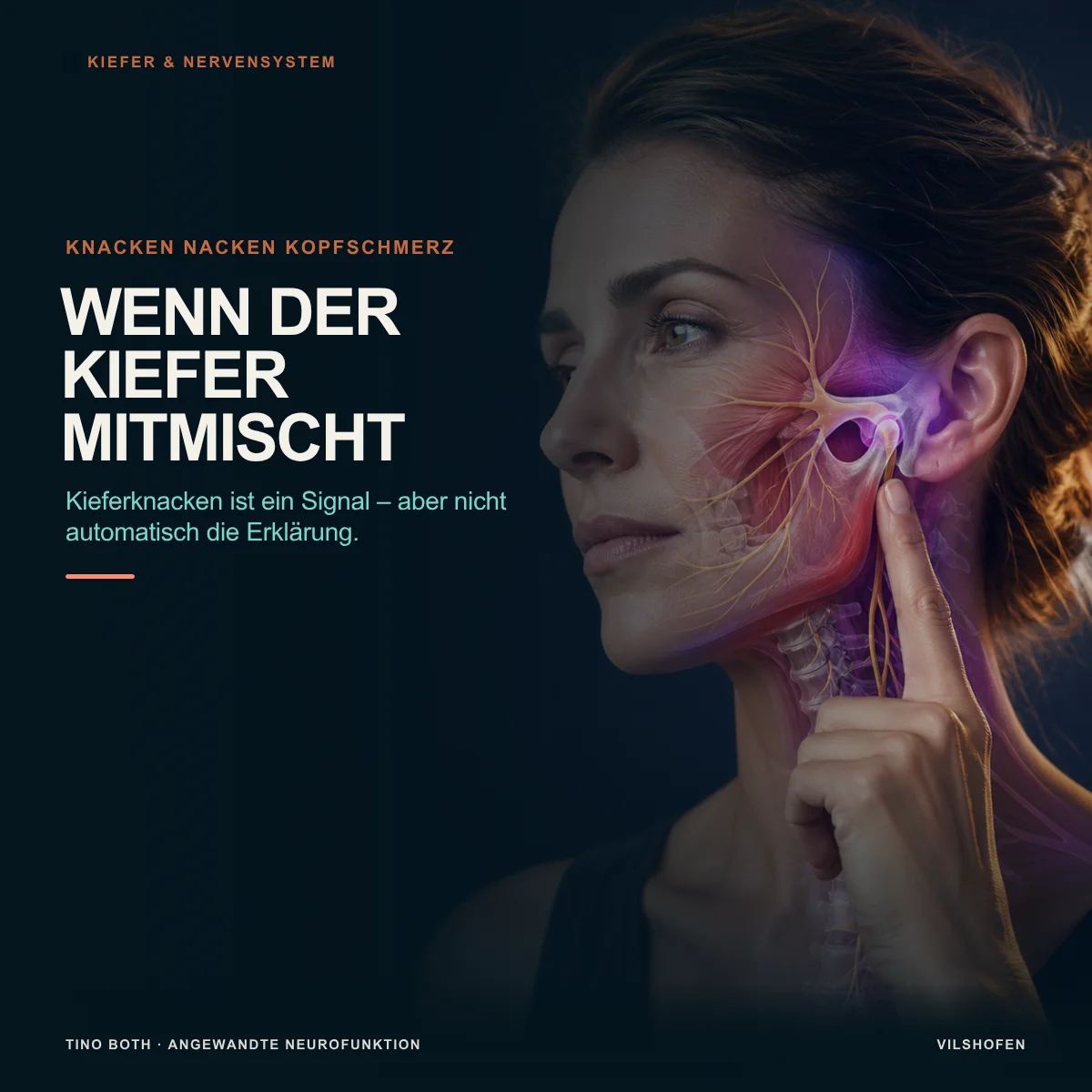
Your jaw clicks when yawning, your neck aches after a long working day and eventually pressure builds in your head. The term TMD soon enters the conversation, and three observations quickly become one supposed cause. Yet a jaw sound alone is often harmless. The question becomes relevant when clicking, pain, restricted movement or head and neck symptoms occur together.
The most important answer firstJaw, neck and head can work closely together functionally. Chewing muscles, jaw joint, trigeminal system and upper cervical spine share movement tasks and neural processing. This does not mean every click automatically represents TMD or causes headaches. What matters is whether a specific jaw function reproducibly changes the personal baseline marker.
Why does the jaw click at all?
A sound may come from the joint without automatically indicating a disorder requiring treatment.
The jaw joint lies immediately in front of the ear. Between the mandibular head and skull is a mobile cartilage disc. As the mouth opens, joint head and disc rotate and glide forwards in a finely coordinated movement. If the disc changes position during this movement and slips back, a distinct click may occur.
These joint sounds are common. As long as the jaw stays pain-free, mobile and capable of loading, they do not automatically need treatment. The pattern becomes more informative if the sound is new, painful, the jaw sometimes locks, opening decreases or movement visibly deviates to one side.
Clicking is not the same as painAn audible click initially describes movement in the joint. Pain, restricted movement, muscle tension and headache are further outputs that should be recorded separately. Their temporal and functional relationship makes jaw clicking relevant for further testing.
How can jaw, neck and head be connected?
The connection arises through muscles as well as shared sensory and neural processing pathways.
Powerful chewing muscles move the lower jaw, while the jaw joint, teeth, periodontal structures, floor of the mouth and mucosa continually supply sensory feedback. Much of this information travels through the trigeminal nerve, the fifth cranial nerve. Its mandibular branch, V3, contains sensory and motor fibres, making it particularly important for chewing, jaw movement and feedback.
At the same time, the head must be stabilised on the cervical spine. Mouth opening changes more than lower-jaw position. The hyoid bone, floor of the mouth, front neck muscles and fine head posture adapt too. Conversely, head movement may alter mechanical conditions for the jaw. The same jaw may therefore feel different in upright sitting than with the head far forwards.
Trigeminal nerve and upper cervical spineSensory input from the face and upper neck converges in closely connected processing areas. This offers a plausible reason why jaw, temple, back-of-head and neck symptoms can occur together or be hard to localise clearly. The connection does not establish an automatic direction: not every headache comes from the jaw, and not every jaw pain begins in the neck.
Clenching, chewing and bite as a loading contextFrequent clenching, night-time grinding, new dental treatment or an unfamiliar mouthguard may change sensory and mechanical context. It matters when the jaw clicks: mornings, eating, concentrating, after stress, in sport or alongside a particular headache pattern.
Does jaw clicking automatically mean TMD?
TMD is an umbrella term for different symptoms, rather than a label inferred from a sound alone.
Temporomandibular disorders comprise various painful or functionally limiting disorders of the jaw joints and chewing muscles. They may include pain when chewing, restricted mouth opening, locking, tender chewing muscles or a painful joint sound. Medical or dental assessment combines history, clinical examination and imaging where needed.
Painless clicking without lost function, by contrast, often does not require treatment. This distinction prevents two errors: dismissing a relevant symptom pattern or prematurely making a harmless sound explain every symptom.
The more useful questionRather than “Is my jaw the cause?”, ask: “Does a clearly defined jaw function reproducibly change my neck, headache marker or an independent test, and can this connection be stabilised specifically?”
Which indications make a functional connection more likely?
Timing, direction and load provide more information than sound alone.
Jaw movement changes the neckHead rotation becomes smaller or more painful with wide mouth opening, a protruded lower jaw or sideways jaw movement. Conversely, jaw opening becomes less steady with the head turned or neck tensed.
Headache follows a jaw patternPain occurs especially after prolonged chewing, clenching or grinding, starts at the temple or cheek, or changes with a particular jaw movement. A notable change after dental treatment or a new mouthguard also belongs in the history.
Movement and sound are one-sidedThe lower jaw visibly deviates when opening, one joint occasionally locks or the chewing muscles feel noticeably different on one side. These side differences suit a retest better than a vague feeling of “tension”.
Stress increases overall loadUnder tension, clenching becomes more frequent, breathing changes and the head and shoulders are held differently. Stress is not automatically the cause, but may intensify several contributing functions at once.
Input, processing, output: a clear model
The jaw provides information; the nervous system determines how movement, tension and pain are organised.
Input arises in the jaw joint, chewing muscles, teeth, floor of the mouth, skin and mucosa, among other places. Information from eyes, balance and cervical spine is added. Processing means comparing these signals in the brainstem, spinal cord and higher networks. Output is what becomes visible or felt: jaw opening, muscle tension, head rotation, pain, balance or a stable or unstable muscle-test result.
This model explains why a local measure sometimes fits well and sometimes does not. If relevant information actually comes from the jaw joint or a chewing muscle, a local stimulus may change the baseline marker. If the crucial connection lies more in the upper cervical spine, an eye function or spatial orientation, the same local measure may remain neutral.
How NeuroFI differentiates jaw, neck and headache
The sequence starts with a stable indicator muscle and ends only once the original question is checked again.
1. Determine a suitable indicator muscleFirst choose a muscle that can be tested painlessly, physiologically and reproducibly. A painful chewing muscle or movement that locks the jaw is not forced as an indicator. Also record the actual problem marker, such as mouth opening, head rotation, temple pressure or a clearly described headache sensation.
2. Introduce the stimulus and examine the connectionThe jaw as reference area is connected to a precise question. Depending on findings, joint and capsule, masseter or temporalis, jaw movement, bite information, trigeminal sensation, floor of the mouth or upper cervical spine may be addressed separately. Open chain, where the lower jaw moves, and closed chain, where the head moves over the stabilised lower jaw, are also distinguished.
3. Test the indicator muscle under the stimulusIf the previously stable muscle stays physiologically strong, this specific connection is initially unremarkable. If it becomes non-physiologically weak under the defined stimulus, a functional disturbance in this particular question appears within NeuroFI. Direction, side and dose are controlled to avoid pursuing a random or physiological change.
4. Find the appropriate solutionPossible solution levels are then tested. A suitable solution reliably removes non-physiological inhibition: stimulus alone — weak; stimulus plus solution — strong. If this pattern repeats, the connection is suitable for integration.
5. Integrate the solutionStimulus and solution are connected neurofunctionally. Afterwards, the original jaw, trigeminal or neck stimulus must leave the indicator muscle strong even without additional solution contact. This change indicates integration of the identified connection within the system.
6. Reassess jaw, neck and headNow return to the actual concern. Does the mouth open more evenly? Does the head turn more freely? Has temple or back-of-head pressure changed? Does improvement remain when the same movement is repeated or combined with an everyday position?
The repeatable NeuroFI logicBefore integration: stimulus → non-physiologically weak. Stimulus plus solution → strong.
After integration: stimulus alone → strong. Immediate change is a functional indication; progress and capacity appear in later retests.
After integration: stimulus alone → strong. Immediate change is a functional indication; progress and capacity appear in later retests.
Three examples of different assessment routes
Similar symptoms may lead to different functional starting points.
Example 1: clicking is audible but functionally neutralThe jaw clicks on opening but stays pain-free and mobile. Neither opening nor joint reference changes the indicator muscle, head rotation or headache marker. The sound is therefore not made the main target. Instead, a clearly notable upper-cervical connection leads to the next assessment route.
Example 2: jaw movement changes neck rotationTurning the head left is restricted. The indicator muscle stays stable during neck movement alone but becomes non-physiologically weak when a particular lower-jaw movement is linked to the left-neck reference. An identified solution stabilises the test, is integrated and then retested against the same combination and head rotation.
Example 3: headache, clenching and trigeminal informationThe headache often starts at the temple and occurs after concentrated screen work alongside clenching. Jaw joint, masseter, bite contact, floor of the mouth, eye function and upper cervical spine are not grouped together indiscriminately, but linked individually to the headache marker. Only the reproducibly notable connection is differentiated further and integrated.
What you can observe yourself
Brief, precise observation is more useful for later testing than constant self-provocation.
Useful questions for seven to ten days• When does the jaw click: first opening, chewing, yawning or speaking?
• Is the sound painless or accompanied by pressure, pulling or locking?
• Does the lower jaw visibly deviate to one side?
• Do headaches or neck pain occur before, during or after the jaw problem?
• Does head rotation change with a relaxed jaw versus firm clenching?
• Is there a connection with sleep, stress, screen work, dental treatment or a mouthguard?
• Is the mouth harder to open in the morning than later?
• Is the sound painless or accompanied by pressure, pulling or locking?
• Does the lower jaw visibly deviate to one side?
• Do headaches or neck pain occur before, during or after the jaw problem?
• Does head rotation change with a relaxed jaw versus firm clenching?
• Is there a connection with sleep, stress, screen work, dental treatment or a mouthguard?
• Is the mouth harder to open in the morning than later?
Deliberate repeated clicking or forceful clenching rarely provides better information and may irritate the area unnecessarily. One or two controlled observations from a clear starting position are usually enough.
When jaw pain or headaches need medical assessment
New severe symptoms, locking and associated neurological signs change the priority.
Please seek prompt or urgent assessmentAfter an accident or blow to jaw and head, with marked swelling, fever, dental or facial inflammation, persistent jaw locking, rapidly decreasing mouth opening or a newly changed bite, seek medical or dental examination. A sudden very severe headache, new paralysis, numbness, speech or vision disturbance, altered consciousness, or headache with fever and marked neck stiffness requires urgent medical assessment.
A functional view of jaw, neck and headache in Vilshofen
The focus is the individual connection, its NeuroFI integration and direct retest.
In my practice in Vilshofen an der Donau, I do not start by assuming a clicking jaw automatically causes neck pain or headaches. First, we record your specific problem and choose a stable indicator muscle. The jaw joint, chewing muscles, trigeminal information, upper cervical spine and, if the pattern suggests it, eye or balance functions are then deliberately distinguished from one another.
A reproducibly notable connection is neurofunctionally integrated as well as observed. Afterwards, reassess the same stimulus, indicator muscle and original output. Additional exercises are included where movement confidence, capacity or everyday transfer need further development.
Does this symptom pattern fit my approach?In a free initial telephone consultation we can clarify when jaw clicking, neck pain or headaches occur, what has been examined and whether a safe functional assessment approach is possible.
Common questions about jaw clicking, neck pain and headache
Brief answers to frequent questions about a clicking jaw.
Is jaw clicking dangerous?Painless clicking without locking or restricted movement is often harmless. New painful clicking, locking or much smaller mouth opening should be examined.
Can jaw clicking trigger headaches?Jaw symptoms and primary headaches occur together more frequently than average. This suggests a possible connection, but not the same direction for everyone. History, medical assessment and reproducible functional testing matter.
Can the neck affect the jaw?Yes. Head posture and neck movement change the mechanical and sensory task of lower jaw, hyoid bone and chewing muscles. Defined movements and retests can assess whether this connection is relevant to symptoms.
Must a splint always be worn for jaw clicking?No. A painless sound alone often needs no treatment. For pain, clenching or a diagnosed jaw-function disorder, appropriate care should be agreed with a dentist or specialist jaw assessment service.
How is the jaw tested in NeuroFI?A stable indicator muscle is connected to a precise jaw, muscle, joint, trigeminal or neck question. A suitable solution must repeatedly remove non-physiological inhibition. After integration, the same stimulus and actual jaw, neck or head function are reassessed.
Conclusion: the connection matters more than the clicking
A good functional assessment does not turn simultaneous symptoms into a premature one-way explanation.
Jaw clicking may be insignificant or become part of a wider symptom pattern. Jaw joint, chewing muscles, trigeminal system and upper cervical spine are closely connected enough to influence each other. Each person nevertheless differs: local joint input matters for one person, jaw motor control, neck or an entirely different function for another.
NeuroFI therefore follows a clear sequence of indicator muscle, precise stimulus, suitable solution, integration and direct retest. Rather than guessing from the symptom, it checks which connection responds notably in the individual case and whether the original output changes afterwards.
Related pages and further topics
Explore connections between pain, jaw, upper cervical spine and Neurofunctional Integration.
Focus pages and contactPain & functional symptoms
Method — Applied Neurofunction and Neurofunctional Integration
Free initial telephone consultation
Method — Applied Neurofunction and Neurofunctional Integration
Free initial telephone consultation
Explore head and neck connections furtherNeck and migraine — cause, consequence or a shared nervous system?
Understanding migraine — why it is much more than headache
Understanding migraine — why it is much more than headache
Sources and further reading
Professional background on jaw sounds, TMD, headache and connections with the neck region.
National Institute of Dental and Craniofacial Research: Temporomandibular Disorders — symptoms, diagnosis and treatment
Schiffman E et al.: Diagnostic Criteria for Temporomandibular Disorders (DC/TMD)
Dibello V et al.: Temporomandibular Disorders as Contributors to Primary Headaches – Systematic Review
Bizzarri P et al.: Temporomandibular Disorders in Migraine and Tension-Type Headache – Systematic Review and Meta-Analysis
Bizzarri P et al.: Temporomandibular Disorders and Orofacial Outcomes in Neck Pain and Cervicogenic Headache – Systematic Review
```