

← All articles
Nervous system & health
Lena’s work: when trauma, body and nervous system belong together
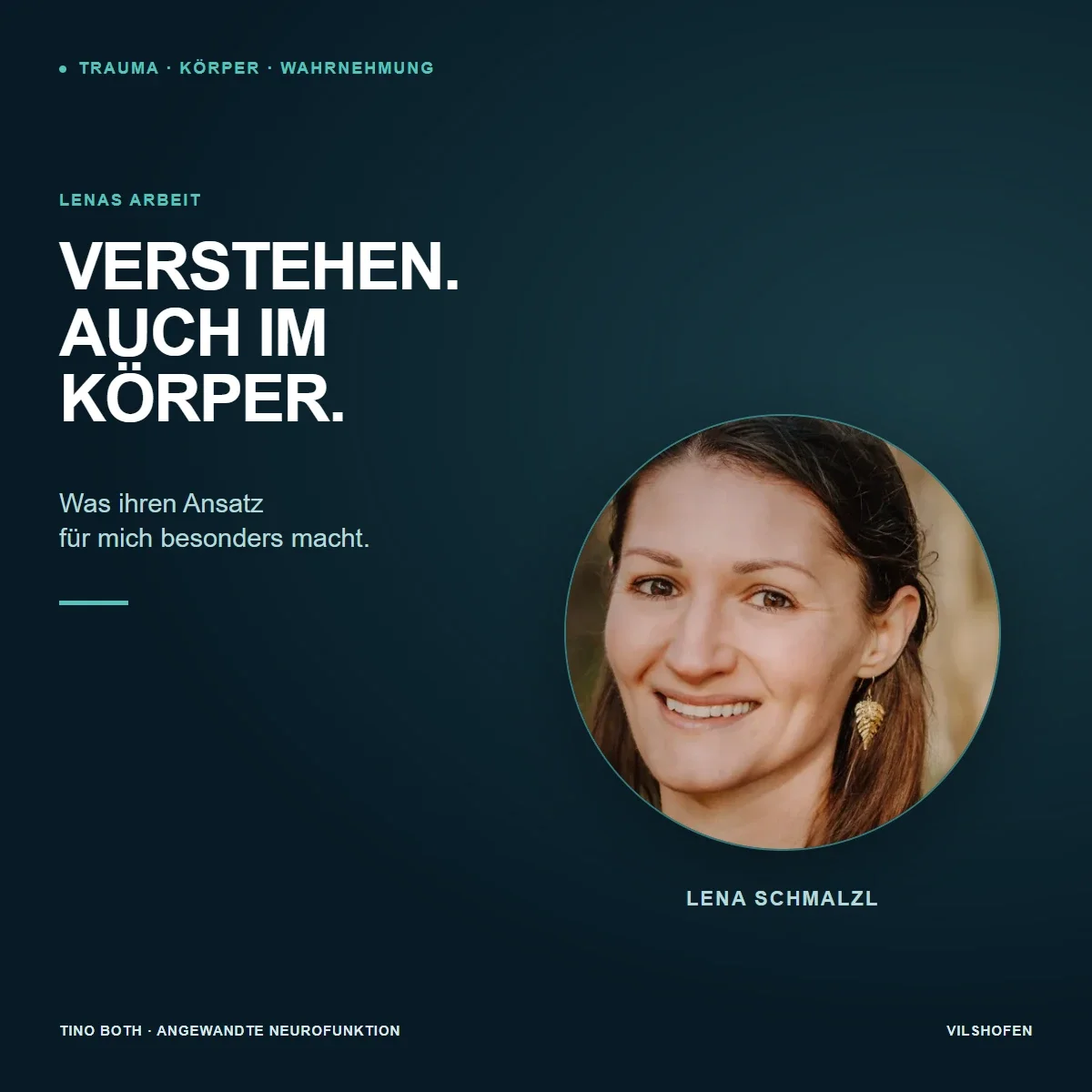
Briefly explained: Body-oriented trauma work includes bodily perception, tension and possible actions alongside thoughts and feelings. Lena Schmalzl supports people in Vilshofen as a practitioner with a German Heilpraktiker licence limited to psychotherapy. Here, I describe what I appreciate about her approach and where it complements my perspective on the nervous system.
Would you like to get to know Lena’s offer personally?If your concern involves distressing experiences, inner tension or connection with your own body, Lena provides information about her support and the initial conversation.
Lena’s appointments and contact details →
Lena’s appointments and contact details →
‘I understand it – but my body still reacts’
You may know that today’s situation differs from the past. You still hold your breath, withdraw or only notice afterwards how tense you were. These experiences can be unsettling: the thought is clear, yet the bodily response does not feel freely chosen.
What interests me in Lena’s work is that she takes this gap seriously. Understanding remains valuable. It may also be important to notice what is happening in the body, which boundary has been reached and what provides support in the moment. Not every response needs to change immediately. First, it needs a setting in which it is allowed to be noticed.
Bodily responses have more than one explanationTension, exhaustion or restlessness do not automatically mean trauma. Life circumstances, illnesses, sleep and other demands may also contribute. Lena’s offer focuses on personal experience and the individual history, rather than a premature interpretation of isolated symptoms.
What ‘body-oriented’ can mean in a conversation
A conversation can explore what happened as well as how telling the story feels right now: does breathing become tighter? Can you still feel the chair? Would you like more distance, a pause or another perspective? The body is considered part of your present experience, rather than read as a piece of evidence.
A possible example: a boundary becomes noticeable earlierSomeone notices only after a demanding conversation that it had already been too much for some time. In support sessions, the earlier signals might first be explored: changed breathing, a tighter feeling or a wish to turn away. The next step is to find an appropriate action – such as pausing, choosing distance or stating a boundary. Pace and direction are agreed together; nothing needs to be forced.
For me, the interesting part is not the search for a spectacular response. It is the possibility of noticing a small change at all and connecting it with a decision of your own. More choice at the right moment can become very practical in everyday life.
Which approaches Lena brings
Lena’s professional background includes a German Heilpraktiker licence limited to psychotherapy, further training in Neurosystemische Integration® and TRIMB® – an approach that works with imagery, movement and breathing, among other things. She also has further training in Bodynamic. This concerns relationships between development, connection with others and bodily patterns of action. She describes her current training status on her About me page.
What matters to me is how this becomes attentive support. A method’s name does not yet answer what someone needs at that moment. An exercise one person finds pleasant may feel unsuitable for another. Feedback, dosing and the option to stop at any time therefore belong in a respectful approach.
Shared themes, different approaches
Lena and I share an interest in how perception, bodily responses and experience work together. In my work with Angewandte Neurofunktion, I also work with trauma-related themes, distressing experiences and mental response patterns. My work is therefore not limited to movement, balance or visual functions. Mental systems also include memories, expectations and the question of how the body responds to a particular thought or emotional relationship.
For example, I am interested in what changes when a particular situation is present in the mind. Which bodily or autonomic response becomes noticeable? In my method, I include a clearly defined mental context in the functional assessment, look for a suitable integration stimulus and then reassess the response with the same reference. The aim is to explore whether the way a memory is handled and the associated bodily response can change, rather than to erase the memory. We agree the pace and scope so that the work remains manageable for the person.
Lena brings her psychotherapeutic framework and her body-oriented, trauma-sensitive approaches. I approach these themes through functional assessment, work with mental systems and neurofunctional integration. This is therefore about different professional approaches with areas of overlap, rather than a division of ‘trauma with Lena, movement with me’. We clarify personally which setting suits a concern; our respective qualifications and roles remain clear.
Related terms, different approachesNeurosystemische Integration® in Lena’s work and neurofunctional integration as part of my method are not the same procedure. A similar name makes neither the way of working nor the offer interchangeable. What matters is the concern you bring and which professional support suits it.
What I value in this connection is that physical and mental themes need not be separated artificially. At the same time, tension or a notable test response cannot simply reveal a particular life story. We begin with the specific concern and the person’s experience, rather than a ready-made explanation.
Frequently asked questions about body-oriented trauma work
Do I have to talk about everything immediately?In the first contact, you can initially clarify what your concern is and which setting you need. A good initial conversation leaves room for questions, boundaries and uncertainty. You discuss what the further work looks like directly with Lena.
Is this simply relaxation training?No. Calm breathing or comfortable contact with the ground can play a role. Support may also concern self-awareness, setting boundaries and handling distressing experiences. The goal is not to be as calm as possible in every situation.
What matters when choosing support?Alongside suitable professional qualifications, the way someone works with you matters to me: are the next steps explained clearly? Are your boundaries and feedback taken seriously? Can you pause and help determine the pace? A method’s name alone does not answer these questions. Use the first conversation to discuss your concern, the setting and open questions.
Why I would like to introduce Lena’s work to you
I value the idea of not reducing a person to their visible response. Someone is not simply ‘too sensitive’ because a situation triggers a lot. Equally, not every bodily response needs a major story. Listening, making finer distinctions and finding a suitable pace: this is where I see a valuable connection between our different areas of work.
Find out whether Lena’s support suits youOn her website, Lena introduces her work, the process and the practical arrangements. You can take your time to learn about it there and get in touch with your concern.
Visit Lena Schmalzl in Vilshofen →
Visit Lena Schmalzl in Vilshofen →
Related pages and articles
Lena and our shared insightsLena’s website: Traumakörperundnatur
Adult education talks on the nervous system, trauma and pain
Adult education talks on the nervous system, trauma and pain
My additional functional perspectiveThe autonomic nervous system explained clearly
When relaxation alone does not help you progress
Initial consultation about my work with Angewandte Neurofunktion
When relaxation alone does not help you progress
Initial consultation about my work with Angewandte Neurofunktion
Sources and further links
- Lena Schmalzl’s website: https://www.xn--traumakrperundnatur-w6b.de/
- About Lena Schmalzl: https://www.xn--traumakrperundnatur-w6b.de/ueber-mich/
- Lena Schmalzl: services: https://www.xn--traumakrperundnatur-w6b.de/meine-leistungen/
- Lena Schmalzl’s Instagram account: https://www.instagram.com/__juliwind__/