

← All articles
Pain & functional symptoms
A constantly tense neck despite massage: what deserves a closer look?
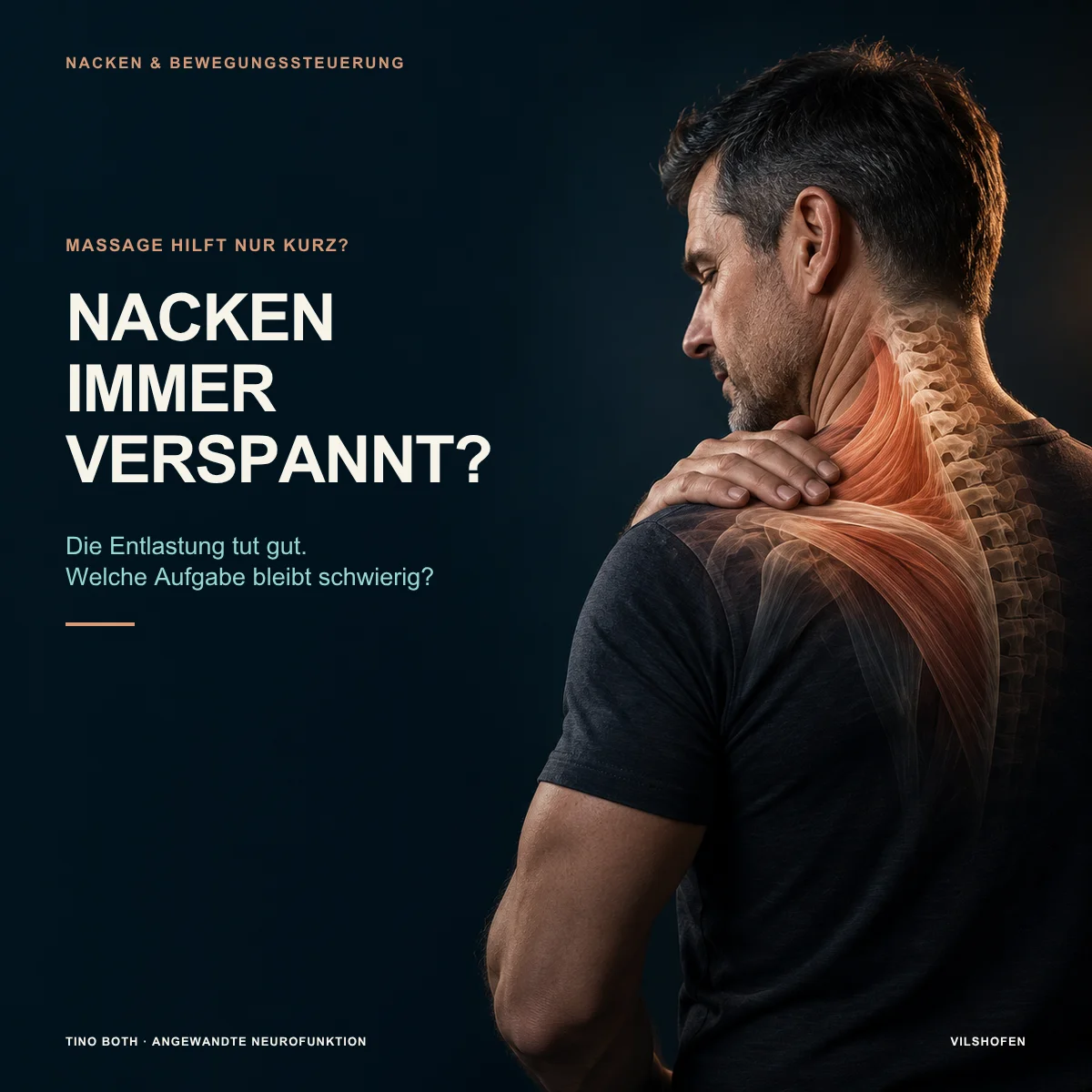
After the massage, you can turn your head more easily again. On the next working day, your neck feels tight once more. That is frustrating, but it does not make the temporary relief worthless. It simply has not yet answered the question of the conditions under which symptoms keep returning.
Why does the neck tighten again despite massage?A massage can feel pleasant while everyday demands barely change. Recurring symptoms may relate to the duration of demands, movement variety, sleep, stress and physical factors. Depending on the situation, it can also be worth examining visual tasks and head movements separately. Recurrence alone does not identify a single cause.
Understand the task as well as the area
“My neck is always tense” sounds straightforward initially. During discussion, however, a much more precise story often emerges: symptoms at the second monitor, when reversing, after prolonged reading or at the end of a period of focused work. These situations do not demand the same things.
During screen work, you hold your head, control your eyes and process information over time. Looking over your shoulder adds larger head and trunk movements. For reading, near vision matters more. A useful assessment therefore begins with a specific task that can be compared again later.
The current guideline on non-specific neck pain emphasises activation and, for chronic symptoms, exercise therapy among other measures. For everyday life, this means that alongside short-term relief, an approach should develop that helps you manage demands better again.
Which differences provide useful indications?
Duration and variationDoes the problem develop after staying still for a long time, or immediately with a particular movement? Does changing position feel more comfortable? A posture need not be perfect to be tolerable. Varying demands is often more useful than holding yourself stiffly “correct” all day.
Head and eyesA sideways glance can involve mainly the eyes, mainly the head or both. These versions can be distinguished. That makes a possible connection testable without explaining every neck pain as an eye problem.
Movement and capacityRange of movement, strength endurance and how movement is distributed across the neck, chest and shoulder girdle are further elements. An improved feeling during movement should also show in the task that actually causes you difficulty.
How the eyes and neck may be connected
Eyes and head work together for orientation. For example, you can look at an object in the room and move your head without losing sight of it. In another task, eyes and head move together towards a new target. This cooperation can be broken into component tasks during functional assessment.
It is interesting, for example, whether a visual task is easy with the head in a neutral position but becomes much more tiring in a particular neck position. Or whether you move your whole upper body when turning to the side screen. These observations help select further assessments. My article on gaze stability in daily life explains the visual background.
What a NeuroFI assessment can involve
Neurofunctional Integration uses its own testing system. It differs from an ordinary strength test of the painful neck. Your concern remains the starting point, for example an uncomfortable look over your shoulder. The following sequence is a simplified example of the NeuroFI working model, rather than a report on a particular client.
1. Find a suitable indicator muscleI choose a muscle that responds reliably under the test conditions and can be tested without pain. With neck symptoms, this need not be a neck muscle. The indicator muscle serves as feedback within the test procedure.
2. Examine a specific connectionA defined combination of contact or stimuli establishes the question in the NeuroFI model. Depending on the findings, for example, the neck area may be considered in relation to a sensory function. Selection follows the particular situation, rather than a blanket list of every body system.
3. Check the muscle response under the stimulusIf the previously stable response changes to notable inhibition, this connection is investigated further within the method. What matters is that the response can be repeatedly demonstrated under comparable conditions.
4. Look for a normalising combinationWe then check which additional stimulus changes the unusual response. A comparison is part of this: the stimulus alone, then together with the identified combination. Only an understandable difference makes this combination relevant to the next stages.
5. Integrate and test againThe identified combination is integrated according to the NeuroFI procedure. We then check whether the original stimulus allows a stable muscle response without the additional solution. The method calls this step integration.
6. Return to the original look over the shoulderAt the end, more than the muscle test matters. We compare the specific head movement again: range, effort and symptoms. Progress in daily life also counts. The NeuroFI response is used as a functional indication, rather than medical proof of tissue damage or its cause.
What you can observe yourself in the meantime
Note a typical situation over a few days rather than monitoring every sensation. Which viewing angle or activity precedes it? How long can you continue? Does switching task help? If possible, bring a description of your workplace and relevant findings to the appointment.
Brief changes of movement in daily life are often more practical than a large evening programme you rarely follow. Repeated forceful stretching into pain or tingling is unsuitable as a self-test. A useful exercise should fit your current capacity.
When is medical assessment important?
After an accident, with increasing weakness, persistent numbness, fever or unusually severe pain, the neck should be medically examined. Sudden neurological deficits are an emergency. Longer-standing or clearly changed symptoms should also be assessed.
Common questions
Is massage pointless for neck tension?No. Pleasant relief can be valuable. If symptoms recur, an active approach tailored to your everyday situation is also worth considering.
Is my posture always responsible?No. Posture is only part of the context. Duration, changes of movement, capacity and other personal factors matter too.
Does NeuroFI have to test the painful neck?Not necessarily. A suitable indicator muscle that can be tested without pain may be elsewhere in the body. Neck movement nevertheless remains an important comparison task.
Can something change during the appointment?An immediate difference can occur. It helps guide further selection. Whether the change proves useful in daily life then needs to be checked.
The next step: consider your specific neck situationIf you would like to know what my approach using Neurofunctional Integration involves, you can find further insights there. For a concern in Vilshofen, Passau or the surrounding area, we can discuss whether a functional assessment is a sensible next step in a free initial telephone consultation.
Sources and further reading
Clinical Practice Guideline: Nonspecific Neck Pain (2025). Recommendations for managing non-specific neck pain. The NeuroFI sequence described comes from the methodology of Neurolog Akademie and is not addressed by this guideline.