

← All articles
Courses
Neurocentric training at KANZLSPERGER: a clear thread and plenty of light-bulb moments
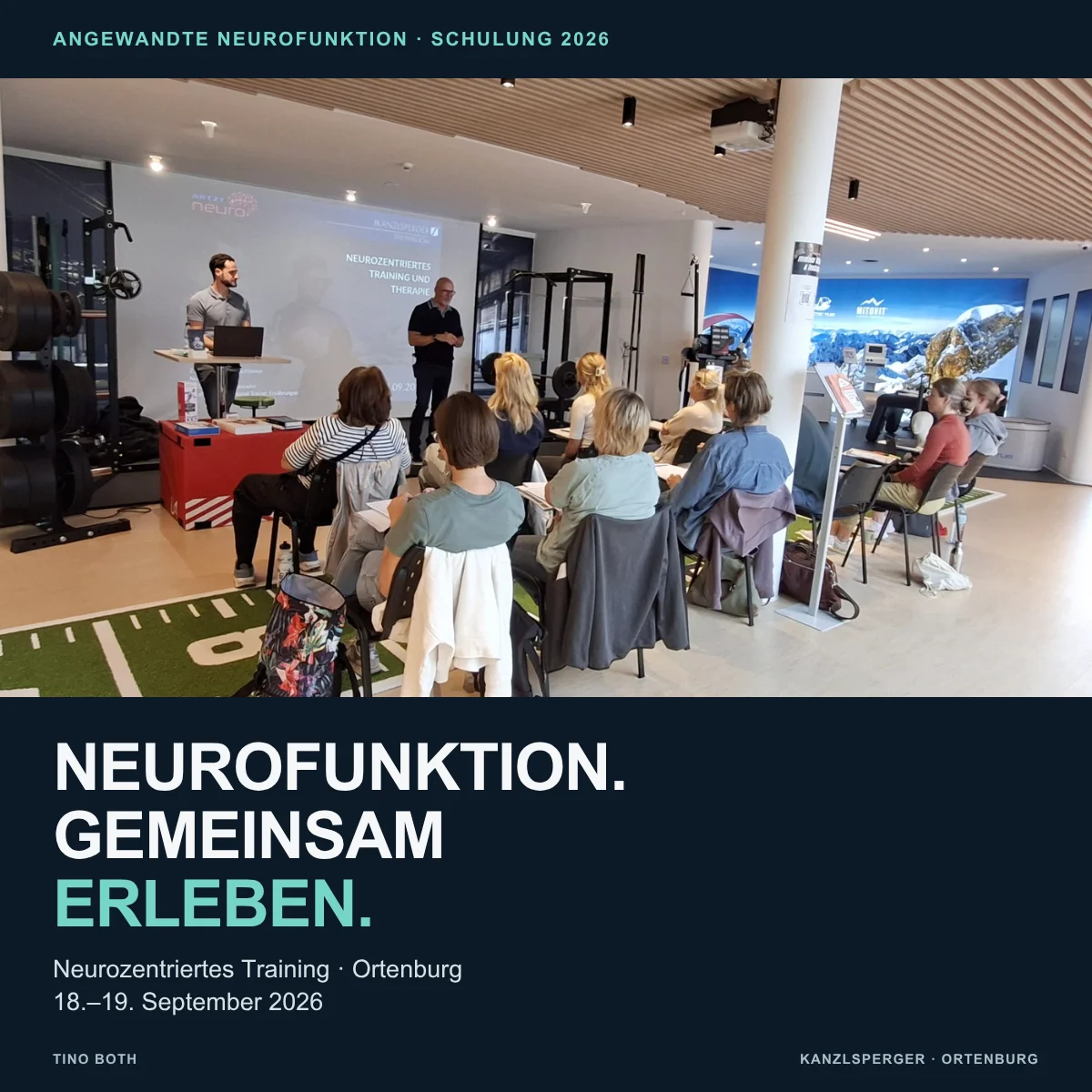
Train auditory orientation first, and afterwards a peripheral perception task becomes noticeably easier. Moments like these stay with you. At my second workshop in the KANZLSPERGER showroom in Ortenburg on 18 and 19 September 2026, we connected this curiosity with an understandable process: how do I move from an observation to a targeted intervention, and how do I check its immediate effect?
Eleven participants from physiotherapy and occupational therapy attended. Over a day and a half, we explored Applied Neurofunction, discussed connections and tried them in practice. Following the first workshop in September 2025 I was able to teach here for the second time, which pleased me very much.
The workshop at a glanceTopic: Neurocentric training and therapy
Dates: 18 and 19 September 2026 · 1.5 days
Venue: KANZLSPERGER showroom, Kamm 13, Ortenburg
Participants: 11 physiotherapy and occupational therapy professionals
Presenter: Tino Both, certified Z-Health Master Practitioner
Dates: 18 and 19 September 2026 · 1.5 days
Venue: KANZLSPERGER showroom, Kamm 13, Ortenburg
Participants: 11 physiotherapy and occupational therapy professionals
Presenter: Tino Both, certified Z-Health Master Practitioner
The focus: from assessment to an appropriate intervention
Professionals working in therapy know many exercises and methods. The crucial everyday question is often: which of these suits this person and their specific task now? This is exactly where the workshop aimed to offer guidance.
My aim was a clear thread connecting two directions. Assessments, meaning structured functional checks, can provide indications for choosing an intervention. Conversely, a familiar exercise or method can be checked for its immediate effect using neurocentric tests. The approach is intended to complement existing professional knowledge and make decisions more understandable.
From the concern to a testable trialChoose a specific target action → assess locally and add the broader picture → choose a suitable approach → record baseline values → introduce a targeted stimulus → repeat the same tests and interpret the result.
More than the most conspicuous individual test matters. Mobility, balance or coordination may respond differently. If one task improves while another becomes harder, both belong in the assessment. A neutral result also helps decide whether to change a variation or choose another approach.
What we connected during the workshop
The course's four overview pages form a map: understand movement, find a starting point, consider the systems involved and develop movement from there. They help connect the many individual topics.
Consider movement and perception togetherWe explored how sensory information, experiences and expectations help shape movement control. This included anticipatory stabilisation, ongoing feedback and how pain and protective responses can be incorporated into the assessment.
Assess vision, balance and body awareness in practiceGaze control, peripheral perception, orientation during head movements and recognising joint positions were important topics. Coordination and auditory orientation were also included. In each case, the key questions were: what stands out, which approach do we choose and how do we compare afterwards?
Develop useful practice from a changeOther content included nerve-related movement approaches, movement couplings, muscle tension, and tasks and feedback that can support practice. An exercise can, for example, be changed through tempo, range of motion, starting position or additional demands. The next step should suit the observed response and the person.
A light-bulb moment: hearing as an approach to visual orientation
One practical demonstration of peripheral perception particularly stayed with me. Initially, one person could not identify the number of fingers shown in the upper left area. We then worked on auditory orientation. When retested, recognition in this area was noticeably better.
The reasoning: for spatial orientation, the nervous system works with information from different senses. Vision and hearing can therefore also be considered in their interaction. In the workshop, we used this neuroanatomical perspective to choose a suitable trial, rather than offering only further visual tasks.
This was an immediate observation within this exercise. Whether and how such a change lasts in everyday life would be the next question. For me, what made this moment especially valuable was that an initially unfamiliar connection became understandable in practice.
The question behind the insightWhen a task is difficult, do we only need to practise that exact task more often, or is another contributing function also worth considering?
Continuing to learn is part of my role too
For this second workshop, I wanted to make the connecting thread even clearer. At the same time, I want to convey as much as possible of what this field offers. I want to provide an overview, open up connections and inspire people to look more closely.
Reconciling these two aims is not always easy with such a complex topic. How much overview helps? Where is more repetition, another example or more practical time needed? I received valuable feedback on these questions to take into a future workshop.
My aim remains to make substantial knowledge accessible. My task is to organise it so that, alongside the exciting possibilities, participants have a clear starting point for their own working day.
Thank you for the questions, participation and exchange
A big thank you goes to Anita for supporting and organising the workshop, to KANZLSPERGER and ARTZT for making it possible and supporting it, and to all participants for their questions, interested exploration and exchange.
I am particularly pleased that the moments of insight came through: experiencing how quickly a function can change with an appropriate stimulus, and taking new questions from that into one's own practice. This combination of curiosity and a testable approach is exactly what I want to convey in my workshops.
Explore neurocentric approaches with your teamDo you work in a practice or organisation and want to explore these connections practically with your team? Please get in touch. We can discuss which topics and workshop format fit your working day. You can find contact options here.