← All articles
Professional development and events
Receptor-based therapy according to Daniel Müller – what I took from the seminar for my work
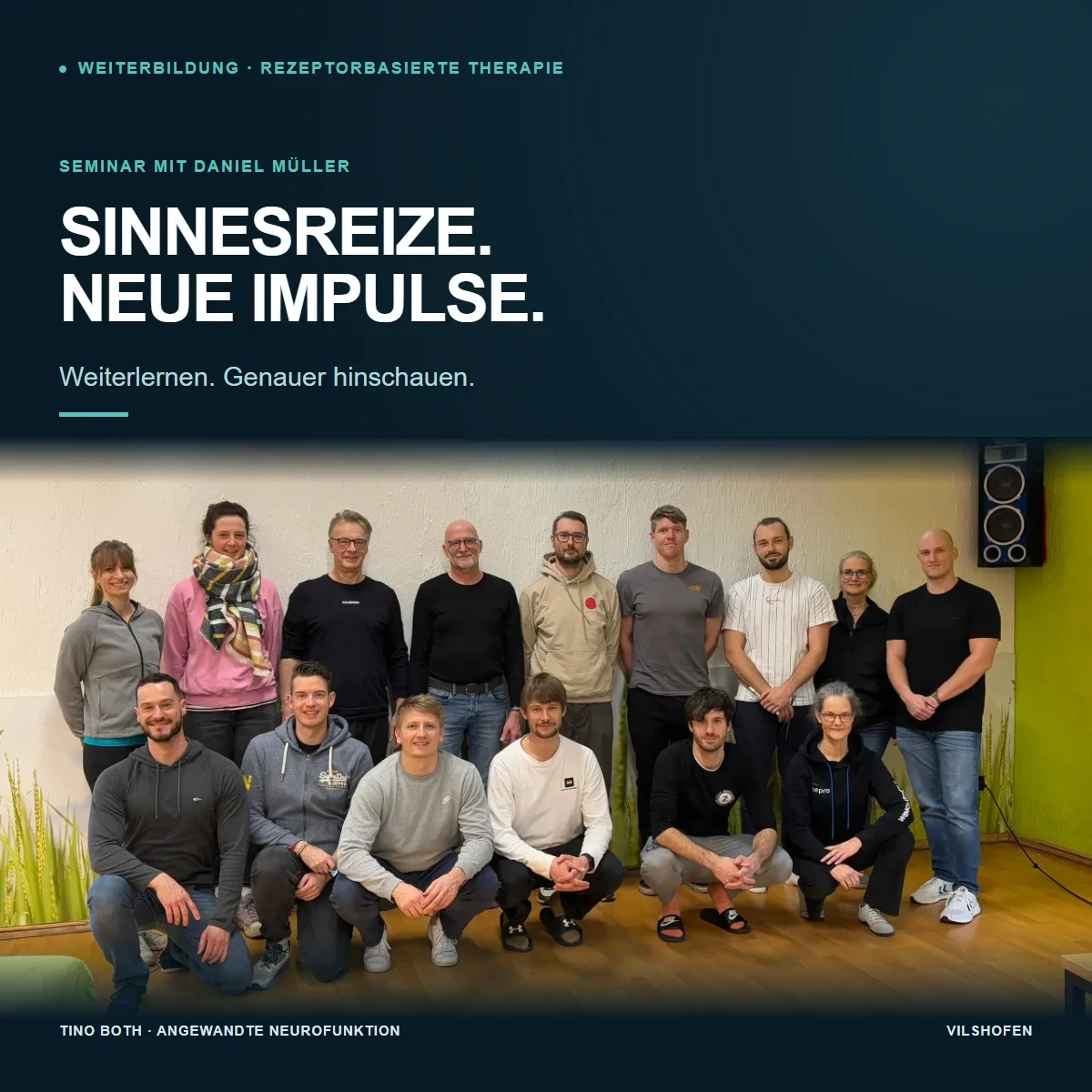
Briefly explained: Receptor-based work asks how particular sensory stimuli change a movement or test response. The seminar ‘Receptor-based therapy – Level 1’ with Daniel Müller was an important prompt for me to examine these differences more closely. Today, this perspective on sensory information is one component of my Angewandte Neurofunktion.
Does a movement remain difficult even though you have already tried a lot?Perhaps it is worth considering not just the movement itself, but also the perceptual conditions involved more closely. In the free initial consultation, we discuss your concern, previous assessment and whether an individual functional perspective in Vilshofen fits it.
Discuss your movement or perception question with me →
Discuss your movement or perception question with me →
What interested me about the seminar
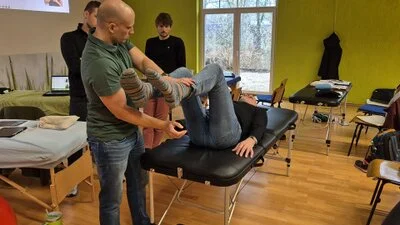
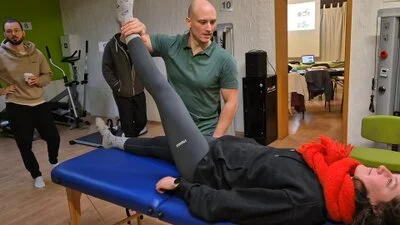
Some professional development provides new exercises. Other courses sharpen the questions with which you approach a task. At the seminar with Daniel Müller at the Kensho Sport and Health Centre, I was particularly interested in how targeted sensory stimuli were connected with muscle and functional tests.
The first training section I attended mainly concerned the proprioceptive system: information about body position and movement. Practical approaches included palpation, muscle tests, functional tests and so-called receptor challenges. These mean deliberately applied stimuli whose influence on a defined response is compared.
Daniel Müller brought together experience from different functional and neurocentric approaches. The number of methods was not my priority. What interested me was the precision of the question: what changes when I add this exact condition?
Receptors: information accompanying movement
Receptors respond to particular stimuli. These include touch and temperature at the skin or changes in muscle length and tension, for example. This information helps control movement and perceive your own body position.
Muscle strength is only one question among severalAn arm may have enough strength for a task yet feel unsteady or held back during a particular movement. We can then additionally consider whether different contact, a different joint position or a clear visual reference changes the task.
This does not replace questions about tissue and tolerance for load. It adds the conditions under which movement works.
This does not replace questions about tissue and tolerance for load. It adds the conditions under which movement works.
Terms such as ‘receptor disturbance’ or ‘sensory disturbance’ are used as explanatory models in such methods. My immediately observable basis is initially more specific: a particular stimulus condition changes a muscle response, movement or sensation. From this, I develop the next assessment decision.
One possible example: compare touch and movement separately
Suppose a movement that has been medically assessed feels unsteady within a particular range. I first record the starting task. If an indicator muscle is also used, it must be reliably testable without pain; it does not have to be in the affected area.
First distinguish, then assess further1. Without an additional stimulus: How does the task work, and how stable is the selected muscle response?
2. With a defined touch stimulus: Do position and test conditions remain the same while only the contact changes?
3. With a different stimulus condition: Does the direction of a gentle skin stimulus make a difference? Does an adjacent contact point remain unremarkable? Does a joint movement respond differently from touch alone?
4. Repeat the difference: I only pursue this route further once the response remains understandable under comparable conditions.
2. With a defined touch stimulus: Do position and test conditions remain the same while only the contact changes?
3. With a different stimulus condition: Does the direction of a gentle skin stimulus make a difference? Does an adjacent contact point remain unremarkable? Does a joint movement respond differently from touch alone?
4. Repeat the difference: I only pursue this route further once the response remains understandable under comparable conditions.
The result need not be ‘this skin area is the cause’. A narrower statement may initially be more helpful: the task changes under one touch condition, but not another. This differentiation prevents every observation immediately disappearing into the broad term ‘tension’.
From an unusual response to a suitable additionIn an additional integration assessment, I look for an input under which the previously unusual muscle response no longer occurs. The original stimulus alone is compared with the same stimulus together with the possible solution. If the difference repeatedly fits, integration follows.
Afterwards, I reassess the original stimulus without the additional solution contact. We then return to your movement. A stable test response and a movement more helpful in everyday life are related, but need to be assessed separately.
Afterwards, I reassess the original stimulus without the additional solution contact. We then return to your movement. A stable test response and a movement more helpful in everyday life are related, but need to be assessed separately.
What I took away for my current work
The training sharpened my perspective on stimulus selection and dose. It makes a difference whether a skin region is touched, a joint is moved or a visual demand is changed. Even if the same movement feels different in all three situations, they do not automatically lead to the same next steps.
It also became important to me not to stop at the first location showing a finding. A local stimulus can influence a comparison, but the helpful addition that follows may address another function. Which connection is pursued should emerge from the test sequence, rather than already be fixed beforehand.
Input → processing → outputThe sensory information is the input. Processing connects it with the current task and other information. Output is what we observe: movement, holding ability or coordination, for example. I consider these levels together without inferring the entire mechanism from a single response.
Receptor-based therapy and my Angewandte Neurofunktion
‘Receptor-based therapy’ here refers to Daniel Müller’s seminar approach. The Level 1 I attended was one component of my professional development. My current work is not equivalent to this single training section.
In Applied Neurofunction, depending on the question, I also consider eye movements, balance, breathing, motor tasks and autonomic relationships. I do not routinely seek as many individual receptors showing findings as possible. I am interested in which function or connection provides useful further clues for the specific task.
Sometimes this leads to a suitable training stimulus, sometimes to an additional integration assessment. For me, the method’s depth lies in selecting these routes deliberately and comparing their results again with the original concern.
What you should be able to understand in an appointment
You do not need to know receptor names. You should be able to recognise which task we recorded initially, which condition changed and why a particular assessment follows. If a variation improves nothing or becomes more unpleasant, that is a reason to adjust, not automatically to do more of it.
With symptoms, previous medical findings and ongoing care belong in this conversation. A functional addition should connect with your situation. New or increasing symptoms should first receive suitable medical assessment.
Frequently asked questions
What does ‘receptor-based’ mean?The perspective focuses on sensory stimuli and how a defined response changes under these conditions. Different stimuli are not categorically treated as the same demand.
Have you completed Daniel Müller’s entire training?This article concerns the first section I attended, ‘Receptor-based therapy – Level 1’. It describes one component of my professional development.
Is your current method the same as receptor-based therapy?No. My Angewandte Neurofunktion brings together various courses and suitable functional assessment routes. The precise choice follows the task and observed responses.
Does the indicator muscle need to be at the painful spot?No. For this additional testing, I choose a reliably testable, pain-free muscle. The affected movement is additionally considered as its own starting and final comparison.
Training as a prompt, not a ready-made answer to every problem
My most important thought from this training remains the precise question about the stimulus: what exactly changes the function, under which conditions and with what practical significance? This perspective helps me avoid reducing a concern too quickly to a single muscle or problem area.
Would you like to examine your specific difficulty more closely?In the free initial telephone consultation, we can clarify whether personal functional testing in Vilshofen fits your concern. The starting point is what restricts everyday life, rather than a list of tests you need to know beforehand.
Arrange an initial consultation about Angewandte Neurofunktion →
Arrange an initial consultation about Angewandte Neurofunktion →
Related pages and articles
Explore functional relationships furtherNeurofunctional integration for complex symptoms: how I work
Understanding functional symptoms – when symptoms are real but not clearly explained
Understanding functional symptoms – when symptoms are real but not clearly explained
From the test to the specific taskFunctionally assessing eye movements – why an indicator muscle shows more than observation alone
VOR explained simply – why the vestibulo-ocular reflex keeps gaze stable
VOR explained simply – why the vestibulo-ocular reflex keeps gaze stable
My approach and your next stepAngewandte Neurofunktion: how I work
My professional journey and areas of focus
Free initial telephone consultation
My professional journey and areas of focus
Free initial telephone consultation