

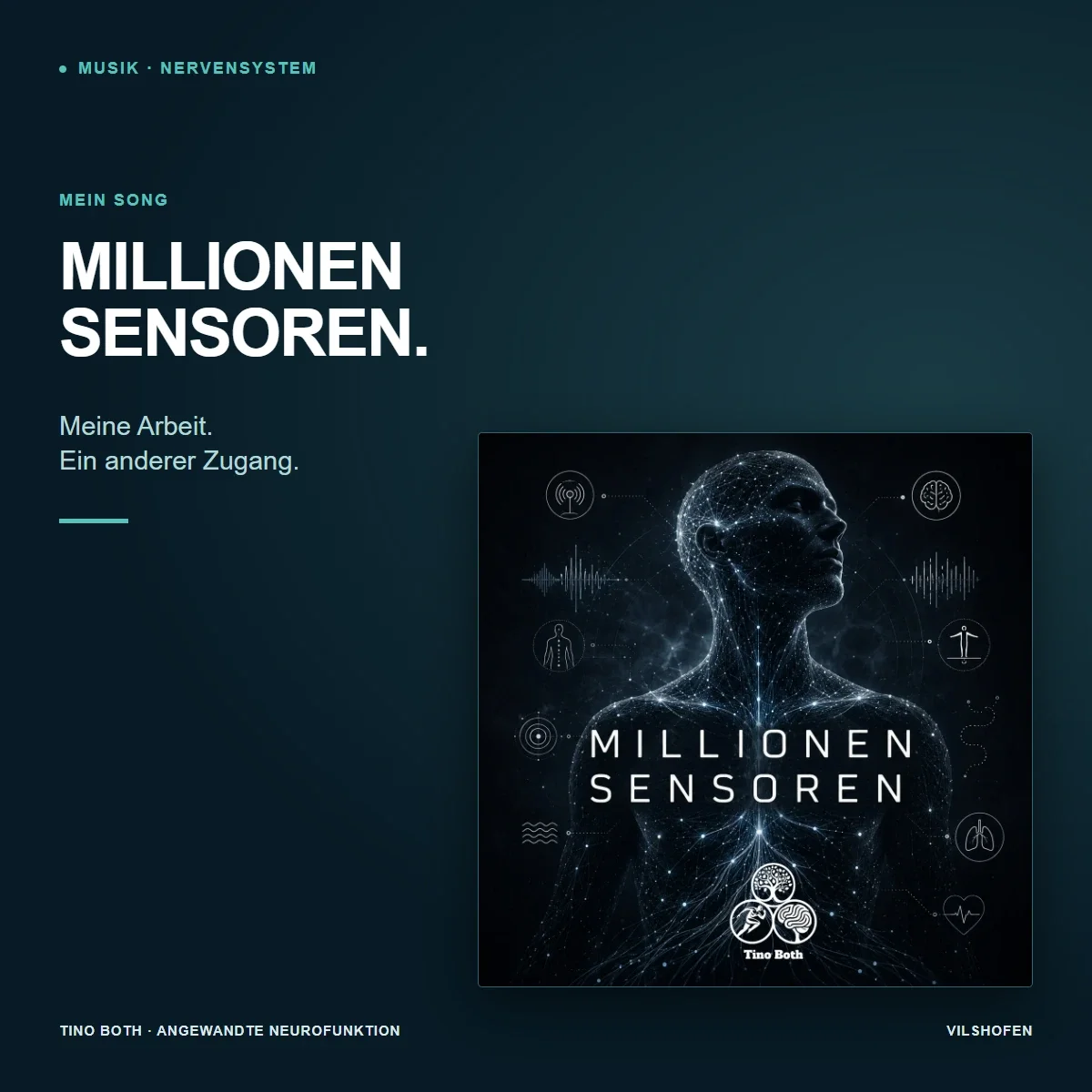
Briefly explained: 'Millionen Sensoren' ('Millions of Sensors') is my AI-assisted song about perception, the nervous system and neurofunctional work. It brings an attitude from my daily work into music: Looking more closely, understanding responses and trying suitable possibilities.
Would you like to listen first?Sometimes a song conveys a feeling for an idea faster than a long text. You can listen directly to 'Millionen Sensoren' here.
Listen to the song on YouTube →
Listen to the song on YouTube →
How my work became a song
I am not a musician. Nevertheless, I wanted to explore whether what excites me about Applied Neurofunction could also be expressed musically. Rather than a textbook set to music, I wanted a song people enjoy listening to and remember something from.
That is how 'Millionen Sensoren' came about. The music was created with the support of artificial intelligence; I released the song through DistroKid. The idea behind it comes from my work: Our body continually supplies information. What we perceive and how we move also depends on how this information interacts.
A song as an introduction — not an explanatory model for every symptomMusic can condense ideas and use imagery. During a personal appointment, such an idea becomes a specific question: What is difficult in everyday life, under which conditions and what can be changed in an understandable way?
The body sends information — but which information matters now?
When walking, you normally do not notice how much happens simultaneously. You see where you want to go. Your balance system registers head movements. Feet, joints and muscles provide feedback about ground contact and body position. This information contributes to controlling your movement.
When movement becomes difficult, the muscle at the site of effort is therefore not automatically the whole explanation. Perhaps the task takes more effort under changed visual conditions. Perhaps it works sitting but not walking. Such differences interest me because they bring the next useful question closer.
A general idea becomes a checkable questionImagine you turn your head and your neck tenses markedly. We first record the movement during which this happens. Then we change a suitable condition, such as a visual reference point, and repeat the same movement. Does it remain the same, become easier or more demanding? Only this comparison decides whether we continue working at this point.
Compensation deserves a second look
A different movement solution is not automatically an error. After an injury, for example, it may make sense initially to manage a task differently. Habits and a situation's demands also shape how we move. The question is whether a movement works for you, rather than whether it matches a perfect image.
I wanted to make precisely this perspective audible in the song. I do not want to work against every tension merely because it exists. I want to understand when it occurs, what changes it and whether a less demanding solution can be found. This also includes discarding an idea if the comparison does not support it.
An AI song with a personal message
What appeals to me about AI music is the possibility of giving my own idea a form that would otherwise be largely inaccessible to me. This does not retrospectively make me a singer or producer in the traditional sense. But it gives me a tool to share my enthusiasm for this work differently.
I dedicate the song to people who observe attentively, question connections and guide their work by the individual response. And of course to everyone curious about why movement, perception or physical wellbeing can feel so different under different conditions.
Listen to 'Millionen Sensoren'
Choose your music platformYouTube
Spotify
Apple Music
Deezer
DistroKid HyperFollow
Spotify
Apple Music
Deezer
DistroKid HyperFollow
You can also access the song through the music section of my About me page. If you like it, I would be pleased if you shared it with someone also interested in this way of thinking.
The lyrics: Millions of Sensors
Millions of sensors
every moment
the body sends quietly
and the system listens in
every moment
the body sends quietly
and the system listens in
The body sends signals, ceaselessly, non-stop
the nervous system builds its picture in the head
when processing falters, it looks for a way
we call it compensation when the system moves
the nervous system builds its picture in the head
when processing falters, it looks for a way
we call it compensation when the system moves
Everything is connected, everything feeds the system
what appears functionally can be seen functionally
test what the stimulus does, observe what happens
when the connection fits again, regulation begins anew
what appears functionally can be seen functionally
test what the stimulus does, observe what happens
when the connection fits again, regulation begins anew
Pressure on the skin, tension in the joint
balance asks: Do you still know where you are heading?
Eyes provide space, breathing sets the rhythm
muscles give an answer when a stimulus does not fit
balance asks: Do you still know where you are heading?
Eyes provide space, breathing sets the rhythm
muscles give an answer when a stimulus does not fit
The body is no riddle without meaning or a plan
it gathers every piece of information and builds order from it
but when the map in the system is no longer clear
it looks for a solution, even if it is not ideal
it gathers every piece of information and builds order from it
but when the map in the system is no longer clear
it looks for a solution, even if it is not ideal
Then the neck tightens, the back holds firm
the gait changes because the system protects you
not because it is broken, not because it fails
but because it seeks its best solution from the data
the gait changes because the system protects you
not because it is broken, not because it fails
but because it seeks its best solution from the data
Sensors, signals, processing, response
input becomes output, protection becomes a symptom
and what looks strange outside can make sense inside
when the nervous system says: I will not leave you alone
input becomes output, protection becomes a symptom
and what looks strange outside can make sense inside
when the nervous system says: I will not leave you alone
The body sends signals, ceaselessly, non-stop
the nervous system builds its picture in the head
when processing falters, it looks for a way
we call it compensation when the system moves
the nervous system builds its picture in the head
when processing falters, it looks for a way
we call it compensation when the system moves
Everything is connected, everything feeds the system
what appears functionally can be seen functionally
test what the stimulus does, observe what happens
when the connection fits again, regulation begins anew
what appears functionally can be seen functionally
test what the stimulus does, observe what happens
when the connection fits again, regulation begins anew
An old trauma, a stimulus, a glance
a joint that no longer moves smoothly with the system
an eye that pulls, a balance system that warns
a breathing pattern that still retains old stress
a joint that no longer moves smoothly with the system
an eye that pulls, a balance system that warns
a breathing pattern that still retains old stress
The body speaks clearly, rarely in words
it shows it through tension, movement and places
through strength, through weakness, through stability
through what suddenly becomes easier or harder
it shows it through tension, movement and places
through strength, through weakness, through stability
through what suddenly becomes easier or harder
No blind guessing, no blanket programme
first we test what the system can really do
stimulus in, response out, then it becomes quite clear
which connection was stable and which uncertain
first we test what the system can really do
stimulus in, response out, then it becomes quite clear
which connection was stable and which uncertain
Not against the body
not against the pain
but understanding the system
step by step, stimulus by stimulus
not against the pain
but understanding the system
step by step, stimulus by stimulus
When the input makes sense again
when protection no longer rules
old compensation can give way
to new regulation
when protection no longer rules
old compensation can give way
to new regulation
The body sends signals, ceaselessly, non-stop
the nervous system builds its picture in the head
when processing falters, it looks for a way
we call it compensation when the system moves
the nervous system builds its picture in the head
when processing falters, it looks for a way
we call it compensation when the system moves
Everything is connected, everything feeds the system
what appears functionally can be seen functionally
test what the stimulus does, observe what happens
when the connection fits again, regulation begins anew
what appears functionally can be seen functionally
test what the stimulus does, observe what happens
when the connection fits again, regulation begins anew
Millions of sensors, a living system
the body shows the direction, we only need to understand it
input becomes clarity, protection is reorganised
when the connection fits again, regulation begins anew
the body shows the direction, we only need to understand it
input becomes clarity, protection is reorganised
when the connection fits again, regulation begins anew
Millions of sensors
every moment
the body sends quietly
and finds its way back
every moment
the body sends quietly
and finds its way back
Would you like to explore the work behind the song?The free initial telephone consultation concerns your specific situation. We discuss whether a functional view of movement, perception and regulation might be useful for you.
Explore Applied Neurofunction →
Explore Applied Neurofunction →
Related pages and articles
More about how I workAbout me and my professional journey
Why I consider complex symptoms beyond the local area
Why I consider complex symptoms beyond the local area
The nervous system clearly explainedThe autonomic nervous system: Activity and recovery
Eye movements as part of orientation
Eye movements as part of orientation