

← All articles
Complex symptoms & the autonomic nervous system
Old injuries, infections and stress: What still affects you today?
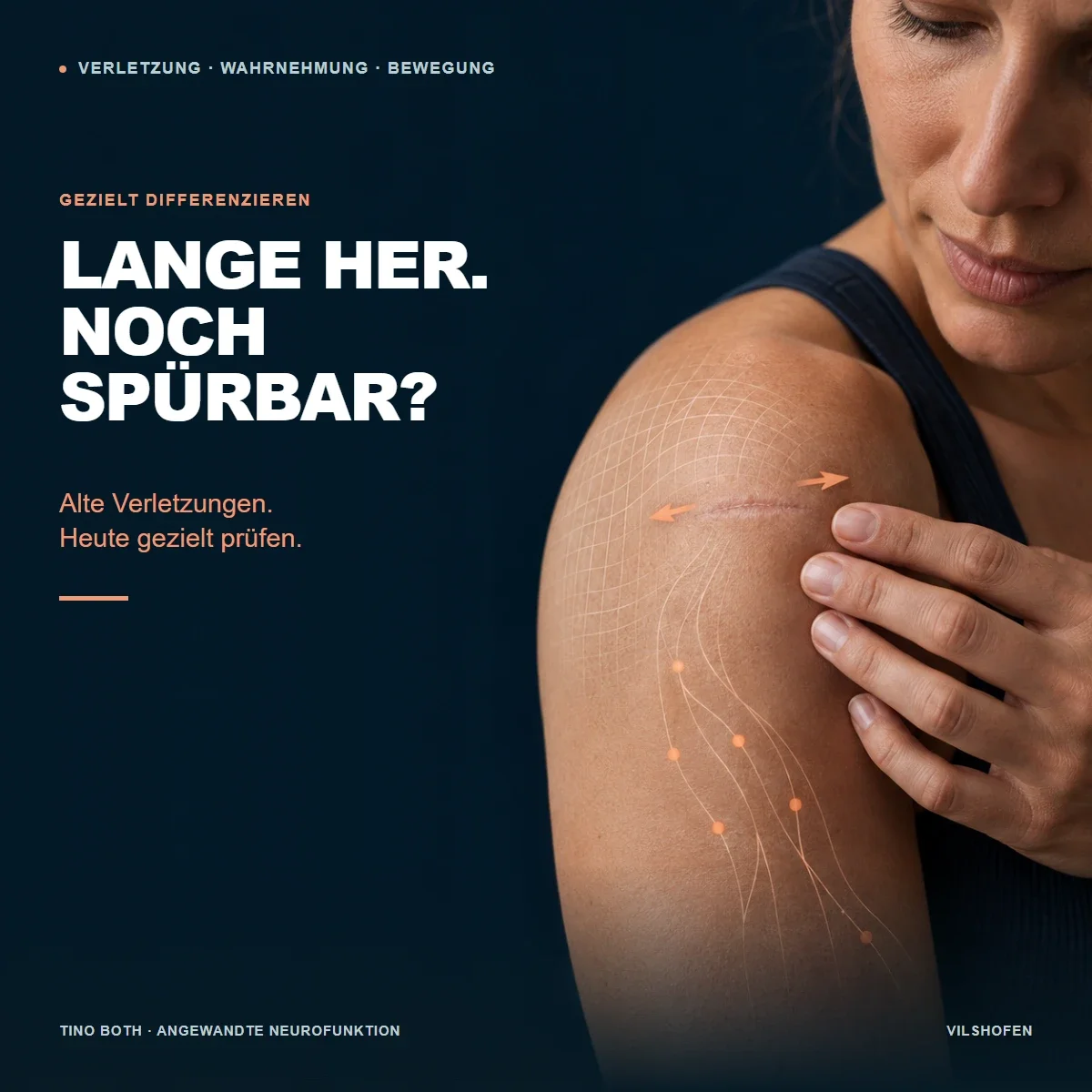
Briefly explained: An old injury may have healed long ago and still influence movement. Symptoms can also remain after an infection or a stressful period — though for different reasons. In Applied Neurofunction, I therefore distinguish the history from today's function: What is currently noticeable, which influence can be compared specifically and what actually changes as a result?
'Things have somehow been different since then' — does that sound familiar?During the free initial telephone consultation, you can describe what changed after an injury, illness or stressful period. We clarify which findings already exist and whether a functional perspective with me in Vilshofen can usefully follow on from them.
Discuss your history and present situation →
Discuss your history and present situation →
The injury was years ago. Movement still feels different.
Perhaps you can raise your arm again but unconsciously compensate while doing so. Perhaps the scar looks unremarkable, while the skin beneath feels unfamiliar or tense. Or after an illness, you notice that your previous capacity for activity has not simply returned.
The connection in time is a good way to begin the conversation. But it is not yet a complete explanation. I find it important to turn 'Since then' into a specific question about today. Otherwise, the history quickly becomes a story that seems to explain everything — without producing a useful next step.
Three histories — three different assessment routes
After an injuryTolerance, movement habits, pain and perception of the affected area may have changed. With a scar, sensitivity or tissue tension may play a part, for example. What matters is which specific movement is restricted today.
After an infectionPersistent exhaustion, breathing difficulties or activity intolerance need medical assessment. This is different from an unusual response to touching an old scar. An infection is not broadly treated as 'stored stress'.
After prolonged demands or distressing experiencesSleep, tension, attention and the personal sense of safety can also be affected. Mental and emotional connections matter here too. A standardised movement programme alone does not always meet the needs of this situation.
A specific example: The direction makes a difference, rather than the scar itself
Take a fully healed surgical scar around the shoulder as a possible example. When raising the arm, a pulling sensation appears at a particular point. The question would go beyond 'Does this scar cause a problem?' I want to distinguish more precisely whether light skin contact alone changes something, whether a particular direction of displacement stands out or whether another tissue demand is relevant.
Touching, shifting sideways and pressing more deeply are different stimuliNeutral contact may produce no unusual response. A very slight displacement of the skin in one direction may have a different effect from displacement in the opposite direction. Superficial skin displacement also differs from pressure on deeper layers. These distinctions are lost when every response is grouped together as 'scar massage'.
Following clearance, and with a fully healed scar free from irritation, I therefore compare different conditions gently. More precisely, rather than more forcefully. The original arm movement remains our reference point.
How this can become a targeted functional assessment
1. Define the movement and a suitable indicator muscleWe record how far the arm can be raised comfortably and when the pulling sensation begins. For an additional muscle assessment, I choose a muscle that can be tested reliably and without pain. The painful shoulder does not itself have to serve as the indicator.
2. Compare one question at a timeNeutral contact, slight sideways skin displacement and the opposite direction are considered separately. Suppose only one direction clearly changes the muscle response: I then pursue precisely that relationship within my assessment system, rather than broadly classifying the entire region as impaired.
3. Look for a suitable additionI check whether additional contact or a sensory stimulus can be found for this unusual combination under which the muscle response becomes appropriate again. The original question alone is compared with the same question plus the addition. An understandable difference under conditions as similar as possible is crucial.
4. Integrate — and assess again without the supporting stimulusIf the combination fits, the integration step follows. I then check the originally unusual direction of contact again, now without the additional support. The desired change should not depend on my continuing to hold the supporting contact.
5. Raise the arm againOnly now do we return to the actual everyday question: Is raising the arm easier, is the pulling reduced or is the range of movement different? Does the change remain with repetition and over time? If only the muscle response changes but movement does not, the original question has not yet been answered sufficiently.
Within my method, I use these contact and muscle comparisons to pursue a possible influence specifically. Practical value comes from the connection to movement: The test response guides the next comparison; your relevant task shows whether it helps us progress in everyday life.
The example also shows why 'more pressure' is not automatically better. If the interesting response already appears with a particular superficial direction, intensive work on all tissue layers is not necessarily the useful next step.
After an infection, the next day's response also matters
A short movement assessment may be useful for an old, healed injury. With marked activity intolerance after illness, by contrast, the immediate response is not enough. Some people feel relatively stable during an activity and experience clear deterioration only hours later.
Such delayed worsening of symptoms is called post-exertional malaise, or PEM. It can occur in ME/CFS, for example; not all fatigue after an infection is PEM. If this pattern fits you, it should be addressed explicitly in medical assessment. For ME/CFS, the NICE guideline advises against training programmes with fixed increases in activity.
A good brief retest is not clearance for more activityEspecially after illness, responses on the same day and over the following days are part of the assessment. A comfortable moment during an appointment must not obscure delayed deterioration. Duration and breaks need to suit current tolerance.
Distressing experiences involve more than movement
If certain situations trigger tension, I also ask about the context and your experience. My work with mental systems means considering this aspect together with the body. It does not mean inferring an unknown memory or hidden trauma from a muscle response.
We work with what you describe and what is tolerable at the moment. You decide what you wish to discuss. Appropriate psychotherapeutic support matters for trauma-related symptoms; existing support is included in further planning.
What you can bring to an initial consultation
Three details are helpful: What changed at the time? Which specific situation is difficult today? How do you respond immediately and later to activity? If you have findings or clearance after surgery, these are also relevant.
You do not need to systematically search every previous injury. Do not apply strong pressure or pulling to scars to provoke a response yourself. New pain, redness, swelling, loss of sensation or strength first require medical assessment.
Frequently asked questions
Can an old scar still influence movement?It is possible, for example with tension, altered sensitivity or tissue restrictions. Its relevance to your present task cannot be determined by age or appearance alone.
Does every scar need functional work?No. Symptoms and a specific question are decisive. An unremarkable scar that tolerates demands without difficulty does not need attention merely because it exists.
Can movement change during an appointment?A short-term change is possible. Whether it helps you becomes apparent in the actual task and over time. This does not establish a fixed number of appointments or predictable success.
Is exhaustion after an infection simply a lack of training?Not necessarily. Persistent symptoms or symptoms that worsen after a delay need assessment. Increasing activity on a hunch can be unsuitable in certain conditions.
Related pages and articles
From the history to today's functionShoulder pain when raising the arm: Distinguishing different assessment routes
Inner restlessness and exhaustion: When relaxation becomes demanding
Autonomic regulation clearly explained
Inner restlessness and exhaustion: When relaxation becomes demanding
Autonomic regulation clearly explained
Which question matters to you today?You do not have to resolve your entire history before we can begin. A specific example from daily life is a good starting point for discussing possible next steps.
Arrange a free initial telephone consultation →
Arrange a free initial telephone consultation →
Sources and further reading
Austrian Health Portal: Scars and scar treatment
NICE NG206: ME/CFS, activity management and post-exertional malaise
NICE NG206: ME/CFS, activity management and post-exertional malaise