

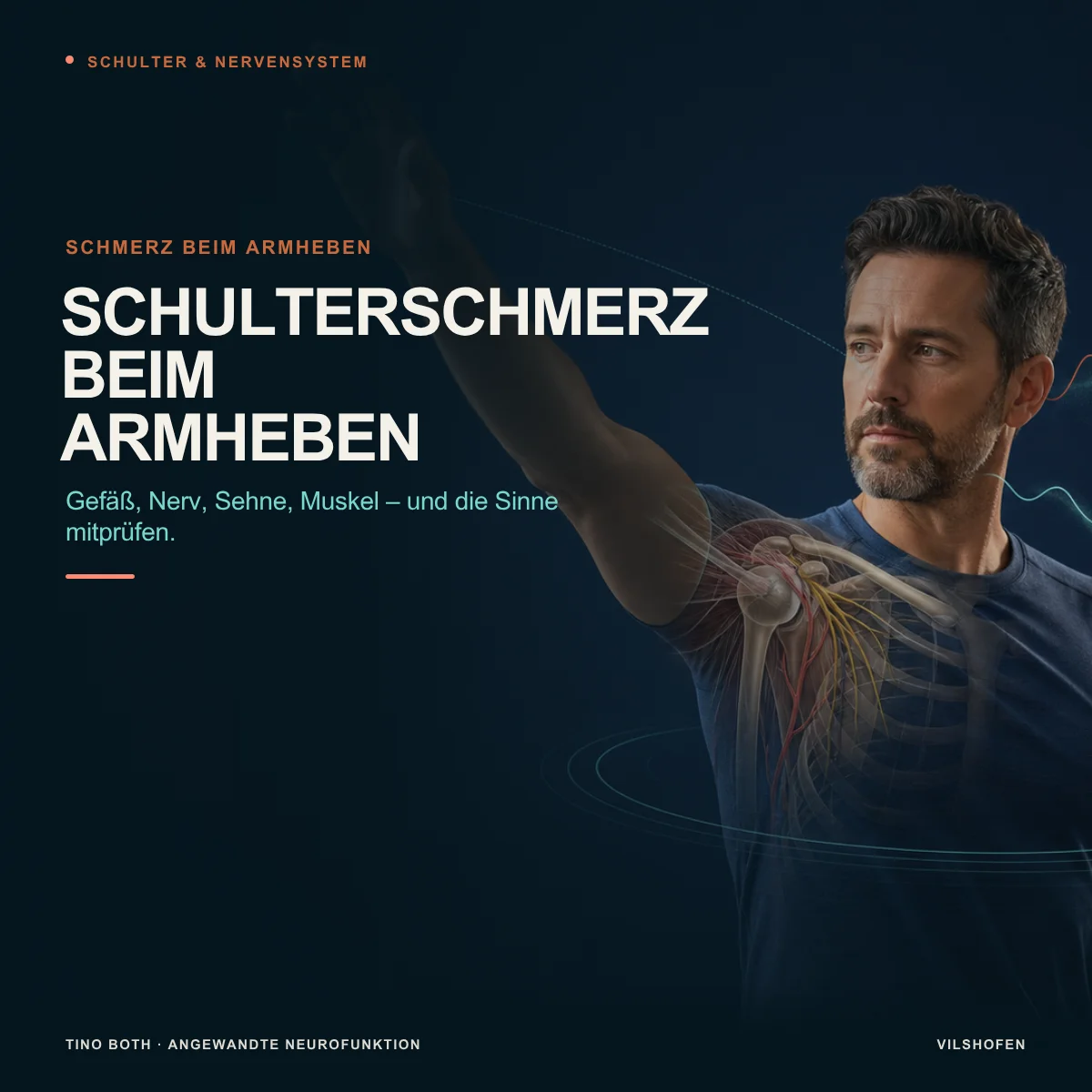
Briefly explained: Your shoulder hurts when lifting the arm, but which functional connection limits movement? In my work with Angewandte Neurofunktion, I distinguish targeted assessment routes: mechanical stimuli at vessels or nerves, sensory information from tendons and muscles, and movement activation. Comparable test responses and reassessment of your shoulder movement narrow down which route warrants further work.
Your shoulder has been assessed, but the same reach remains painful?Do you want more than another general shoulder exercise? In a free initial consultation, describe the movement limiting you. Discuss whether personal functional testing in Vilshofen suits your concern, with targeted questions about tissue information, nerve and vascular mechanics and a subsequent movement comparison.
Book an initial consultation for your shoulder →
The initial telephone consultation is free.
Book an initial consultation for your shoulder →
The initial telephone consultation is free.
It is this particular reach
You want to put on a jacket, take something from an upper shelf or lift your arm during sport. At a particular height, it pulls. Perhaps you compensate with your upper body or use the other hand to help. At rest, little is noticeable, but this exact movement remains difficult.
The first useful distinction is: which task hurts under which conditions? Slow lifting without weight differs from a fast throw. Sideways lifting may feel different from reaching diagonally forwards. These differences guide further assessment.
What may be involved in pain when lifting the arm
Rotator-cuff tendons, bursae, joints and other structures may contribute to shoulder symptoms. Injury or symptoms from the neck region are also possible. The explanation is assessed through history, examination and further diagnostics where appropriate. The IQWiG overview of shoulder pain describes subacromial pain and the importance of active treatment, among other topics.
An imaging finding and an everyday difficulty are not the same. Some changes also occur in people without pain. Conversely, painful movement deserves attention even when a finding does not clearly explain why that reach causes difficulty. The functional question therefore complements questions about tissue and capacity.
A painful point is not a complete movement planPain location, direction and load belong together. It may help to consider the sensitive area, how the arm is guided, which support helps and when movement is easier.
Why perception and activation belong in the assessment
Lifting an arm involves more than switching on one muscle. The nervous system continually processes information from muscles, joints, skin and other sensory systems. This produces movement adapted to the task: you orient yourself, regulate force and guide the hand to a target.
I therefore assess whether a difficult movement feels different under deliberately changed conditions. This may involve a different starting position or appropriately selected sensory stimulus. Not every sense is automatically tested for every shoulder. A clear question is more helpful than a long list of random tests.
Muscle, tendon, nerve or vessel: same movement, different questions
I consider more than which muscle should be stronger or tissue more mobile. Targeted contact and stimulus combinations examine different functional relationships separately. Assigning a muscle response to such a relationship is part of the contact and muscle-testing system used. This produces a working hypothesis pursued through further responses and your original movement.
Vascular mechanics: could the body limit movement to protect a vessel?This is a specific question within my methodology: could mechanosensitive receptors at a vessel or its surroundings supply information that prompts the nervous system to limit shoulder movement? Mechanosensitive means responding to mechanical changes such as pressure or stretch.
The shoulder reference area is combined with the designated vascular-mechanics contact points. The question is whether this particular combination changes the previously stable indicator-muscle response. “Perhaps it involves vessels” becomes an exactly defined test question.
The shoulder reference area is combined with the designated vascular-mechanics contact points. The question is whether this particular combination changes the previously stable indicator-muscle response. “Perhaps it involves vessels” becomes an exactly defined test question.
Nerve mechanics: is another assessment route notable?A nerve passes through tissue that moves during arm lifting. An additional contact assessment considers mechanical loading separately from the vascular question. Deliberately selected positions and contact combinations can be compared.
A notable nerve-related question need not end the search: an additional vascular question may change the response. Such comparisons make the approach more differentiated than “The nerve is notable, so stretch it”.
A notable nerve-related question need not end the search: an additional vascular question may change the response. Such comparisons make the approach more differentiated than “The nerve is notable, so stretch it”.
Tendon or muscle: which sensory information is examined?The sensory side is divided further. A tendon-related question differs from one about a muscle spindle, a sensor within muscle. Rather than grouping everything as “muscle tension”, test selected stimuli consecutively and compare responses.
Activation: how is movement organised?Another question concerns activation and inhibition of contributing muscles. For an upward reach, muscle activity must be present and fit the movement. Activation assessment therefore forms a separate route alongside sensory tissue information.
How I assess movement and its functional relationships
Before starting, record a tolerable baseline movement, for example how far and comfortably you can lift the arm. The method's testing sequence follows. The indicator muscle need not be at the painful shoulder. This matters especially if a direct shoulder test would produce pain or compensation.
1. Choose a suitable indicator muscleIdentify a muscle whose response can be checked painlessly and reliably in a suitable position. Only a stable baseline test provides a comparison for subsequent questions. An arm yielding because of pain would be a poor foundation.
2. Apply a clear stimulus or examine a connectionThe selected stimulus or contact combination narrows the question. For vascular mechanics: shoulder as reference area plus the associated contact points. Change conditions specifically so the response can be assigned to a particular question.
3. Retest the indicator muscleIf the previously stable response cannot be maintained under this condition, it is classed as notable inhibition according to the method's criteria. This response starts further differentiation. If stable, this route is not simply treated as notable.
4. Seek a suitable solution and cross-checkSeek an addition under which the notable inhibition disappears. Compare original stimulus alone — notable response; same stimulus with identified solution — stable response. Repeat under comparable conditions. If not reliable, differentiate further.
5. Integrate the identified solutionThe suitable integration sequence aims for the changed response to remain without continued solution contact. Then apply only the original stimulus again. The intended result is a stable indicator-muscle response under that original question too.
6. Return to actual shoulder movementNow the everyday question matters: how does arm lifting work? Compare range, pain and effort with the start. Change may be immediately perceptible. Its reliability and useful further support become apparent over time.
Possible example: the vascular question changes the test
You lift the arm sideways. Beyond a particular height, an unpleasant pulling appears. Record this movement as baseline marker. Since direct shoulder muscle testing hurts, choose another painlessly and stably testable indicator muscle.
Connect the shoulder reference to vascular mechanics. Suppose the indicator repeatedly yields under this combination while another tested combination leaves its response unchanged. Vascular mechanics then becomes the specific working hypothesis: could processing mechanical stimuli at the vessel contribute to movement restriction?
How this lead is pursuedSeek an addition that removes the notable muscle response. The original stimulus stays the same. Repeatedly compare:
Shoulder + vascular question: notable inhibition.
Same question + identified solution: stable muscle response.
Only once this comparison is clear does integration follow. Recheck the original question without additional solution contact. Then lift the arm exactly as at the start.
Shoulder + vascular question: notable inhibition.
Same question + identified solution: stable muscle response.
Only once this comparison is clear does integration follow. Recheck the original question without additional solution contact. Then lift the arm exactly as at the start.
The difference is directly understandable: we pursued a specific question and returned to movement, rather than simply massaging the painful area or trying an arbitrary exercise. Is the reach greater, less painful or easier? If unchanged, the approach needs further checking. What matters is change in your shoulder that holds up in daily life.
Possible example: the difference appears only under load
Your arm can move in principle, but a particular reach feels limited. I consider whether a muscle holds against resistance in a comfortable position and also: what changes when those particular structures face a different demand? A possible approach illustrates this difference.
Not every shoulder nerve responds alikeSuppose selected tests for several nerves supplying the shoulder are unremarkable. The subscapularis, a muscle on the front of the shoulder blade, also initially holds stably. Only after a dosed loading position with added shoulder-blade movement does it yield more noticeably in comparison.
The question becomes more precise: rather than “Is the shoulder weak?”, “Which condition changes this muscle response?” I use such direct comparison only when pain-free and without compensation. Otherwise choose a suitable indicator muscle outside the affected shoulder.
The question becomes more precise: rather than “Is the shoulder weak?”, “Which condition changes this muscle response?” I use such direct comparison only when pain-free and without compensation. Otherwise choose a suitable indicator muscle outside the affected shoulder.
Compare this observation with an additional contact check: shoulder region alone, then with a contact assigned to the nerve-related route within my methodology. If only the combination responds, pursue that lead. An initial nerve response does not yet establish which additional stimulus might help.
Why vascular mechanics may then matterShoulder movement changes mechanical conditions for muscles, nerves and surrounding tissue. One working hypothesis is therefore whether mechanical signals from the vascular surroundings contribute to the restriction.
In this example, assess an additional contact near the collarbone assigned to vascular mechanics. Repeat the same tolerable loading. A more stable muscle response provides a lead for further assessment, rather than simply an instruction to stretch the initially notable nerve harder.
This concerns the mechanical movement question. Autonomic regulation of vessel diameter or a circulation question would be considered separately.
In this example, assess an additional contact near the collarbone assigned to vascular mechanics. Repeat the same tolerable loading. A more stable muscle response provides a lead for further assessment, rather than simply an instruction to stretch the initially notable nerve harder.
This concerns the mechanical movement question. Autonomic regulation of vessel diameter or a circulation question would be considered separately.
If the difference with and without additional contact is repeatedly clear, perform the suitable integration. Reassess original loading without that contact. Then comes your crucial comparison: how does the original reach or arm lift now work?
What is distinctive is the order: a notable muscle response leads to a targeted next question. It is not immediately a complete explanation of shoulder symptoms. An approach may emerge that a blanket search for a “too weak” or “too tight” muscle would miss.
How do eyes, balance, hearing or smell relate to this?
The shoulder belongs to a person orienting themselves and responding to surroundings. Assessment can therefore extend beyond local tissue. Connections with visual processing, balance, hearing or smell are possible separate routes.
For example, the question is whether an exactly defined visual stimulus paired with the shoulder reference changes the indicator response, whether a suitable solution can be found and how arm lifting works after integration. The same logic can apply to other sensory relationships where appropriate. Assessment remains specific even beyond the shoulder.
Not every notable test gets its own exerciseThe decision follows the chosen route and your response. Sometimes integration is central; sometimes a targeted movement task or useful addition to existing training. Shoulder pain alone does not bring a blanket exercise catalogue.
What to observe before an appointment
Remember one typical movement, such as reaching into an upper kitchen cupboard. Is it easier without an object? Does direction matter? What happens after loading and next day? You need neither test into pain nor press on nerves or vessels yourself. A precise everyday description is enough initially.
After an accident with marked restricted movement, new pronounced weakness, persistent altered sensation, a cold or discoloured arm, or a hot swollen shoulder with fever, prompt medical assessment matters. Shoulder or arm pain with chest pressure, breathlessness or cold sweat: 112.
Common questions about shoulder pain on arm lifting
Does a painful arc automatically mean impingement?No. The movement pattern is an observation to interpret alongside other findings. It alone cannot safely identify one structure as the explanation.
Why test another muscle if my shoulder hurts?The indicator provides a comparison for a targeted stimulus question in this additional assessment. It should be reliably and painlessly testable. Shoulder movement separately provides the everyday initial and final comparison.
Will I need many eye or balance exercises afterwards?Not automatically. Useful additions depend on the individual question and response. Integration and longer-term training are different elements.
Can I continue physiotherapy?Appropriate existing care remains important. In the initial consultation, discuss how a functional addition might fit your current plan instead of building contradictory programmes alongside each other.
A more precise question for your shoulder
Vascular mechanics, nerve mechanics, sensory tissue information and activation lead to different questions. Differentiated assessment keeps them from disappearing into a general “The shoulder is tense”. You should understand which connection is pursued, why a particular integration is chosen and how movement responds.
Would you like to know which assessment route may suit your shoulder?Begin with the movement limiting your daily life. In a free initial telephone consultation, discuss existing assessment and whether an appointment for Angewandte Neurofunktion in Vilshofen suits you. You need neither your own explanation nor further self-tests.
Book a free initial shoulder consultation now →
The initial telephone consultation is free.
Book a free initial shoulder consultation now →
The initial telephone consultation is free.
Related pages and articles
Explore pain and my approachPain despite unremarkable imaging: when to consider function further
Why pain does not always arise where it is felt
Neurofunctional Integration for complex symptoms: how I work
Why pain does not always arise where it is felt
Neurofunctional Integration for complex symptoms: how I work
Connect perception and movementUnderstanding oculomotor function: how eye movements guide daily life
Assessing eye movements functionally: why an indicator muscle shows more than observation alone
VOR explained simply: why the vestibulo-ocular reflex stabilises gaze
Assessing eye movements functionally: why an indicator muscle shows more than observation alone
VOR explained simply: why the vestibulo-ocular reflex stabilises gaze
Related areas in VilshofenPain and functional symptoms
Visual difficulties and visual processing
My approach: Angewandte Neurofunktion
Visual difficulties and visual processing
My approach: Angewandte Neurofunktion
Sources and further reading