

← All articles
Professional development and events
Therapy Day 2026 in Ortenburg: Neurocentred training — event archive
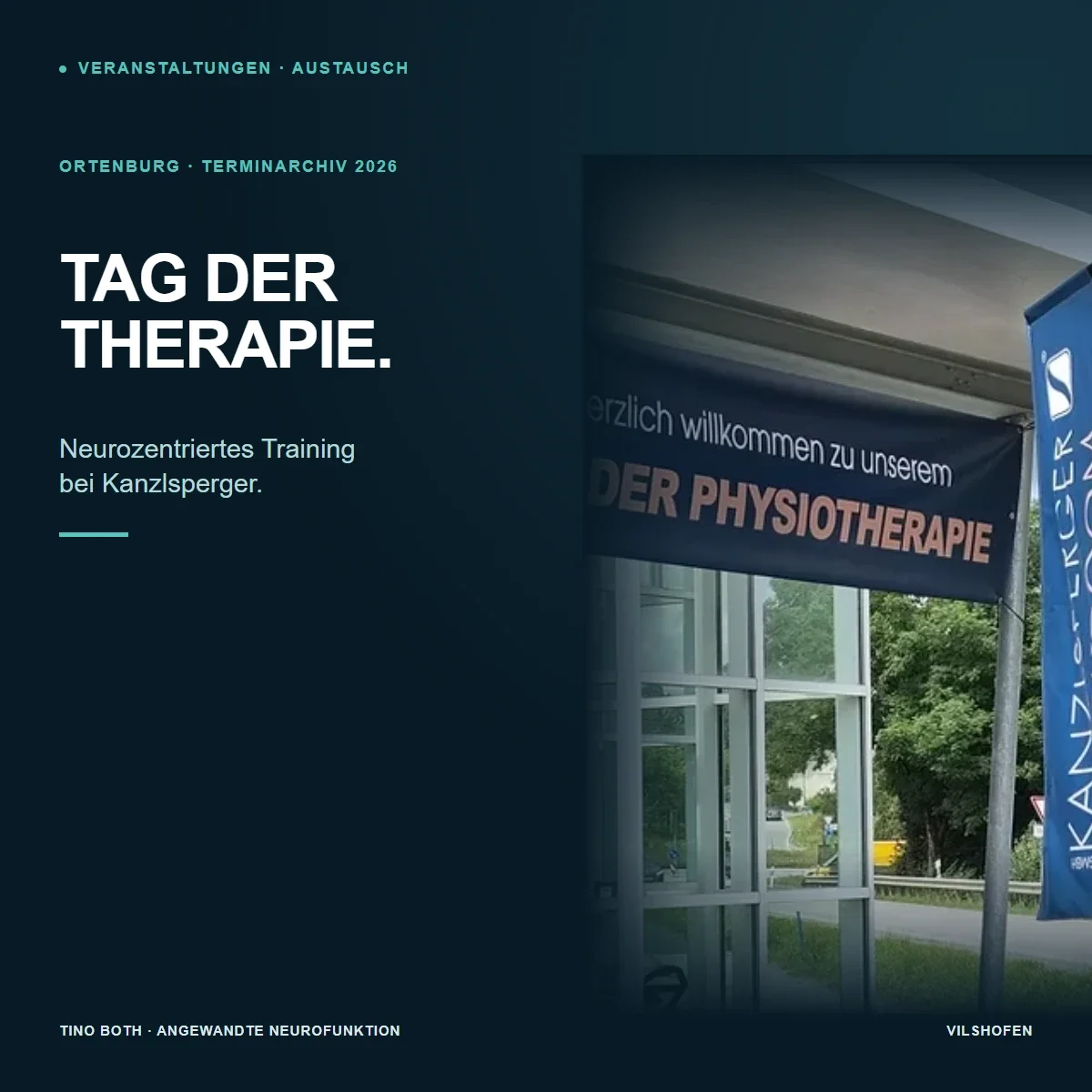
Briefly explained: Two practical workshops with me on neurocentred training, along with conversations at the ARTZT Neuro stand, were announced for Therapy Day on 18 July 2026 at the KANZLSPERGER showroom in Ortenburg. The focus was on practical applications and how to check the response to a training stimulus in a clear, understandable way.
Are you interested in a training session or applying this personally?The event has passed. If you would like to explore neurocentred work for yourself or your team, we can still discuss your questions and a suitable format independently of the event.
Enquire about personal support or a training session →
The initial telephone consultation is free of charge.
Enquire about personal support or a training session →
The initial telephone consultation is free of charge.
Event archive: Therapy Day 2026Date: Saturday, 18 July 2026, 09:30–16:00
Venue: KANZLSPERGER showroom, Kamm 13, 94496 Ortenburg
Format: Expert talks, practical workshops, exhibition and discussion
Status: Past event. The registration deadline has expired.
Venue: KANZLSPERGER showroom, Kamm 13, 94496 Ortenburg
Format: Expert talks, practical workshops, exhibition and discussion
Status: Past event. The registration deadline has expired.
What makes this event concept interesting
Professional knowledge becomes particularly accessible when questions can be explored directly through practice. Therapy Day was designed as a mix of talks, workshops, an exhibition, challenges and conversations. The event was aimed at people working in therapy, training, rehabilitation and everyday clinical practice.
The announced programme included equipment-based therapeutic methods, groin pain in everyday life and training, and experiences from physiotherapy in elite sport and the Olympic environment. Practical sessions were also planned on topics including shockwave therapy, blood flow restriction, electrotherapy, taping and neurocentred training.
My announced contribution: A practical look at neurocentred training
Two practical workshops with me were scheduled for the ARTZT Institute: One during the morning block and another in the afternoon. There was also the opportunity to talk to me at the ARTZT Neuro stand.
The central question: What does this stimulus do to this task?An eye exercise, a balance stimulus or a change in body awareness is not suitable simply because it appears in an exercise catalogue. First, a specific task is needed as a starting point. Then one condition is deliberately changed and the same task is checked again.
Observe → make a targeted change → compare again. This process helps make the choice of an exercise understandable.
Observe → make a targeted change → compare again. This process helps make the choice of an exercise understandable.
Visual information, balance and body awareness offer different approaches. In practical work, I am interested in when a particular demand becomes difficult and how the response differs following an appropriate change. This turns 'bringing more nervous system into training' into a specific decision.
A possible example of this way of thinking
Suppose a small step followed by a turn of the head feels unsteady, while the same step with the head still goes well. Immediately describing the entire sense of balance as the problem would be imprecise. We can first compare head movement, visual target and the stepping task separately.
A difference determines the next stepIf standing with head movement remains comfortable, the combination with the step is examined more closely. If the visual target becomes harder to recognise even during a small head movement, gaze stabilisation is a more relevant next question. A short task selected afterwards is checked against the original stepping movement, with appropriate support for safety.
This possible approach explains the working principle. It does not assume that every participant needs the same exercise.
This possible approach explains the working principle. It does not assume that every participant needs the same exercise.
ARTZT Neuro: Tools and their use
At the announced ARTZT Neuro stand, the practical use of products was intended to be central alongside the products themselves: How can a visual or sensory stimulus be selected? What changes its intensity? Which starting task is suitable for comparison?
For me, the decision does not begin with buying a tool. An aid should support a thoughtfully selected task. Without a clear goal and a subsequent comparison, it often remains uncertain whether its use is actually helping at that moment.
Who was the programme intended for?
The mix was aimed at physiotherapists, professionals from other therapeutic occupations, trainers and people responsible for a practice or health service. The combination of professional input, practical application and exchange with other professional groups was particularly interesting.
The original event announcement with the venue and date can be read on the KANZLSPERGER event page. This blog post remains available as an event archive; it is not a current invitation to register.
Frequently asked questions
Can I still register for this event?No, the event described here on 18 July 2026 is in the past. You can contact me directly about a new training enquiry.
Is neurocentred training only of interest to professionals?The event was aimed at a professional audience. In personal support, however, tasks and explanations are adapted to your concerns and circumstances.
Do I need special training equipment?Not as a rule. A specific function is the starting point. Whether an aid is a useful addition depends on the chosen task.
Related pages and articles
Explore past eventsNeurocentred training — a look back at Physiotherapy Day in Ortenburg
Neurocentred training & therapy — two days that change perspectives - September 2025
Neurocentred training & therapy — two days that change perspectives - September 2025
Understanding perception and trainingVOR explained simply — why the vestibulo-ocular reflex keeps your gaze stable
Assessing eye movements functionally — why an indicator muscle shows more than observation alone
Assessing eye movements functionally — why an indicator muscle shows more than observation alone
How I work and your next stepAngewandte Neurofunktion: How I work
My professional journey and areas of focus
Free initial telephone consultation
My professional journey and areas of focus
Free initial telephone consultation
Sources and further links
- KANZLSPERGER GmbH: Therapy Day 2026: https://showroom.kanzlsperger.de/tag-der-therapie