← All articles
Press articles
Tino Both in the Vilshofener Anzeiger: discover Angewandte Neurofunktion
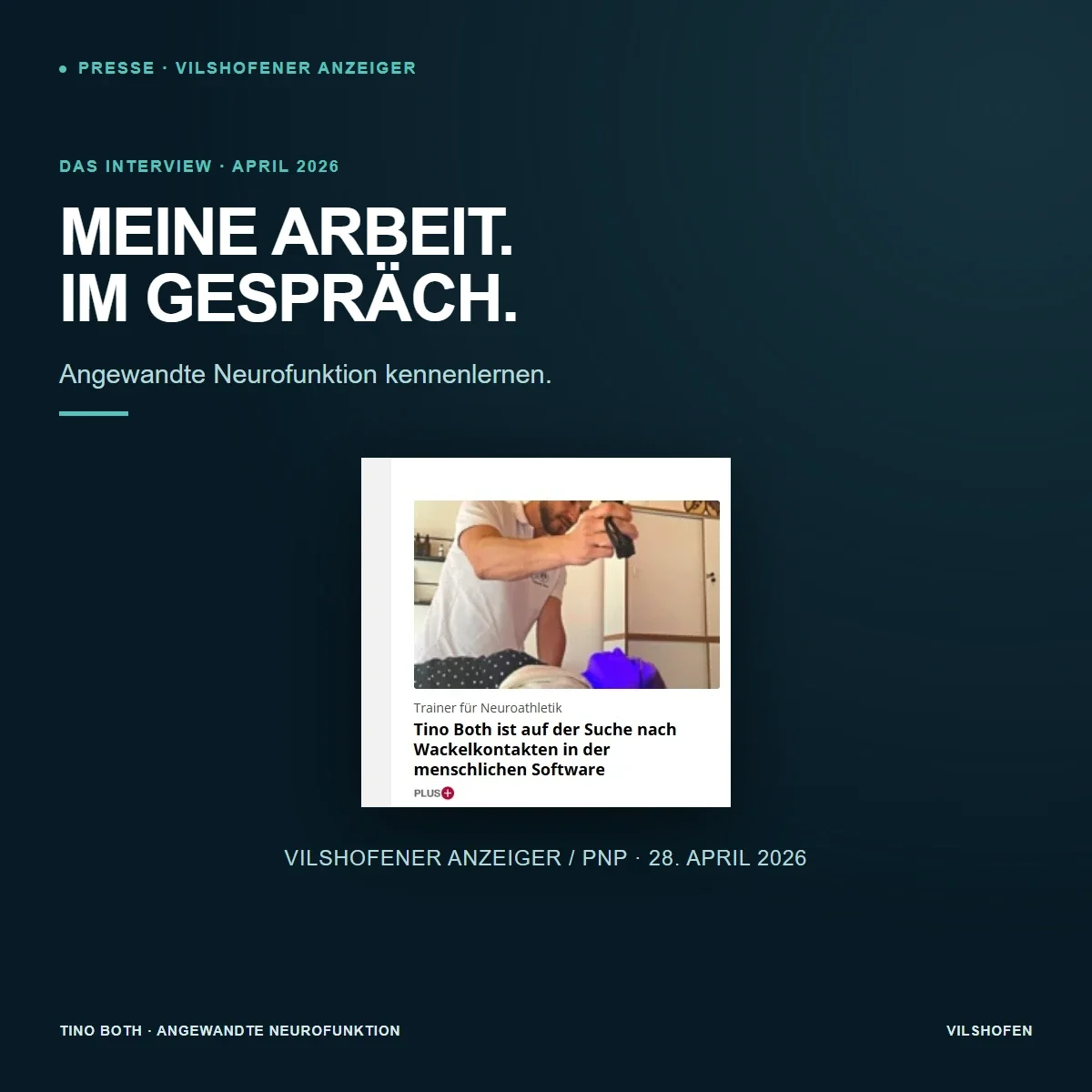
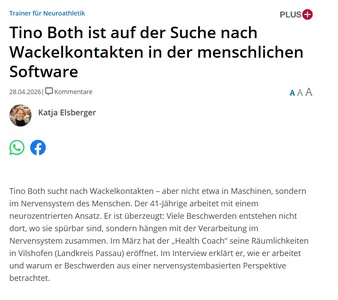
Briefly explained: On 28 April 2026, the Vilshofener Anzeiger / PNP reported on my work. The focus was neuroathletic training and my functional perspective on movement and symptoms: which demands are involved, and what changes through targeted stimuli?
Did you discover me through the newspaper article?You do not need to know the technical terms. In the free initial telephone consultation, tell me what limits you in everyday life or sport and what has already been assessed. Together, we consider whether my work in Vilshofen fits your question.
A personal initial consultation about your own concern →
A personal initial consultation about your own concern →
The interview in the Vilshofener Anzeiger
Under the headline ‘Tino Both is looking for loose connections in human software’, the Vilshofener Anzeiger introduced my approach. I am pleased this brings attention to an approach that many people have so far mainly encountered in competitive sport.
To the original interviewYou can find the newspaper article at PNP. Depending on your access, the full text may require a subscription.
Read the interview in the Vilshofener Anzeiger / at PNP →
Read the interview in the Vilshofener Anzeiger / at PNP →
My thanks go to Katja Elsberger for the pleasant conversation and her interested engagement with my work. Thanks also to Julia Bindereder, who, as a VA intern, agreed to a small self-test. This turned a conversation about an initially abstract subject into a practical insight too.
What the ‘loose connection’ image can make understandable
The expression is a vivid metaphor. My aim is to consider movement beyond the muscles and joints involved. The nervous system also uses information from the eyes, balance organs, skin and body perception. The task we perform and its conditions influence the demands on this interaction.
If a movement is difficult, a closer question is therefore worthwhile: does it also happen while sitting? Only while walking? With a steady gaze or only during head movement? These differences help turn a general symptom into an assessable question.
One possible example: walking only becomes unsteady when looking around
Three conditions that do not demand the same thingWalking straight ahead: We choose a short, familiar route in safe surroundings and record how walking and stability feel.
Considering the component tasks: In a supported position, we consider gaze control and a small head movement separately. If a target becomes unclear or the task uncomfortable, that matters for the next selection.
Comparing the combination: Only if it is safely possible do we add a small gaze or head turn while walking. If the difficulty only appears here, we direct the next trial towards this combination instead of simply demanding more leg strength.
Considering the component tasks: In a supported position, we consider gaze control and a small head movement separately. If a target becomes unclear or the task uncomfortable, that matters for the next selection.
Comparing the combination: Only if it is safely possible do we add a small gaze or head turn while walking. If the difficulty only appears here, we direct the next trial towards this combination instead of simply demanding more leg strength.
A selected, low-dose training stimulus is then compared again with the original walking task. What matters is not how challenging the exercise looks, but whether the relevant task can be performed more favourably and tolerably. New, severe or increasing walking unsteadiness and dizziness should be medically assessed first.
Not every functional question leads to the same method
In Applied Neurofunction, I combine different possibilities for functional assessment. For a training question, breaking things down into component tasks like this can be particularly helpful. For another question, targeted contact assessments and an indicator muscle that can be tested without pain may be added. I do not want to reduce every situation to an eye exercise or everything to a muscle test.
What connects both approaches is their relationship to your concern: we define what should change, assess a specific connection and compare the response. Which method makes sense depends on the question and how things develop.
Who might be interested in getting acquainted
Perhaps you come because of an unsteady movement, recurring symptoms or a difficulty in sport. Perhaps you have already had examinations and additionally want to understand which functional demands play a role for you. In the first conversation, we clarify your concern and whether my service fits it.
I have worked in Vilshofen an der Donau since March 2026. For me, the newspaper report is a lovely opportunity to give people in the region an initial introduction to my work. The next step does not have to be another grand explanation – a specific question from everyday life is enough.
Related pages and articlesGet to know the approach more closelyAngewandte Neurofunktion: my approach
About me and my professional journey
Z-Health Master Practitioner: my training journey
About me and my professional journey
Z-Health Master Practitioner: my training journey
Relevant to your concernDizziness and balance
Vision and visual processing
Pain and functional symptoms
Free initial telephone consultation
Vision and visual processing
Pain and functional symptoms
Free initial telephone consultation