

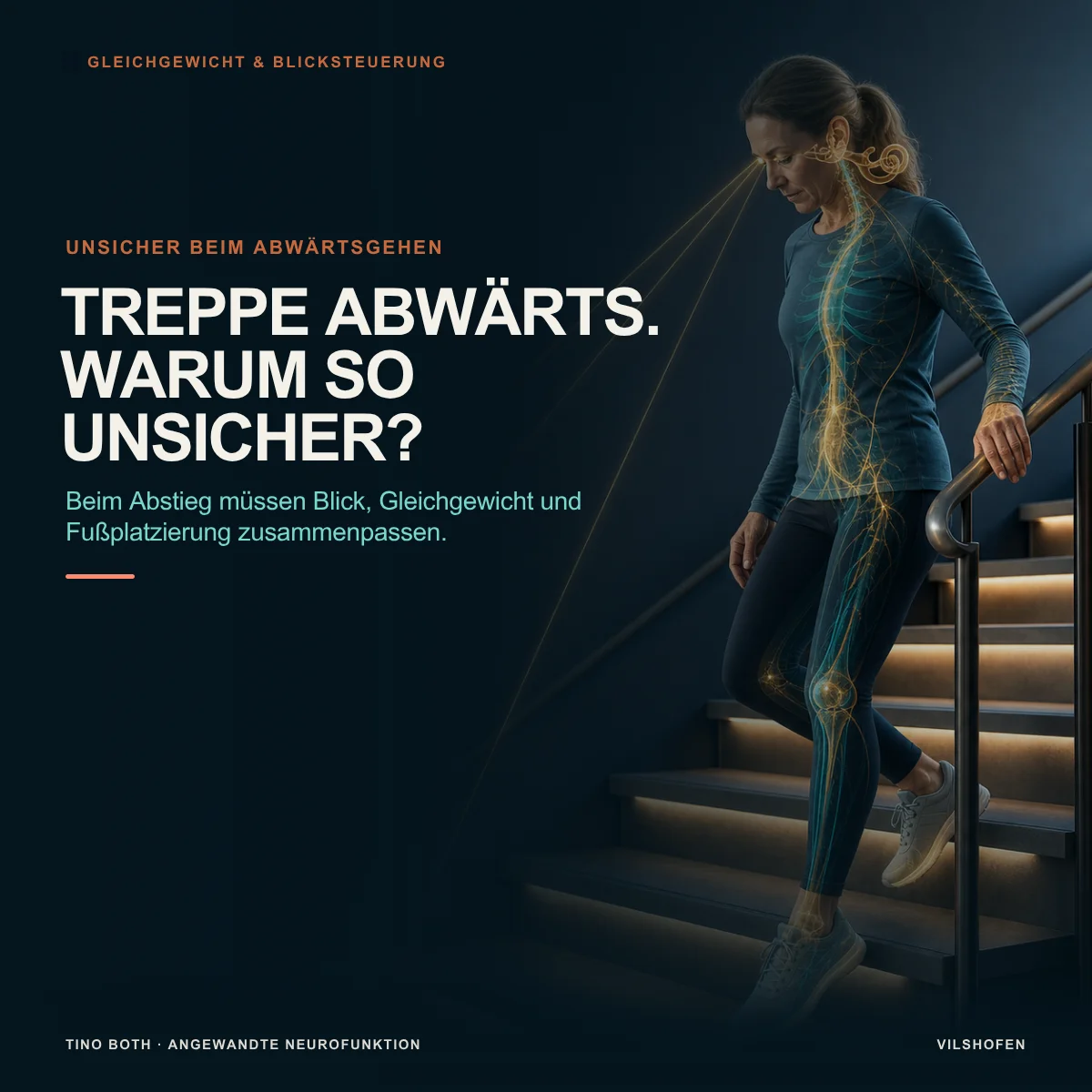
Briefly explained: Unsteadiness going downstairs does not automatically mean insufficient leg strength. During descent, the body must lower its weight in control, judge the next step and place the foot appropriately. Strength, joint function, vision and balance work together. What matters is which part of this task becomes difficult for you.
Going up is fine, but downstairs you lack confidence?If uncertainty persists despite training or after assessment, describe the specific stair situation. We discuss whether a safe functional view of movement and orientation suits your concern.
Discuss stair unsteadiness in an initial consultation →
The initial telephone consultation is free.
Discuss stair unsteadiness in an initial consultation →
The initial telephone consultation is free.
Before the next step comes hesitation
Your legs support you in daily life. Yet before stairs, you seek the handrail, look down for a long time or put both feet on the same step in turn. Perhaps it happens only on unfamiliar stairs, or mainly at the start or transition to the last step.
These differences matter. They show that “using stairs” is not one single ability. Ascent, descent and the transition to level ground have different demands. It is worth examining exactly the situation limiting you.
Why going down differs from going up
During ascent, the body is lifted. During descent, the supporting leg must brake downward movement in control while the other foot reaches a lower surface. Muscles also lengthen under load. Joint mobility, pain and available strength reserves can influence this process.
The nervous system also needs information about the next step: where does it start, how big is the height difference and where is the body moving? Eyes supply spatial clues. The vestibular system detects head movement and orientation to gravity; signals from feet, muscles and joints help estimate body position.
Strong legs and unsteady descent can coexistGeneral strength differs from controlled lowering onto a particular step. Equally, an interesting sensory explanation should not obscure a real strength or joint problem.
Helpful differences in everyday life
Loading or movement hurtsClear pain during lowering, a knee giving way or a swollen joint warrants particular attention to local capacity. Repeated provocation does not clarify the task.
The step is hard to judgeUnsteadiness with patterns, low contrast or unfamiliar lighting makes the visual condition relevant. Using familiar bright stairs differs from identifying a dark step edge in time.
Head movement or gaze shifts change the feelingPerhaps descent works while you closely watch every step but becomes less steady when briefly looking up. How vision, balance and movement interact is then relevant. First consider this in a safer, simpler situation.
None of these patterns is a self-test to establish the cause. They help describe more precisely at an appointment when uncertainty appears. Several factors may contribute simultaneously.
What clear step edges can do
An easily recognisable edge helps visually judge the step. A small study in older adults with simulated visual impairment found more favourable values for some movement measures, including heel clearance, with higher edge contrast. It investigated specific features of descent, rather than definitively ruling out future falls.
Adequate light, clear steps, well-fitting shoes and an accessible handrail are sensible everyday foundations. Existing markings should indicate the actual edge without creating a trip hazard. If new glasses change spatial vision, fitting and use also belong in the assessment.
How a safe functional assessment begins
First discuss progress, falls, pain, dizziness, visual changes and previous examinations. Then choose a safely comparable task. This may initially be weight shifting on level ground or controlled lowering at a low, supported step. A long staircase is unnecessary.
Define conditions: handrail or support, step height, starting leg, light and speed. Observe hesitation, foot placement, lowering control and your sense of steadiness, among other things. Only then change a condition deliberately. This makes it easier to recognise whether a difference relates to the chosen change.
Possible example: same step, clearer orientationA low step is physically manageable, but starting remains hesitant. Under supported conditions, compare a clearer edge with the previous situation. Height, speed and support remain unchanged. If the task becomes understandably easier, visual design is a useful further assessment point. In another person, controlled acceptance of load may be central instead.
Looking towards the step: what do the eyes do, and what does the head do?
“I become unsteady as soon as I look down.” This sounds clear but may mean different tasks: lowering only the eyes, tilting the head, or looking at the step while shifting weight onto one leg. In my work with Angewandte Neurofunktion, I separate these demands before deciding what to pursue.
A possible example: gaze direction changes the test responseAssessment begins in a safe position, away from the stairs. I choose an indicator muscle that can be tested painlessly and reliably. Initially the head remains still while you look ahead, then down. Head tilt is then considered as its own demand.
Suppose the response already changes with a maintained downward gaze although head position stays unchanged and you are not lowering any weight yet. I would not simply prescribe knee strengthening. I would first assess more closely how gaze position interacts with muscle response in this test situation.
In another pattern, these comparisons remain unremarkable; only accepting load at the supported step is difficult. Leg control, joint mobility and foot contact then receive different weight.
Suppose the response already changes with a maintained downward gaze although head position stays unchanged and you are not lowering any weight yet. I would not simply prescribe knee strengthening. I would first assess more closely how gaze position interacts with muscle response in this test situation.
In another pattern, these comparisons remain unremarkable; only accepting load at the supported step is difficult. Leg control, joint mobility and foot contact then receive different weight.
A fluid eye movement and the response to a maintained gaze direction differ. You may reach a target easily with your eyes yet show a different muscle response in that exact gaze position. For me, this difference is a functional assessment lead within my methodology, not a reason to make every stair problem an eye problem.
From the notable direction to a suitable integrationIf the gaze position is repeatedly notable, compare additional inputs or contact combinations with that exact position. A variation giving a stable response only when looking ahead does not yet answer the original question.
If an addition fits, compare: downward gaze without addition, with addition, then without again. Only then integrate the identified combination. Afterwards, reassess forward gaze, the previously notable direction and its opposite. Switching between positions remains part of the view.
The supported everyday task then matters: same step height, support and starting leg. Do hesitation, foot placement or controlled lowering change? The chosen approach must be judged against this.
If an addition fits, compare: downward gaze without addition, with addition, then without again. Only then integrate the identified combination. Afterwards, reassess forward gaze, the previously notable direction and its opposite. Switching between positions remains part of the view.
The supported everyday task then matters: same step height, support and starting leg. Do hesitation, foot placement or controlled lowering change? The chosen approach must be judged against this.
The step stays the same; the question becomes more preciseIt matters whether the leg struggles to control load or an additional gaze or head demand makes the task harder. This distinction may lead to a very different starting point from ever more repetitions of the same stair exercise.
Going up works, but you hesitate before going down? This description is enough for a free initial telephone consultation. Together, clarify which assessments already exist and whether a safe functional assessment in Vilshofen is a suitable next step.
Training must return to your staircase
A useful approach may involve strength and controlled lowering, an appropriately dosed orientation task or several prerequisites combined. Build it gradually. Improving an isolated standing test does not automatically make everyday stair descent easier.
With sufficient safety, bring practice closer to your goal: suitable step height, appropriate support and later the actually relevant conditions. The handrail is not a sign of failure. It is a useful aid enabling safe movement and a meaningful comparison.
What you can observe without added risk
Note which stairs are already difficult in daily life: first or last step, unfamiliar height, little light, patterns or direction changes. Record accompanying pain, dizziness, new visual problems or altered foot sensation. Use the handrail and seek help where needed.
Closed eyes, deliberately poorer lighting, hurried descent or removing support are unsuitable self-tests. Even an apparently good day is no reason to make previously unsafe stairs harder on your own.
When medical assessment takes priority
Sudden new gait unsteadiness with double vision, speech disturbance, paralysis, one-sided numbness or severe unfamiliar headache is an emergency: 112. Repeated falls, increasing uncertainty, giving way or a newly swollen joint or joint painful after an accident warrant prompt assessment. This also applies to new marked visual or dizziness symptoms.
Common questions about stair descent
Why is going down harder than going up?Going down, you must brake body weight in control and place the foot on a lower surface. This combination demands strength, joint function and spatial orientation differently from ascent.
Can uncertainty occur without knee pain?Yes. Judging steps, balance, movement coordination and capacity may be difficult independently of pain. The specific situation helps select the next assessment.
Should I use the handrail less to train?Not on your own if unsteady. Support creates safety. Reduction is considered only when movement is controlled and the situation sufficiently supported.
Will I have to go down stairs repeatedly at the appointment?No. Component functions can be compared in safe starting positions. A low supported step may suffice for initial and final comparisons; selection depends on your capacity.
Confidence does not come from persuasion
“You only have to be brave” does not explain why the step remains difficult. An approach breaking the task into understandable parts and recombining them is more helpful. In my work in Vilshofen, we consider which next step fits your daily life under safe conditions.
Would you like to do more than somehow manage descent?Describe which stairs make you unsteady and which assessments have already taken place. We discuss whether my functional support is suitable.
Free initial consultation about gait unsteadiness →
The initial telephone consultation is free.
Free initial consultation about gait unsteadiness →
The initial telephone consultation is free.
Related pages and articles
Walking, vision and spatial orientationUnsteady walking in the dark: understanding vision and balance
VOR explained simply: why the vestibulo-ocular reflex stabilises gaze
Visual vertical explained simply: how the nervous system recognises “upright”
VOR explained simply: why the vestibulo-ocular reflex stabilises gaze
Visual vertical explained simply: how the nervous system recognises “upright”
Consider visual functions more closelyOculomotor function explained simply: why eye movements involve more than seeing
Gaze fixation: why stable vision matters for daily life, reading and orientation
Vergence and accommodation explained simply: how eyes adjust to near and far
Gaze fixation: why stable vision matters for daily life, reading and orientation
Vergence and accommodation explained simply: how eyes adjust to near and far
Related areas in VilshofenGait unsteadiness and balance problems
Dizziness and balance
My approach: Angewandte Neurofunktion
Dizziness and balance
My approach: Angewandte Neurofunktion
Sources and further reading
Increasing the contrast of tread edge highlighters improves stair descent safety in older adults with simulated visual impairment (2021) — step contrast and measured movement features.
Step edge highlighters and illuminance changes influence stair descent in a real-world setting (2022) — edge marking, lighting and descent speed.
Step edge highlighters and illuminance changes influence stair descent in a real-world setting (2022) — edge marking, lighting and descent speed.