

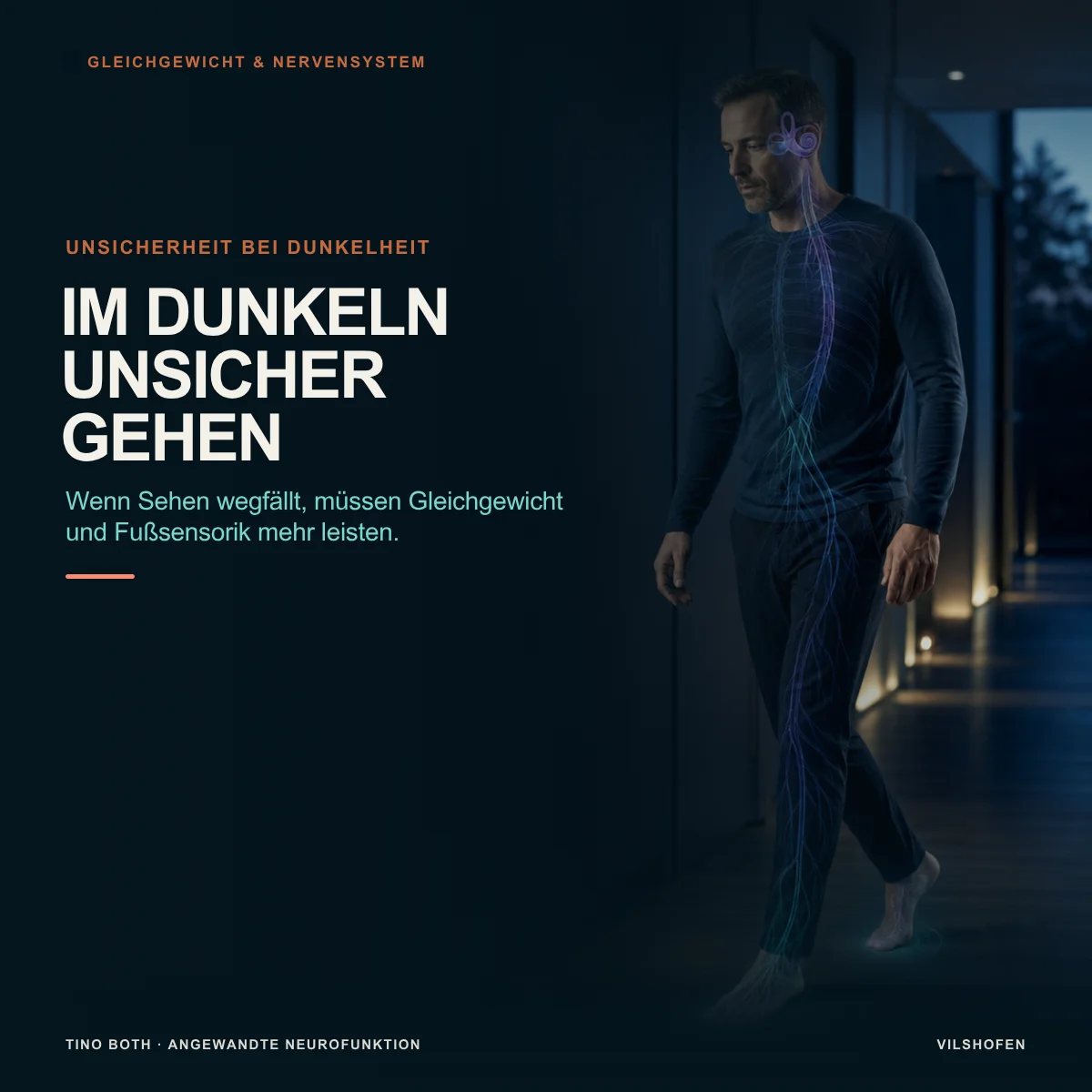
Briefly explained: If walking is less steady in darkness, visual orientation cues that support you in light are missing. Information from balance organs and body awareness then matters more. This can make existing uncertainty more noticeable, but does not yet identify which function contributes in your case.
Daylight is fine, but dark paths make you cautious?Describe when uncertainty occurs and what has been examined. We discuss whether an individual functional view of vision, balance and walking in Vilshofen is a sensible next step for your situation.
Discuss your walking uncertainty →
The initial telephone consultation is free.
Discuss your walking uncertainty →
The initial telephone consultation is free.
The route is familiar. Yet darkness changes your walking.
Walking to the car in the evening, you notice smaller steps. In a dim corridor, you seek support from the wall. The ground may be level, but you concentrate on looking down and feel less steady than by day. This is a specific observation we can work with.
First distinguish: is recognising obstacles mainly harder? Is spatial orientation difficult? Or does swaying occur although the route is familiar? These experiences may coexist, but do not automatically lead to the same explanation or exercise.
Why the eyes help with balance
Information from several sources combines for orientation and balance. Eyes provide clues about surroundings and movement. Balance organs detect head movement among other things. Muscles, joints and skin contribute information about body position and contact surfaces. The NIDCD explains this interaction.
In good light, edges, door frames and fixed reference points are easier to recognise. Darkness provides fewer usable cues. The task changes even though your legs are the same. People relying strongly on visible reference points may feel this difference particularly clearly.
Seeing well and orienting confidently are related but different tasksSharp text in a sight test does not alone answer how well you orient on a dark route. Lighting, contrast, head movement and other senses also belong to the situation. A precise description of the everyday problem is worthwhile.
Which connections may be assessed
“Worse in darkness” alone does not determine the cause. Visual problems, vestibular changes or body-awareness changes may matter. Medication, circulatory responses and the surroundings also belong in assessment. Initially, what matters is which change is new and how much it restricts you.
One familiar example is bilaterally reduced vestibular function: the Bárány Society consensus describes increased unsteadiness in darkness or on uneven ground as typical. Additional criteria and professional examinations are needed for assessment. Being unsteady in darkness does not automatically mean this condition is present.
How your precise description changes the approach
Only in low light, or also on uneven ground?A dark level corridor involves a different combination of demands from a lit woodland path. Grouping both under “poor balance” would obscure important differences.
During straight walking or mainly when looking around?Head movement adds another demand to walking. If gaze becomes unsettled or uncertainty appears only then, this observation helps choose a more precise functional comparison.
Similar for a long time or suddenly very different?The course matters for assessment. Gradual change, new glasses and sudden gait unsteadiness are different starting situations.
Why I also look under your foot when darkness makes you unsteady
When reduced light reveals the problem, visual involvement and an eye examination seem obvious. But balance also uses touch and pressure at the feet. When clear reference points are missing, other information available for orientation becomes even more relevant. I therefore consider the eyes and, where appropriate, ground contact closely.
A possible example: different information rather than more leg strengthBegin in good light with safe supported weight shifts or a short walking route. Then, sitting, assess how clearly you perceive and locate light touch at different sole areas: ball of the big toe, outer forefoot and heel. Compare right and left separately.
Suppose contact at the ball of the big toe is harder to locate than elsewhere. Initially, this is a specific observation. I can try a brief well-tolerated touch or vibration stimulus there and repeat the same standing or walking task. Lighting, shoes and support remain unchanged.
Suppose contact at the ball of the big toe is harder to locate than elsewhere. Initially, this is a specific observation. I can try a brief well-tolerated touch or vibration stimulus there and repeat the same standing or walking task. Lighting, shoes and support remain unchanged.
If the task becomes easier, that is notable: no extra muscle strength was built in this short time. A sensory input changed, information your nervous system receives from the foot. We check whether the approach is useful through repeated comparisons and subsequent progress. A pause or becoming familiar with the task may also make a difference.
Touch, joint position and head movement are different assessment routesTouch: how well do you notice and locate contact on the sole?
Body position: how accurately can you reproduce a specified foot position?
Orientation during movement: what changes when a small head movement is added to safe standing or walking?
A difficulty in one task does not automatically mean the others are difficult too. A notable foot contact would therefore be pursued differently from uncertainty arising only with head movement.
Body position: how accurately can you reproduce a specified foot position?
Orientation during movement: what changes when a small head movement is added to safe standing or walking?
A difficulty in one task does not automatically mean the others are difficult too. A notable foot contact would therefore be pursued differently from uncertainty arising only with head movement.
Here, Angewandte Neurofunktion means seeking an approach that may make your specific task easier, rather than the hardest balance obstacle course. Only once an approach is tolerable under safe conditions is it carefully transferred to everyday life. Change in good lighting is not permission to tackle a dark path. New numbness or clearly reduced foot sensation also warrants medical assessment.
Would you like to know which starting point suits your gait uncertainty? In a free initial telephone consultation discuss whether low light, an uneven path or looking around is harder, and how personal assessment in Vilshofen might build on that.
Useful everyday measures
Ensure adequate light and clear walking routes on regularly used paths. Use existing handrails and allow time for transitions. Suitable visual aids and clearly visible step edges may matter. Safety is a foundation for learning, rather than an obstacle.
Observe differences that arise anyway: is dusk already difficult, or only near-total darkness? Does an uneven path add difficulty? Is looking around less steady? You do not need to deliberately seek these situations. Avoid unsupported self-tests with eyes closed or on dark stairs.
When to seek medical assessment?
New, increasing or fall-related gait unsteadiness warrants medical assessment. This is especially true with other changes such as hearing problems, altered sensation or recurring light-headedness. Sudden severe uncertainty with speech disturbances, signs of paralysis, double vision or severe new headaches is an emergency: 112.
Common questions about unsteadiness in darkness
Is unsteadiness in the dark always an eye problem?No. Less light changes the whole orientation task. Balance, body awareness and other factors may contribute alongside vision.
Why does a visible door frame or wall help?A clear reference point may make spatial orientation easier. Its benefit initially shows the usefulness of that information in the situation, rather than which other function has changed.
Should I practise walking in darkness?Not as a blanket self-exercise. With uncertainty and fall risk, safe conditions come first. Progression is chosen to fit capacity with appropriate support.
Can functional training be relevant despite unremarkable examinations?Yes. A particular everyday task can still be assessed more closely. Existing findings and recommendations are included. We check whether a tolerable, practically useful approach can be found.
Would you like to make daily life more confident again?In a free initial telephone consultation, discuss your situation and a possible approach in Vilshofen. A specific description of the difficult route already helps.
Arrange an initial consultation about gait unsteadiness →
The initial telephone consultation is free.
Arrange an initial consultation about gait unsteadiness →
The initial telephone consultation is free.
Related pages and articles
Gaze, balance and spatial orientationVOR explained simply: why the vestibulo-ocular reflex stabilises gaze
Visual vertical explained simply: how the nervous system recognises “upright”
Oculomotor function explained simply: why eye movements involve more than seeing
Visual vertical explained simply: how the nervous system recognises “upright”
Oculomotor function explained simply: why eye movements involve more than seeing
Understanding everyday uncertaintySwaying dizziness explained simply: why the ground seems to move although nothing sways
Dizziness, nausea and visual disturbances: understanding connections
Visual overload: why a supermarket can trigger dizziness
Dizziness, nausea and visual disturbances: understanding connections
Visual overload: why a supermarket can trigger dizziness
Related areas in VilshofenGait unsteadiness and balance problems
Dizziness and balance
Visual difficulties and visual processing
My approach: Angewandte Neurofunktion
Dizziness and balance
Visual difficulties and visual processing
My approach: Angewandte Neurofunktion
Sources and further reading
NIDCD: Balance and balance disorders
Bárány Society (2017): Consensus on bilateral vestibular dysfunction
Bárány Society (2017): Consensus on bilateral vestibular dysfunction