

← All articles
Neuroathletic training & performance
Neuroathletic training for recreational athletes: When your training does not flow
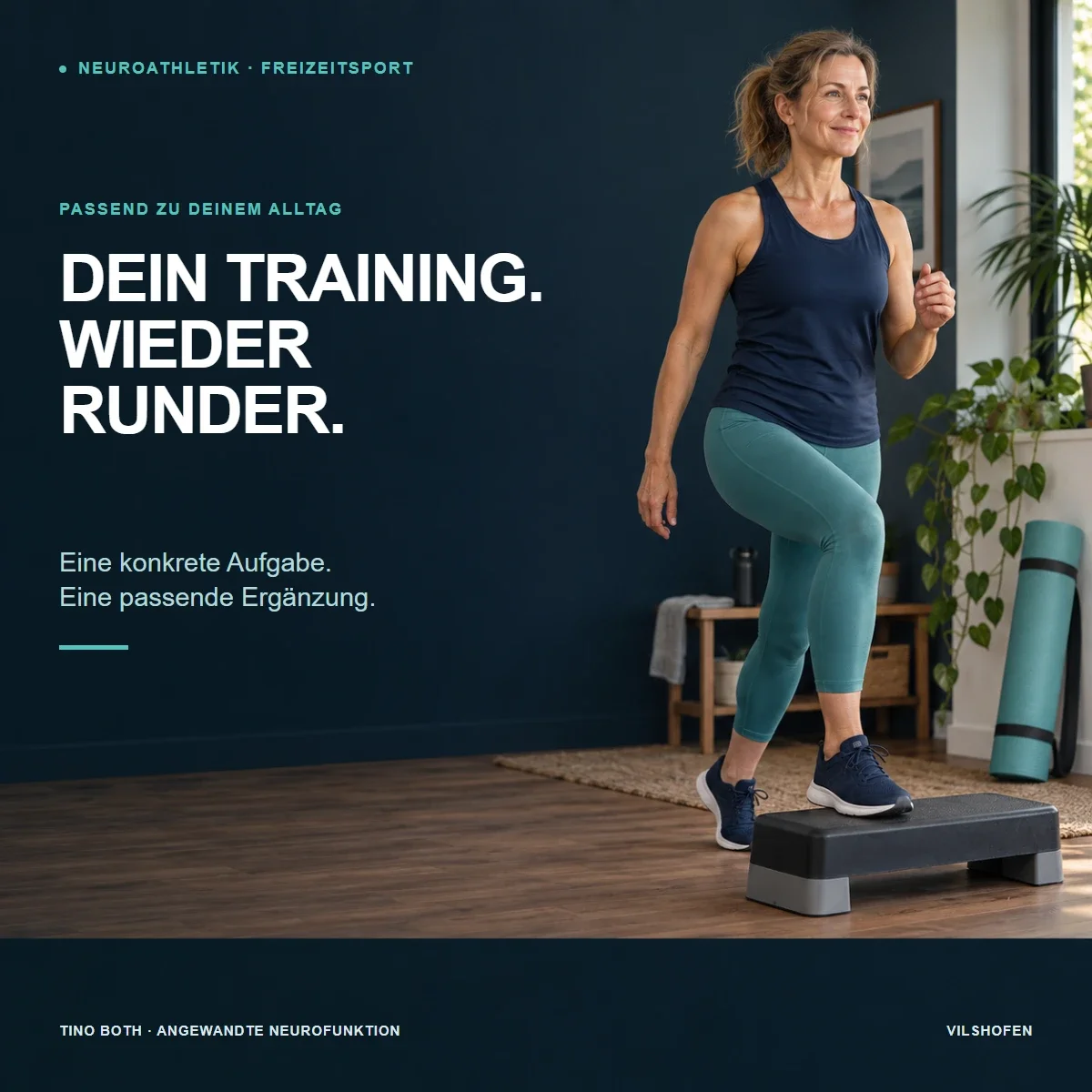
Briefly explained: Neuroathletic training can complement recreational exercise by considering perception and movement control specifically. A particular task that does not flow is the starting point. A suitable stimulus is tried and the same task assessed again. Strength, endurance, technique and recovery remain the foundations of your training.
Do you train regularly — yet one movement remains difficult?Tell me which task you are stuck with and what your training currently looks like. During the initial consultation, we clarify whether individual functional assessment in Vilshofen can be a useful addition for you.
Talk about your training →
The initial telephone consultation is free of charge.
Talk about your training →
The initial telephone consultation is free of charge.
You want to move, rather than manage a second training plan
Two sessions fit into the week. Perhaps you also run or cycle at weekends. You are already doing something. Yet stepping up onto a step feels more awkward on the left than the right, you lose track during rapid changes in a class or one movement remains surprisingly tense.
The tempting answer is often more exercises. But for people with work, family and limited training time, another question is more helpful: Which addition is useful for this exact difficulty — and what can we leave out?
When an additional perspective can be worthwhile
Neuroathletic training begins with the information you use for movement. You see where you are moving, feel contact with the ground and make sense of your body's position. This does not create an alternative to physical training. It creates an additional way to examine the conditions of a difficult movement more closely.
The task works slowly, but not with a gaze shiftYou feel secure when stepping up calmly. As soon as you also look forwards or orient yourself in the room, it becomes less steady. Comparing these conditions is then worthwhile.
You notice a difference but can barely describe it'The left feels strange' can be a beginning. Together, we turn this into a specific observation: Where does unsteadiness begin, at which speed and with what support?
You have tried many things but lack a clear measureA new exercise sensation is interesting. For selection, we also need a repeatable task through which we can recognise whether the addition is usable for you.
Not every training problem needs a special sensory explanation. Too little sleep, a sudden jump in demand, an overly difficult exercise variation or unsuitable recovery can be much more obvious explanations. These foundations therefore belong in the conversation.
A possible example: Stepping up lacks a smooth sequence
Imagine a low step is readily manageable in terms of strength. Yet with every step, you spend a long time finding your position and lean your upper body far forwards. We choose a safe height and something to hold. The aim is a clearly observable starting task, rather than challenging you through wobbling.
What we might compareInitially: Several calm repetitions with the same step height and similar speed. What feels unsteady, and where do additional corrections appear?
Then: We change one condition, such as the visual reference point or conscious awareness of foot contact. Selection follows observation.
Afterwards: The same original task again. If targeted preparation seems helpful, we assess it again before turning it into a recommendation.
Then: We change one condition, such as the visual reference point or conscious awareness of foot contact. Selection follows observation.
Afterwards: The same original task again. If targeted preparation seems helpful, we assess it again before turning it into a recommendation.
This can lead to a very small addition: Clearly dosed preparation before a familiar exercise, rather than a long extra programme. The result may equally be that a lower step, more support or different activity planning currently makes more sense. Both are useful next steps.
Why your body sensation counts — but does not decide alone
'That feels easier' is important feedback. I also want to know whether the task remained comparable: Was it slower, did you use more support or was the second attempt simply more familiar? A few calm repetitions often help interpret such differences.
With a suitable approach, we therefore observe more than the immediately good moment. Does the addition remain well tolerated? Can you use it again at the next session without much effort? Does the movement that originally bothered you specifically change? An interesting experience then becomes a decision for daily life.
A small selection is an advantageYou do not need to train every sensory system daily. A well-understood task with a manageable dose is easier to use reliably in everyday life than a long list with an unclear purpose.
How the addition fits into a normal training week
We begin with what you already do and want to keep doing. A possible addition receives a fixed place: For example, before a particular strength exercise or a part requiring greater coordination. Duration and difficulty follow your response; more is not automatically more helpful.
This does not replace endurance and strength stimuli. The WHO recommendations on physical activity emphasise regular endurance activity and muscle-strengthening movement. A short gaze or perception task serves different purposes from a walk, a longer bicycle ride or sufficiently challenging strength training.
Especially with little time, an honest question is worthwhile: Do I need a special preparatory exercise, or would an easier entry into the actual movement help more? I want to find an approach with you that you can really use, rather than fit in as many additional tasks as possible.
What you can record before an appointment
Choose one movement you specifically want to change. Note when it is easy and when difficult. Does the problem appear at the beginning or only after many repetitions? Does speed matter? Is it an uncertain sequence, pain, breathlessness or exhaustion? These distinctions help choose the right direction.
A short video from your usual training can help if you can record it safely. You do not need to provoke a particularly poor repetition. Your existing training plan and what matters personally to you also form part of the starting information.
New symptoms need appropriate assessment first
New pain during exertion, persistent dizziness or a clear change in performance should be assessed medically. With chest pain, fainting or sudden severe breathlessness during exertion, stop the activity and get immediate help. A retest is not the priority in these situations.
Frequently asked questions about neuroathletic training in recreational sport
Do I need to be very athletic already?No. The functional perspective begins with a task suitable for you. Your goal and current tolerance matter, rather than a particular performance standard.
Do I need extra equipment?Not as a rule. Many tasks can be assessed using simple targets, a safe standing surface or familiar movements. Equipment is useful when it answers a specific question better.
How long do I need to practise daily?There is no universal requirement. A short, well-tolerated addition often makes sense initially. Further dosage depends on your response and whether it proves useful in your target task.
Can I continue my existing training?If it is appropriate for your health and tolerable, it continues to provide the foundation. A functional addition should support your training and be coordinated with existing support.
Training that fits you again
You do not need to analyse every movement in minute detail. But if a specific task repeatedly stalls, structured assessment can bring clarity: What is already working well, which condition makes the difference and which addition is actually worthwhile?
Would you like to make your training more focused rather than more extensive?We discuss your concerns and consider whether an in-person appointment in Vilshofen suits you. Feel free to bring the one movement that particularly matters to you.
Discuss a suitable addition →
The initial telephone consultation is free of charge.
Discuss a suitable addition →
The initial telephone consultation is free of charge.
Related pages and articles
Complement training appropriatelyNeuroathletic exercises: How to find what suits you
Balance in sport: Why standing on one leg alone is not enough
Neuroathletic training vs traditional athletic training — where the difference really lies
Balance in sport: Why standing on one leg alone is not enough
Neuroathletic training vs traditional athletic training — where the difference really lies
Your sport in focusNeuroathletic training in strength sports: Using strength and movement with control
Neuroathletic training for runners: What gaze, rhythm and foot contact contribute
Neuroathletic training in ball sports: Seeing, deciding and responding appropriately
Neuroathletic training for runners: What gaze, rhythm and foot contact contribute
Neuroathletic training in ball sports: Seeing, deciding and responding appropriately
Relevant areas of focus in VilshofenNeuroathletic training and performance optimisation
Visual disturbances and visual processing
How I work: Angewandte Neurofunktion
Visual disturbances and visual processing
How I work: Angewandte Neurofunktion
Sources and further reading
WHO: Physical activity — an overview of regular endurance and strength activity.