

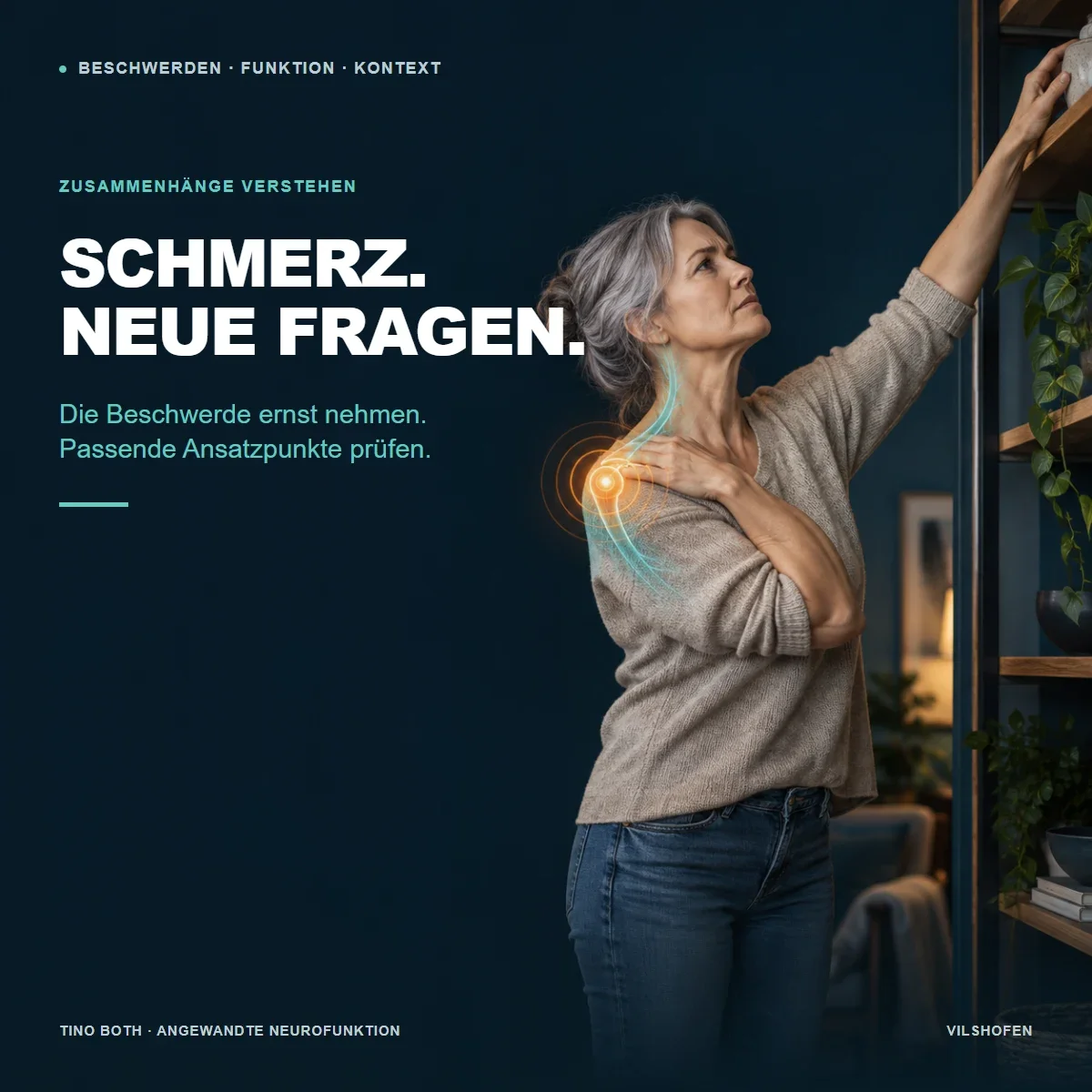
Briefly explained: People looking for alternative pain therapy are often looking for a sensible next step. It is worth bringing established care, personal goals and an additional functional perspective together.
Would you like to know which next step suits your pain?In the free initial telephone consultation, you describe your situation and what matters to you. Together, we clarify whether my Angewandte Neurofunktion in Vilshofen could be a sensible next step for you.
Arrange a free initial telephone consultation →
Arrange a free initial telephone consultation →
Understand the next step, rather than collecting another method
You have already tried several things. Heat feels good and movement is easier after a massage, but the restriction returns. The search for alternative pain therapy often grows out of this experience. It does not have to mean distrust of medicine. Often, what is simply missing is an understandable plan.
It is worth making a distinction first: do you need a fresh medical assessment, an adjustment to treatment or an additional functional question? These routes can complement each other. Prescribed medicines should not be stopped on your own initiative.
What ‘alternative’ cannot answer
The term says little about quality, benefit or who is responsible. It covers very different services. A responsible approach states the goal it is used for, what is actually observed and when another professional is needed.
For persistent pain, adapted movement, medical treatment, psychological support and strategies for everyday life can, for example, form part of coordinated care, depending on the situation. A method should not claim to make every other approach unnecessary.
Consider pain location, load and processing together
Where it hurts matters. The task and conditions under which it hurts matter just as much. Pain intensity is not a direct measure of the extent of tissue damage. Physical conditions and the processing of stimuli belong in the same picture.
That is why I ask about more than the painful muscle. Skin sensation, joint position, nerve mobility, vision, balance, breathing and relevant context can also be considered when the question calls for it. Not every one of these areas has to show a finding in your case.
One possible assessment route: not every touch is the same stimulus
Starting situationWith longer-lasting shoulder sensitivity, a light stroke may feel different from steady pressure. I first compare these stimulus qualities in a tolerable, targeted way, rather than assuming ‘more pressure helps more’. The starting question remains a movement from everyday life, such as putting on a jacket.
Make targeted distinctionsAn additional contact-based assessment can use an indicator muscle that has been tested without pain. First, the response to a specific question is assessed, followed by its combination with a potentially supportive input. If the response remains more stable during repeated comparison, integration follows, and then the original assessment is repeated.
Compare againYou then put the jacket on again. A changed muscle response and an easier everyday action are two separate observations. Together, they help select the next trial and follow its effect in everyday life.
Why the type of stimulus makes a difference
Stroking, steady pressure, vibration and a small pulling movement provide different sensory information. In my assessment system, they are not treated as arbitrarily interchangeable. The initial question is which quality, at which location, is well tolerated and changes a previously defined function.
Alongside this, where the question makes it appropriate, I use contact-based assessments with a suitable indicator muscle. A stimulus is compared with and without a potentially supportive contact. After integration, it is assessed again before we return to the actual everyday task.
What a change should mean for everyday life
A movement that becomes easier during the appointment is a good start. This leads to the next question: what level of load is appropriate afterwards, and how can it remain tolerable? We therefore consider both the immediate comparison and what happens afterwards.
You can observe when symptoms occur, which support helps and which activities matter to you. You do not have to keep examining your body for faults. One clear everyday marker is often enough to understand progress or overload better.
Frequently asked questions
Can work on pain take place without additional exercises?Depending on the question, the initial focus may be perception, stimulus comparison or contact work. What makes sense in the longer term emerges as things progress.
Is a quick change possible?An immediate response can occur. Whether it lasts and helps in everyday life is assessed further.
Who is an initial consultation suitable for?People who want to clarify their next step and find out whether an additional functional perspective fits their situation.
When a further assessment matters
New paralysis, acute chest pain with breathlessness or sudden severe neurological symptoms are emergency signs: 112. Pain after an accident, new bladder or bowel problems, fever or a marked unexplained deterioration require prompt medical assessment.
Sources and further reading
Related pages and articles
Continue readingPain & functional symptoms
Book an appointment directly
Complementing physiotherapy: when symptoms persist
Pain location and cause: why they can differ
Chronic pain: what is maintaining it today?
Functional symptoms: real and easier to understand
Understanding types of pain: tissue, nerves and processing
Pain despite an unremarkable MRI: what helps next
Book an appointment directly
Complementing physiotherapy: when symptoms persist
Pain location and cause: why they can differ
Chronic pain: what is maintaining it today?
Functional symptoms: real and easier to understand
Understanding types of pain: tissue, nerves and processing
Pain despite an unremarkable MRI: what helps next
What would be a helpful next step for you?You do not need a ready-made explanation. A specific everyday situation and your goal are enough to begin.
Request your free initial telephone consultation here →
Request your free initial telephone consultation here →
Sources and further links
- IASP – Revised Definition of Pain: https://www.iasp-pain.org/publications/iasp-news/iasp-announces-revised-definition-of-pain/
- Gatchel et al. – The biopsychosocial approach to chronic pain: https://pubmed.ncbi.nlm.nih.gov/17592957/
- CDC – Nonopioid Therapies for Pain Management: https://www.cdc.gov/overdose-prevention/hcp/clinical-care/nonopioid-therapies-for-pain-management.html