

← All articles
Children, concentration & learning
My child takes ages to copy from the board: what might be behind it?
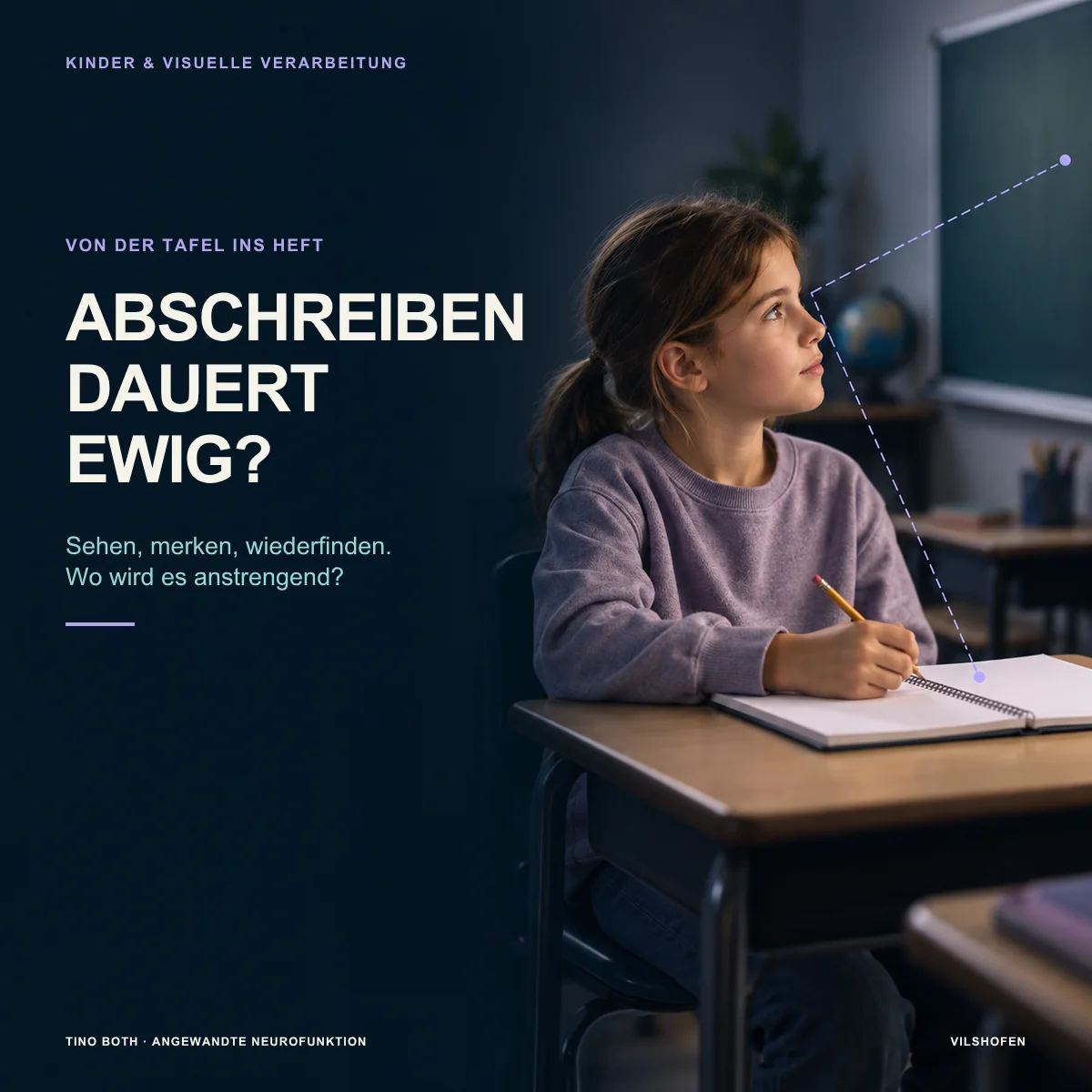
The class has nearly finished. Your child has copied only half of what is on the board. They keep looking up, searching for their place in the exercise book and asking what they were about to write. At home, they actually know the words. “Just concentrate” explains little in this situation.
Why can copying take so long?Copying combines several demands: recognising text, shifting gaze, seeing clearly at a different distance, retaining a section, finding the correct place again and writing. If one component takes considerable effort, the whole process can stall. This does not automatically mean insufficient effort or a particular visual or learning difficulty.
Everything that has to happen between board and exercise book
First, your child has to find the relevant text on the board. They then read a word or short section. When looking down, they have to locate the correct place in the exercise book, still retain what they saw and put it onto paper by hand. Then the next shift begins.
The eyes are not simply moving back and forth at random. Rapid gaze shifts move towards targets. Focusing and the coordination of both eyes adjust to the distance. Language processing, working memory and writing movements operate at the same time. Slowness can arise at different stages.
The Austrian Ophthalmological Society lists difficulties with copying and changes of viewing distance as possible signs to consider in a vision assessment. These observations are reasons to look more closely, not a diagnosis drawn from an exercise book.
Three comparisons can make the question more precise
Copying beside the exercise book or from the board?If the model lies directly beside the book, the change in distance is smaller. If this is noticeably easier, it is worth discussing the differences: distance, print size, seating position and gaze shifts. This does not yet establish which factor matters most.
Recognising or putting it onto paper?Can your child read the passage aloud easily but writes it very slowly? Or does recognising it already take time? This distinction helps avoid prematurely treating vision, reading and writing as the same thing.
A short section or a full board?Many lines, tight spacing and additional tasks can make finding one's place harder. A longer section to remember can also require more effort. The amount of text is therefore part of the task, rather than merely background.
What you can discuss with the teacher and your child
Specific questions without an examination-like tone help: “Does anything look blurred?” “Is it hard to find your place again?” “Does writing feel tiring?” Sometimes a child describes the difficulty more clearly when speed and mistakes are not the focus.
The teacher can add whether the problem occurs only with the board, also with nearby models, or in other subjects. An appropriate seat, a clearly laid-out model or temporarily less copying can ease the demands when agreed together. These adjustments create room for learning while the difficulties are assessed more closely.
Demanding extra long pages of copying at home often does not answer the unresolved question. A child who is already exhausted is more likely to show how overwhelmed they are under further time pressure than to demonstrate individual abilities.
How I consider the component tasks functionally
My work with children involves clear, short tasks without pressure to perform. First, we clarify what the child finds difficult in daily life and which examinations have already taken place. Depending on the situation, we consider gaze shifts, near-to-far changes, orientation on a model, body position or a simple hand task. The child should know what is being tried at each point.
Example: finding, retaining and copying a symbolInstead of immediately asking the child to copy a whole sentence, we begin with a few easily recognisable symbols. Initially, the model and paper are close together. A different distance is then introduced under comparable conditions. We look for difficulties with shifting gaze, finding the place again or copying. An adjustment is then checked on the same task. Mistakes, effort and the child's experience matter as much as time. This is a constructed example, not a standardised school test.
If one particular demand becomes easier, we check whether this also changes a small task resembling schoolwork. Successfully completing an exercise is not yet the same as finding copying in the classroom easier. Daily life remains the reference point.
An additional NeuroFI assessment provides another form of feedback: in the course model, for example, a near-to-far stimulus is introduced, followed by a check of a previously suitable indicator muscle. An unusual response is differentiated further; a suitable combination of stimuli is sought, integrated and tested again. The child's particular task then matters again. The muscle test replaces neither an eye examination nor an assessment of learning attainment.
Which support suits which question?
Blurred vision, double vision, noticeable squinting, recurring headaches or previously unexplained visual problems warrant an ophthalmological examination, with orthoptics where appropriate. A brief visual acuity test alone does not answer every question about how the eyes work together.
Where reading, spelling, language or handwriting skills are central, suitable elements may include school support, specialist learning support, occupational therapy or further professional assessment, depending on the findings. Neurocentric training can provide an additional view of functional demands and should connect with these approaches.
The goal remains specific: more comfortable viewing, managing a task better, or needing fewer pauses to search. Improved eye functions do not guarantee better school grades. In the CITT-ART study the vision training investigated in children with convergence insufficiency showed no advantage over the control treatment in standardised reading tests after 16 weeks. Vision and reading are connected, but are not the same ability.
Common questions from parents
Is my child simply not concentrating?Slow copying does not establish that. If seeing, remembering or writing takes effort, it can also look like inattention from outside. The task should be considered more closely.
The sight test was good. Can gaze shifts still be difficult?A good visual acuity result does not automatically describe every component of vision. An ophthalmologist or orthoptist can clarify which assessments have already been included and whether further assessment is useful.
Does more copying practice help?Appropriate practice can be useful. However, if one component remains unexplained and difficult, simply increasing the amount may only increase the effort. The difficulty should first be understood more precisely.
What should I bring to an appointment?A short description of the situations, existing findings and, where useful, anonymised work samples help. Your child does not need to prepare or prove anything.
Understanding where the task becomes difficult for your childIf you would like to examine the functional demands more closely, you can find information about my work with children in Vilshofen. In a free initial telephone consultation we discuss your observations and a suitable next step.
More topics about children on the blog
Concentration difficulties and the nervous system
When reading becomes tiring
Balance and concentration
Restlessness and regulation in children
Daydreaming and easily overwhelmed
School difficulties despite good abilities
When writing, reading and sitting take effort
What parents can expect from a functional assessment
Podcast: learning does not happen only in the head
Neuroathletic training, motor skills and coordination in children and young people
When reading becomes tiring
Balance and concentration
Restlessness and regulation in children
Daydreaming and easily overwhelmed
School difficulties despite good abilities
When writing, reading and sitting take effort
What parents can expect from a functional assessment
Podcast: learning does not happen only in the head
Neuroathletic training, motor skills and coordination in children and young people
Sources and further reading
Austrian Ophthalmological Society: Children's Eyes & Learning.
CITT-ART Investigator Group (2019): Effect of Vergence/Accommodative Therapy on Reading in Children with Convergence Insufficiency. Randomised study distinguishing visual function from reading performance.
CITT-ART Investigator Group (2019): Effect of Vergence/Accommodative Therapy on Reading in Children with Convergence Insufficiency. Randomised study distinguishing visual function from reading performance.