

← All articles
Neuroathletic training & performance
Neuroathletic training in elite sport: From a good test to a better game action
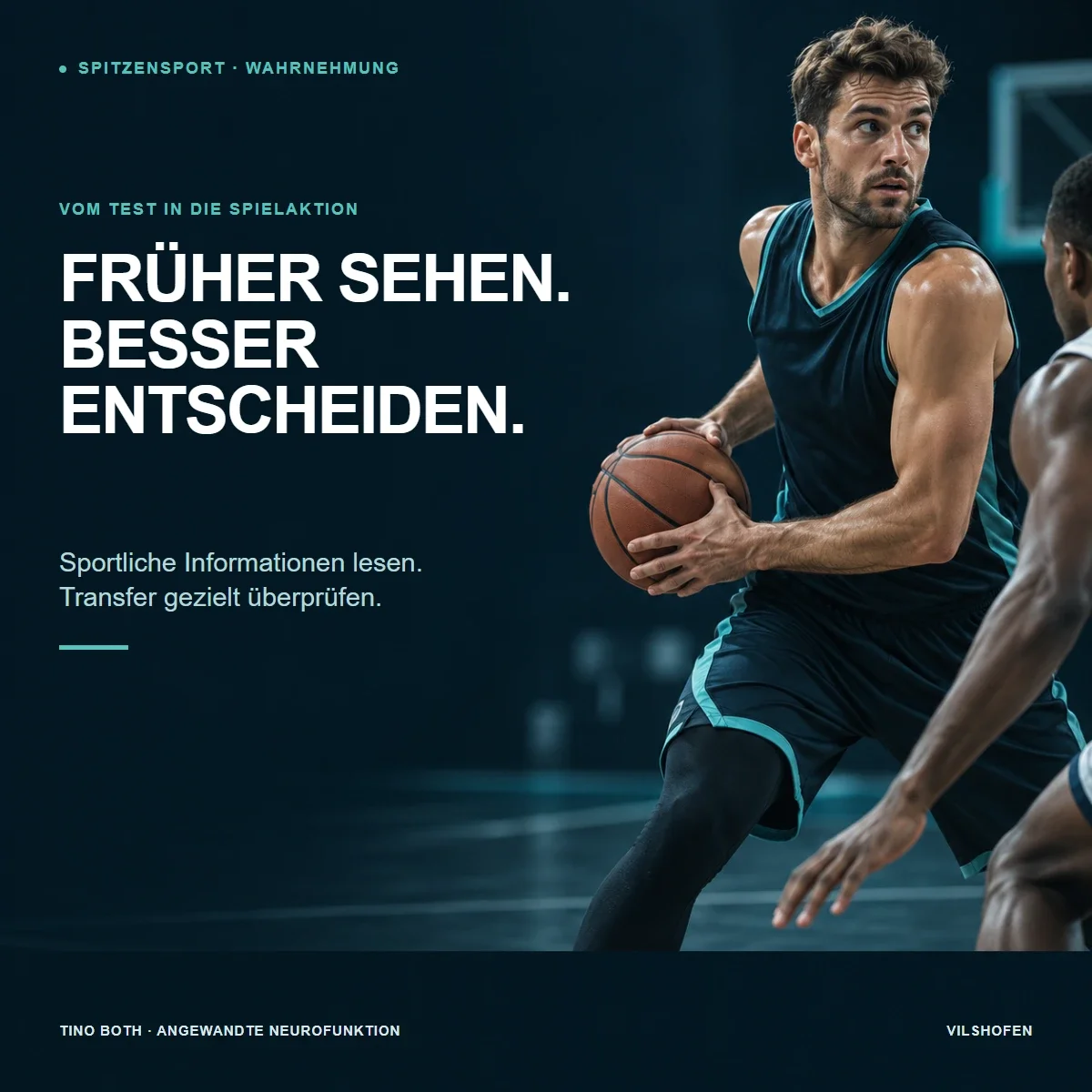
Briefly explained: Neuroathletic training in elite sport focuses on perception and movement control under sporting demands. Benefit for a specific game or competitive action matters more than a record in an isolated test. Exercise selection, demands and evaluation of success therefore need to suit the sport.
Fast in the test — yet still late in the decisive action?If you or your coaching team want to explore a specific question about perception or coordination, we can narrow down the approach during the initial consultation. The goal is a suitable addition to existing training, rather than a second system alongside your plan.
Discuss a sporting question →
The initial telephone consultation is free of charge.
Discuss a sporting question →
The initial telephone consultation is free of charge.
The light comes on. You press quickly. But do you read the game earlier as a result?
A reaction test provides a clear number. It can be compared and often improved with some practice. On the pitch or court, the situation differs: You need to recognise which information matters, interpret a feint, identify teammates' positions and execute suitable movement under time pressure.
This is precisely the crucial point for ambitious athletes. Not every trainable ability currently limits personal performance. And not every improvement in an exercise automatically reaches where it is needed.
Perception, decisions and action belong together
In basketball, an open passing lane may exist only briefly. In tennis, preparation for the opponent's stroke begins before the ball reaches you. Recognising relevant cues early gains time for movement. This is more than a fast response to an arbitrary signal: It is reading ahead in a sport-specific way, also called anticipation.
Useful cues change with the task. Looking at an opponent's shoulder may help in one situation and distract from more important information in another. Useful analysis therefore begins with the action — rather than a decision that every athlete needs the same eye exercise.
Three questions before an additional training measureWhich action? For example, recognising an unmarked teammate in good time rather than generally 'reacting faster'.
Which information? Positions, direction of movement and available time, rather than only a lamp's colour.
Which result? A suitable decision and an executable movement, rather than exclusively a shorter reaction time.
Which information? Positions, direction of movement and available time, rather than only a lamp's colour.
Which result? A suitable decision and an executable movement, rather than exclusively a shorter reaction time.
A possible example: Recognising the passing lane earlier
Suppose a player has good technical abilities but often decides late under pressure from opponents. A manageable game situation is chosen together with the coach. We consider when the player perceives the relevant options and whether the subsequent movement begins in time.
The task is simplified initially without losing the decisive connection: Fewer options, more predictable sequences or less pressure from opponents. If the observation supports it, a specific visual or orientation function can also be assessed. An isolated assessment is then an intermediate step, rather than already the performance goal.
From an indication to a checkable additionRecord the starting situation: Several comparable actions, observing decision and execution separately.
Select an approach: For example, structure visual scanning before receiving the ball or first simplify an unusual component demand.
Return to the game task: Use new but comparable situations to assess whether the decision also improves outside the practised sequence.
Select an approach: For example, structure visual scanning before receiving the ball or first simplify an unusual component demand.
Return to the game task: Use new but comparable situations to assess whether the decision also improves outside the practised sequence.
If only the same known sequence is repeated afterwards, the player may have memorised it. Further evaluation therefore also requires changed situations, later checks and feedback from normal training. This application to the target task is called transfer.
What research on perception training actually shows
A meta-analysis by Müller and colleagues from 2024 examined twelve studies on a specific procedure: Sport videos are stopped before the decisive moment so the subsequent action must be judged from early cues. The results support improvements in anticipation, including in transfer tasks close to the sport. Questions remain because of the limited number of studies. The findings concern this training form, rather than every service described as neuroathletic training.
Another systematic review by Guo and colleagues from 2025 highlights an important difficulty: With digital visual training, progress is sometimes greater when the test and exercise are very similar. Familiarity with the task can influence the result. In practice, what remains in another sport-relevant task is therefore interesting.
A better test result is a beginning, rather than a competitive resultI want to know which action becomes more reliable through the addition. A test can help with selection. Evaluation becomes more informative when the sporting target task and the course over time are also considered.
How individual functional assessment fits into a performance team
Performance already emerges from the interaction of conditioning, technique, tactics, recovery and support. An additional perspective should therefore address a clearly named question. This includes the coach's previous observations, the current training phase and any requirements from the medical team.
In my work, this can mean examining a visual or vestibular component demand more closely: Does target recognition change during head movement? Does a movement become less precise when extra orientation is needed? We compare suitable conditions and choose the next step according to the response. The athlete's planned workload remains in view.
If I use additional contact or stimulus assessment, I also consider its method-specific test response. It does not replace sporting performance measurement. The decisive follow-up question remains whether the chosen approach proves useful in the original movement and later in training.
Not every phase needs new stimuli
Shortly before an important competition, a familiar, well-tolerated routine may be more valuable than an extensive new programme. A development phase offers more room to try an addition systematically. A measure therefore needs to fit the timing as well as the person.
After head injuries, with new visual disturbances, marked dizziness or neurological signs, clearance for further activity belongs in medical care. A briefly improved test result is no basis for shortening return requirements.
Frequently asked questions about neuroathletic training in elite sport
Does neuroathletic training make every athlete faster?Such a general effect cannot be promised. The useful question is which specific demand appropriate training should improve and how this will be checked.
Are reaction lights useless?No. They can suit clearly defined tasks or motivation. What matters is which ability is measured and whether it fits the sporting question.
Can perception training replace sport technique?No. Perception, decision and movement need to work together in the sport. An isolated addition is therefore connected again with the technical and tactical task.
Can my coach be involved in planning?Yes. Coordination about the target task, observations and demands is particularly useful in competitive sport. We discuss with you which information is shared.
The best addition shows its value in action
A good approach does not have to look spectacular. It should address a relevant demand, be dosed understandably and receive a checkable place in normal training. Additional perception training then becomes a targeted complement rather than another collection of interesting exercises.
Would you like to assess a specific sporting demand more closely?During the initial consultation, we discuss the goal and existing support. Based on this, we can judge whether functional assessment in Vilshofen is useful for your situation.
Coordinate your sporting goal and the approach →
The initial telephone consultation is free of charge.
Coordinate your sporting goal and the approach →
The initial telephone consultation is free of charge.
Related pages and articles
Explore sporting demands furtherNeuroathletic training in ball sports: Seeing, deciding and responding appropriately
Balance in sport: Why standing on one leg alone is not enough
Neuroathletic training in strength sports: Using strength and movement with control
Balance in sport: Why standing on one leg alone is not enough
Neuroathletic training in strength sports: Using strength and movement with control
Exercise selection and visionNeuroathletic exercises: How to find what suits you
Understanding oculomotor function: How eye movements guide daily life
VOR explained simply — why the vestibulo-ocular reflex keeps gaze stable
Understanding oculomotor function: How eye movements guide daily life
VOR explained simply — why the vestibulo-ocular reflex keeps gaze stable
Relevant areas of focus in VilshofenNeuroathletic training and performance optimisation
Visual disturbances and visual processing
How I work: Angewandte Neurofunktion
Visual disturbances and visual processing
How I work: Angewandte Neurofunktion
Sources and further reading
Müller et al. (2024): Visual Anticipation Through Temporal Occlusion Training — a meta-analysis of training sporting anticipation.
Guo et al. (2025): Learning Effects in Digital Sports Visual Training — a systematic review of the importance of similar exercise and test tasks.
Guo et al. (2025): Learning Effects in Digital Sports Visual Training — a systematic review of the importance of similar exercise and test tasks.