

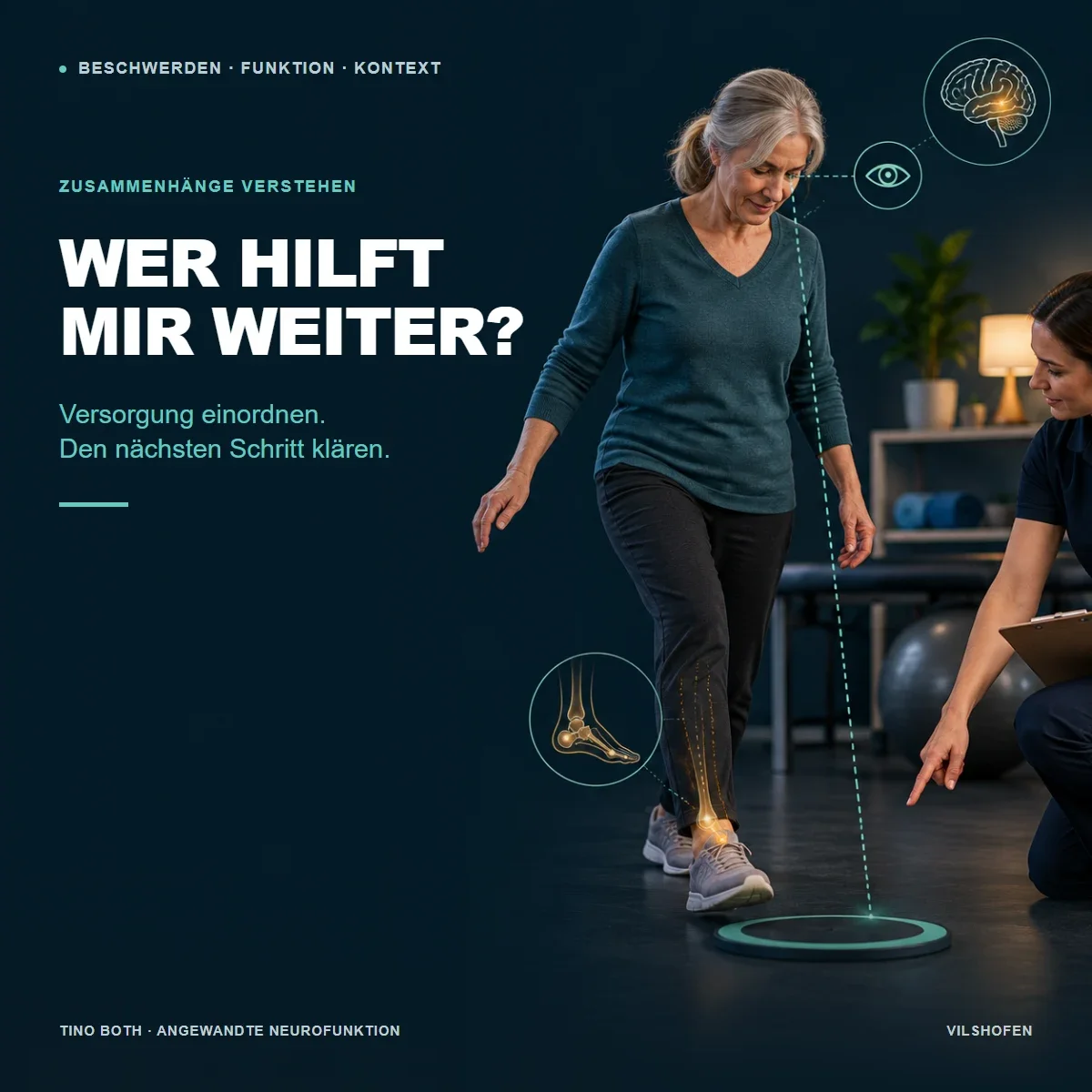
Briefly explained: The right contact for pain depends on what you need: medical assessment, therapy or an additional functional perspective. In Vilshofen, I offer Angewandte Neurofunktion with individual tests and re-tests.
Would you first like to clarify whether my approach suits you?In the free initial telephone consultation, you describe your situation and what matters to you. Together, we clarify whether my Angewandte Neurofunktion in Vilshofen could be a sensible next step for you.
Arrange a free initial telephone consultation →
Arrange a free initial telephone consultation →
Not every open question needs the same professional
You seek help because pain, unsteadiness or visual demands restrict everyday life. Services range from medical diagnostics through physiotherapy and occupational therapy to coaching and training. Before booking another appointment, it is worth asking: what should this appointment achieve?
An unexplained new symptom needs a different contact from additional training development after completed rehabilitation. For long-standing pain, coordinated pain medicine care can make sense. Additional functional work should fit this.
Distinguishing medical assessment, therapy and additional support
Doctors are responsible for assessing illnesses. Prescribed physiotherapy or occupational therapy addresses the relevant therapeutic question. Appropriately qualified psychotherapeutic services can matter for mental illnesses or trauma-related symptoms.
My work is called Angewandte Neurofunktion. I consider individual functions, sensory information, movement, regulation and, where appropriate, mental relationships. The focus is making specific questions tangible through understandable comparisons and re-tests.
How you can recognise a suitable service
Can it explain why a particular test fits your concern? Are the starting situation and change described understandably? Is your capacity considered? Is it clear which questions lie outside the service? These criteria are more helpful than especially big promises.
Scepticism is sensible if every symptom is traced back to the same cause or existing care is dismissed categorically. Good cooperation can use different perspectives without continually forcing a new either-or choice on you.
One possible assessment route: first the right question, then the appointment
Starting situationIn the initial consultation, you might describe: ‘I can walk, but looking left makes me unsteady.’ I ask how long this has been present, what has already been examined and which accompanying symptoms occur. If further assessment is needed, that is the next step.
Make targeted distinctionsFor later functional work, this exact combination can serve as a safely adapted starting task. We then separate walking, gaze shifts and head movement. A component function showing a finding is assessed specifically, a suitable input is added and the same starting task is considered again.
Compare againYou therefore do not need to know the correct technical term beforehand. A clear everyday situation is often the best starting point. Together, we clarify whether my work fits as an addition and what a realistic first goal would be.
What happens in my work in practice
An everyday issue first becomes a marker: a defined movement, short visual task or safe orientation task, for example. I observe which demand is difficult and how it responds to a targeted input.
Where the question fits, contact-based assessments are added. A suitable indicator muscle is identified; the specific assessment and a potentially supportive stimulus are compared. After integration, the original test and everyday task follow. You should be able to understand what was assessed and what actually changed.
Vilshofen as a personal starting point
I work in Vilshofen an der Donau. The location is also accessible for people from Passau, Deggendorf and the wider Lower Bavarian region. Whether travelling makes sense should depend on the fit of your concern, rather than just a long list of symptoms that sound treatable.
In the free initial telephone consultation, we therefore clarify beforehand what concerns you, what has already been examined and which additional benefit you hope for. Another medical or therapeutic step may be more important first.
What you do not need to prepare
You do not need to master technical terms or present a supposed cause. A specific situation, the course so far and known findings are enough to begin. Uncertainty about what you actually need can also be part of the conversation.
The outcome should be an understandable next step: a suitable appointment, an assessment that remains open first, or recognition that another service fits better.
Frequently asked questions
Is the initial consultation by telephone?Yes. It is a free telephone conversation for orientation.
Can I enquire while receiving therapy?Yes. We clarify whether an addition makes sense and is compatible with your existing plan.
Do you only work with movement?No. Perception, regulation and suitable mental relationships also belong in my functional perspective.
When a further assessment matters
New paralysis, acute chest pain with breathlessness or sudden severe neurological symptoms are emergency signs: 112. Pain after an accident, new bladder or bowel problems, fever or a marked unexplained deterioration require prompt medical assessment.
Sources and further reading
Related pages and articles
Continue readingPain & functional symptoms
Taking a functional look at dizziness
Taking a functional look at visual disturbances and visual processing
Taking a functional look at complex nervous system disturbances
Neuroathletic training and performance optimisation
Concentration and learning in children
Functional symptoms: real and easier to understand
Chronic pain: what is maintaining it today?
When the body protects even though nothing is damaged
Complementing physiotherapy: when symptoms persist
Taking a functional look at dizziness
Taking a functional look at visual disturbances and visual processing
Taking a functional look at complex nervous system disturbances
Neuroathletic training and performance optimisation
Concentration and learning in children
Functional symptoms: real and easier to understand
Chronic pain: what is maintaining it today?
When the body protects even though nothing is damaged
Complementing physiotherapy: when symptoms persist
What would be a helpful next step for you?You do not need a ready-made explanation. A specific everyday situation and your goal are enough to begin.
Request your free initial telephone consultation here →
Request your free initial telephone consultation here →