

← All articles
Complex symptoms & the autonomic nervous system
No treatment options left, or psychosomatic? Thinking further about unexplained symptoms
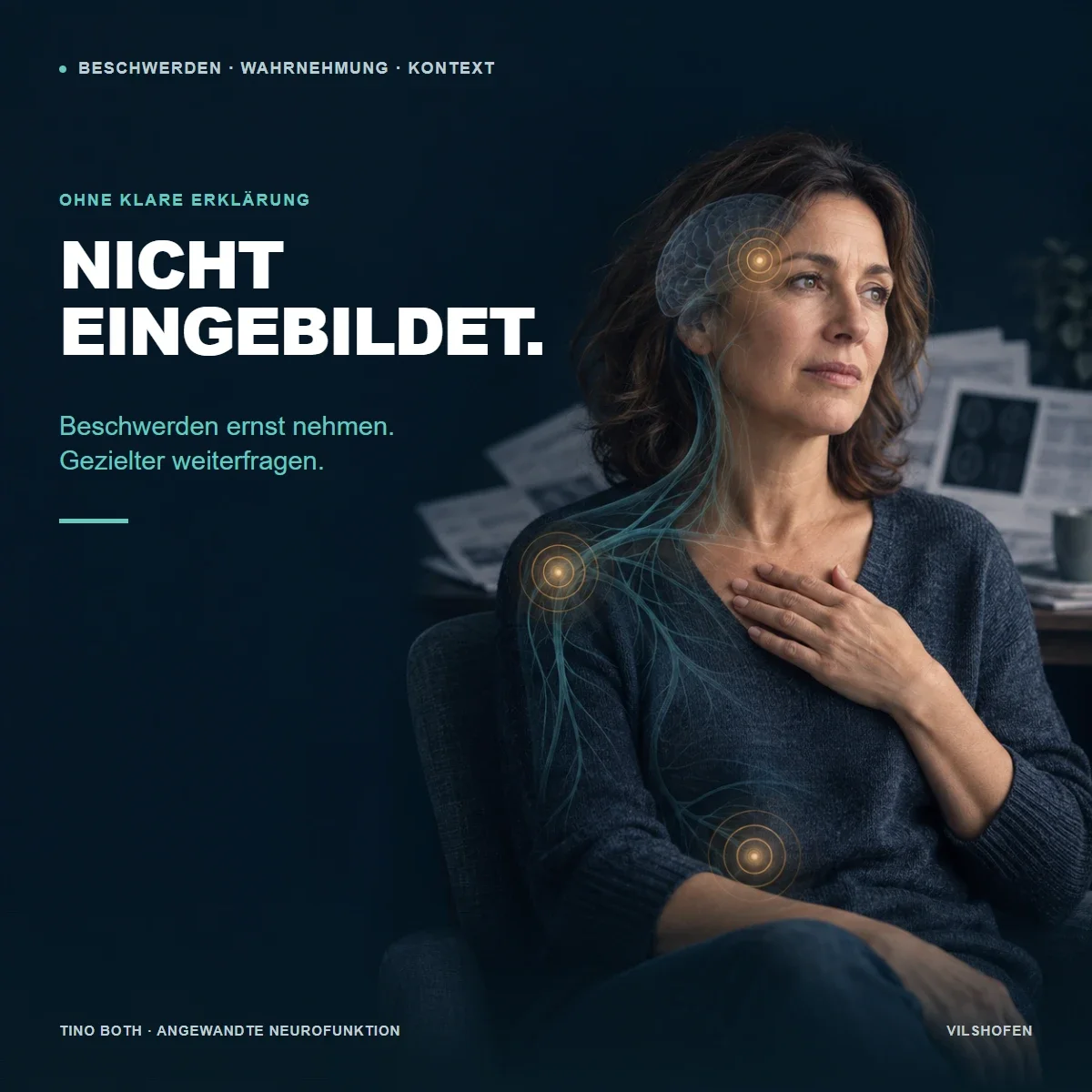
Briefly explained: 'No treatment options left' or 'no abnormal findings' does not mean your symptoms are imaginary. It initially describes a limit of the explanation or treatment so far. A useful next step begins with a specific question: During which task, under which conditions and through which influences does how you feel change?
Have you already tried a lot — and want to know what could come next?During the free initial telephone consultation, you can describe what restricts your daily life, what has been examined and what support you are seeking. We discuss whether my work with Applied Neurofunction fits. You do not need your own explanation of your symptoms for this.
Discuss your situation during an initial consultation →
Discuss your situation during an initial consultation →
When 'there is nothing wrong' does not fit your daily life
The findings are unremarkable. Yet shopping makes you dizzy, your neck stays tense or your energy disappears after a manageable task. You can be pleased about a reassuring examination and feel desperate at the same time because it leaves your most important question unanswered: Why do I still not feel better?
Perhaps you have already visited several specialties, tried exercises and started treatments. Each new attempt brings growing hope and also the effort of telling your story again from the beginning. Another general recommendation such as 'less stress' is of little help while its meaning for your particular daily life remains unclear.
What 'no treatment options left', 'psychosomatic' and 'functional' actually mean
'No treatment options left' is not a complete assessment of your possibilitiesFor longer-standing symptoms, this phrase is often used when previous measures have not helped sufficiently. Ask what exactly is meant: Have particular treatments been exhausted? Is a suitable explanation missing? Or is a further measure currently being discouraged? These are different situations.
Psychosomatic does not mean made upPhysical processes, experience, expectations and demands influence each other. A psychosomatic assessment does not dismiss symptoms. Nor does it make physical support unnecessary. Likewise, an unremarkable MRI does not automatically establish a psychological cause.
Functional describes a question about how a system worksHow does a movement go? How stable does gaze remain when walking? How is activity tolerated? Such functions can be considered even when one image does not offer a sufficient explanation. The appropriate medical classification follows targeted examination, rather than merely the absence of a finding.
The British health service NHS explicitly states that medically unexplained symptoms are real. Further assessment includes their course, medication, accompanying illnesses and physical and psychological demands, among other things. You do not have to choose between 'in the body' and 'in the head'.
Ask a different question instead of doing more of the same
A symptom label is often too broad to select the next measure. 'Dizziness' does not yet tell us whether standing up, head movement, a crowded supermarket or prolonged reading is difficult. 'Shoulder tension' does not show whether it exists at rest, begins only with reaching or increases particularly in a stressful situation.
In my work, this becomes a checkable task. We choose something meaningful to you that can be observed tolerably: A gaze shift, a particular movement, a short walk or an everyday situation. We record what is difficult before changing anything. This gives us a reference point that does not change with every new exercise.
From a general problem to a specific assessment ideaToo general: 'My nervous system does not work.'
More specific: 'I can read the text sitting down. When I then turn my head and stand up, it takes me a long time to feel oriented again.'
Reading, gaze shifts, head movement and standing up can now be considered separately first. Everything does not need to be demanded at once.
More specific: 'I can read the text sitting down. When I then turn my head and stand up, it takes me a long time to feel oriented again.'
Reading, gaze shifts, head movement and standing up can now be considered separately first. Everything does not need to be demanded at once.
A possible example: Not every gaze stimulus is equally demanding
Imagine someone whose symptoms have been assessed medically reports neck tension and discomfort during screen work. We begin with a specific task, rather than a complete eye programme: Looking at a short, clearly readable text and then turning the head within a comfortable range.
First, the head stays still while gaze shifts between two targets. Then the eyes stay on one target while a small head movement is added. Distance, lighting and duration remain as similar as possible. If only the second condition becomes demanding, 'train the eyes' is still too imprecise: The connection between gaze stabilisation and head movement is now particularly interesting.
A next step might be a smaller movement at a slower speed with a clearer target. We then repeat the starting task under the original conditions. If only the simplified exercise becomes easier, transfer is still missing. If the relevant task also becomes more comfortable, we have an approach whose tolerability and usefulness can be observed further.
How I differentiate more precisely within my method
Applied Neurofunction includes direct functional comparisons and, when appropriate to the question, additional contact assessments with an indicator muscle. This muscle serves as a repeatedly checkable reference. It must be testable reliably and without pain; a painful region does not become the test muscle merely for that reason.
The question, the search for a solution and assessment again1. Starting point: We define your difficult function and a suitable indicator muscle.
2. Ask specifically: A selected stimulus or combination of contacts brings a particular functional relationship into the assessment — rather than several systems indiscriminately at once.
3. Compare the response: If the muscle becomes unusually weak under this condition, we seek input under which the response becomes stable again. The alternation between the stimulus alone and the stimulus plus a possible solution is repeated.
4. Integrate: The suitable combination is applied specifically. We then check whether the original stimulus is also tolerated without the additional solution stimulus.
5. Return to your concern: What has changed in reading, turning, walking or how you feel? A different test response alone is not yet the goal.
2. Ask specifically: A selected stimulus or combination of contacts brings a particular functional relationship into the assessment — rather than several systems indiscriminately at once.
3. Compare the response: If the muscle becomes unusually weak under this condition, we seek input under which the response becomes stable again. The alternation between the stimulus alone and the stimulus plus a possible solution is repeated.
4. Integrate: The suitable combination is applied specifically. We then check whether the original stimulus is also tolerated without the additional solution stimulus.
5. Return to your concern: What has changed in reading, turning, walking or how you feel? A different test response alone is not yet the goal.
For me, practical value lies in differentiation. An understandable selection, rather than simply 'more rest', 'more strength' or 'more eye exercises'. Short-term changes help with this selection; whether they actually benefit you also becomes apparent in daily life and over time.
Mental influences are part of my work too
My work goes beyond movement. Attention, mental images, distressing experiences and the expectation of a difficult situation can also matter. We consider them as possible conditions under which your body responds differently, rather than arguments against physical symptoms.
A possible example: A movement goes well in a neutral situation but becomes clearly more tense as soon as you think of a particular upcoming task. Addressing only the range of movement would then be incomplete. If suitable and well tolerated for you, this specific context can be included in functional assessment. The goal is greater freedom to act, rather than forcing distressing memories. Appropriate professional support is part of care for severe trauma-related problems or mental health conditions.
Why a standard programme sometimes does not help you progress
An exercise can be well chosen yet take place at the wrong dose. It can train an ability that is not decisive for you. Or it can make several demands simultaneously when even one is already difficult. Lack of sleep, an illness, medication and persistently excessive everyday demands also do not disappear because a functional test briefly looks better.
I am therefore interested in more than your immediate response. The demand also needs to fit later that day and the following day. If minor effort repeatedly triggers marked, delayed and prolonged deterioration, that is an important reason for medical assessment and adjusting activity — rather than general further progression.
What you can observe before an appointment
A few details are more helpful than constant checkingAn important everyday situation: What would you like to be able to do more easily again?
A pattern: When is it easier and when harder — for example, sitting or standing, in quiet surroundings or with many stimuli?
The timing: Does the response begin immediately or only later?
Previous experiences: Which examination or support helped? Which exercise was too much?
Note observations that you notice anyway. You do not need to deliberately provoke symptoms or monitor your whole day.
A pattern: When is it easier and when harder — for example, sitting or standing, in quiet surroundings or with many stimuli?
The timing: Does the response begin immediately or only later?
Previous experiences: Which examination or support helped? Which exercise was too much?
Note observations that you notice anyway. You do not need to deliberately provoke symptoms or monitor your whole day.
When renewed medical assessment is important
New or clearly changed symptoms deserve a new assessment, even if previous examinations were unremarkable. Sudden paralysis, speech disturbance, severe breathlessness, acute chest pain or impaired consciousness requires immediate emergency help. Unexplained weight loss, persistent fever, bleeding or progressive deterioration also need medical assessment.
What a realistic next step can be
Perhaps the next progress is not immediately explaining every symptom. It may be understanding one important situation more precisely, finding a tolerable option and being able to act a little more predictably again. This is more specific than hoping for one exercise for everything.
In Vilshofen an der Donau, I support people with Applied Neurofunction. If you come from Passau, Deggendorf or elsewhere in Lower Bavaria, you can also first clarify by telephone whether my approach suits your concern. Existing findings and ongoing support remain part of the overall picture.
Frequently asked questions
Am I healthy if there are no abnormal findings?Unremarkable findings can make important illnesses less likely. But they do not automatically explain every symptom or mean that you must feel symptom-free. The question addressed by the examination and your subsequent course matter.
Do I have to accept a psychosomatic explanation to get support?You do not have to adopt a particular explanation during the initial consultation. We can begin with your specific limitation and consider physical and mental influences openly.
How does this differ from more general exercises?We choose a specific starting task, deliberately change one condition and compare again. This makes it understandable why a particular input is pursued — or why we discard it again.
Can something change during the appointment?It is possible. It is neither predictable for everyone nor equivalent to a lasting result. What matters is whether the change is repeatable, tolerable and useful in daily life.
You do not have to decipher your symptoms yourself firstDuring the initial consultation, describe the one situation that currently limits you most. From there, we can discuss which next step might be useful.
Arrange a free initial consultation →
Arrange a free initial consultation →
Related pages and articles
Understanding symptoms and regulationAutonomic nervous system / autonomic dysregulation
Pain & functional symptoms
The nervous system out of balance — when many symptoms are connected
Understanding functional symptoms — when symptoms are real but not clearly explained
Chronic pain: Finding a cause when nothing is clearly damaged
When the body protects even though nothing is damaged
Pain despite unremarkable imaging — when further functional consideration is useful
Nociceptive and non-nociceptive pain — why pain is only the system's output
Understanding the autonomic nervous system — sympathetic, parasympathetic and functional symptoms
Dizziness, nausea and visual disturbances — why the nervous system often connects several systems
Lena's work from my perspective — why trauma, the body and the nervous system belong together
Pain & functional symptoms
The nervous system out of balance — when many symptoms are connected
Understanding functional symptoms — when symptoms are real but not clearly explained
Chronic pain: Finding a cause when nothing is clearly damaged
When the body protects even though nothing is damaged
Pain despite unremarkable imaging — when further functional consideration is useful
Nociceptive and non-nociceptive pain — why pain is only the system's output
Understanding the autonomic nervous system — sympathetic, parasympathetic and functional symptoms
Dizziness, nausea and visual disturbances — why the nervous system often connects several systems
Lena's work from my perspective — why trauma, the body and the nervous system belong together
Vision, balance and personal supportDizziness & balance
Visual disturbances and visual processing
How I work: Angewandte Neurofunktion
Why an eye problem often does not feel like an eye problem
When visual stimuli overwhelm — why supermarkets, crowds and patterns can be demanding
Visual disturbances and visual processing
How I work: Angewandte Neurofunktion
Why an eye problem often does not feel like an eye problem
When visual stimuli overwhelm — why supermarkets, crowds and patterns can be demanding
Sources and further reading